
Human Forever | The man who moved into a dementia ward, with Teun Toebes | Club Sandwich
Dementia is the leading cause of death in Australia, and a lot of what we believe about it is making things worse. This week, meet the man who moved in. Ageing parents? You've got them. We've got you.
JOIN THE CLUB: Visit https://clubsandwich.community to join the tribe, access resources, and find our private Facebook community.
SEND US YOUR QUESTION: hello@clubsandwich.community
In this episode:
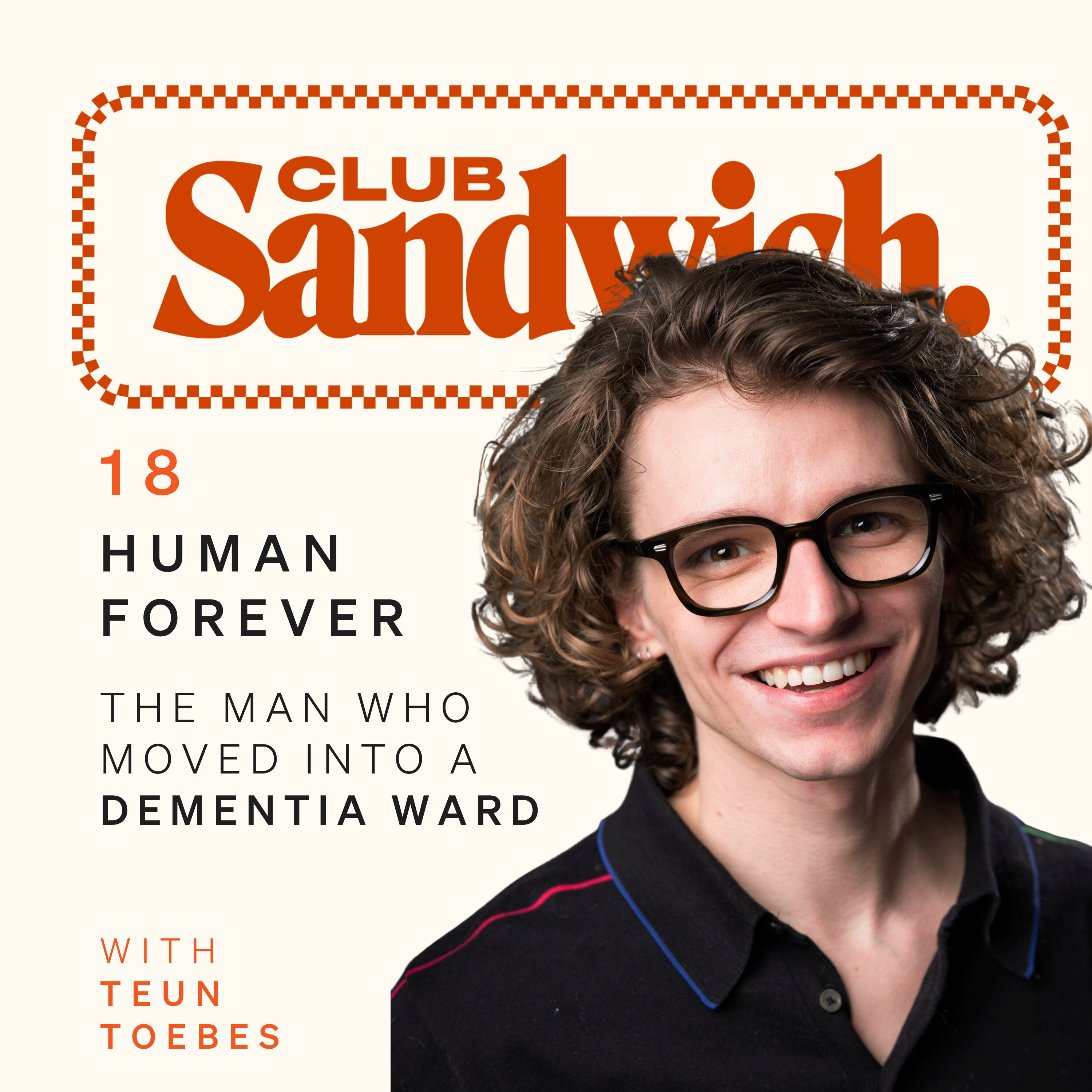
Our youngest guest yet. At 21, Dutch nurse Teun Toebes moved into the locked dementia ward of a nursing home and stayed three and a half years. Sarah Macdonald sits down with him on his first day in Australia to talk about what living alongside 130 housemates with dementia taught him: that the hardest part of the diagnosis is often not the disease, it's the way the world treats you once you have it. We don't lack beds or money, he says. We lack humanity.
This Week's Hack: Take them out, and keep showing up. Your parent may not remember the visit, but they remember the feeling. So do the drive, the cup of tea, the trip to the shops, even when it feels pointless. And when you don't know what to say or do, be okay with not knowing. Caring for someone with dementia is a shared job, not a solo one.
Send this to: Send this to your sibling, or to anyone who has stopped visiting because "they won't remember anyway." This is the episode that gently puts that one to bed.
A moment that stays: Teun takes his housemate Ellie to her son Marcel's house. She walks in, bursts into tears, and says, "Now I finally know where my son lives." She couldn't have told you the address. But she felt it.
Meet the regular Clubbers:
Melissa Reader — CEO of Vera and expert on Australia's ageing crisis.
Jo Lamble — Clinical psychologist specialising in guilt and family dynamics.
Dr Ginni Mansberg — GP and women's health advocate who tells it straight.
Dr Stephanie Ward — Geriatrician helping you understand when "old" becomes a crisis.
Kerry Milligan — Gogglebox star bringing humour and honesty to the sandwich generation.
Topics covered in this episode:
- Why a 21-year-old nurse moved into a locked dementia ward, and what three and a half years taught him
- The "code of freedom": being the only resident who can open the door
- Why the stigma hurts more than the disease
- Identities change with dementia, but they are not lost
- The language problem: "brain gymnastics," "the restaurant of mistaken orders"
- How to be with a parent who has dementia, even when you don't know how
- Guilt, and why caring for someone with dementia is a shared responsibility
- "They remember the feeling, not the visit"
- Opening the locked doors: how 500+ Dutch care homes did it
- Over-medicalisation: thickener, walkers, hip airbags and protein drinks by default
- Quality of care vs quality of life
- "Use it or lose it": real knives, real plants, real dogs, real campfires
- Why one nursing home spent 10,000 euros a year on plastic plants
- The hospital-bed problem and the cost of standardising care
- Dementia as Australia's leading cause of death, and why that framing can backfire
Mentioned in this episode:
- Human Forever — Teun Toebes and Jonathan de Jong's award-winning documentary, touring Australia. Tour dates: 11 JUNE – MELBOURNE, 12 JUNE – BANGALOW, 13 JUNE – BRISBANE. To find out more, visit https://human-forever.com/join-the-movement/
- The Housemates — Teun's bestselling book about life on the ward.
- Teun's new book with Jonathan de Jong — out September 2026.
Credits:
Club Sandwich is brought to you by Vera, helping families caring for ageing parents navigate this stage of life so you don't have to do it alone.
This episode was supported by Australian Unity Home Health and Care. Visit https://australianunity.com.au/clubsandwich.
This episode was supported by NSW Trustee and Guardian — wills, power of attorney and enduring guardianship, sorted properly, so the people you love aren't left guessing. Search NSW Trustee and Guardian, or call 1300 10 20 30.
Vera is your candid companion as you care for an ageing parent. Have a look at https://vera.guide.
Sarah Macdonald — Host + Executive Producer
Melissa Reader — Commissioning Editor, Executive Producer + Clubber
Justin McArthur – Executive Producer.
Audio + video edits by P. Zinner Podcasts (https://pzinner.com.au)
Thanks and kudos to Sean Wayland for our theme music Club Sandwich — hear more at https://seanwayland.com
See omnystudio.com/listener for privacy information.
Transcript
Club Sandwich is recorded on Gadigal Land, home of the EORA Nation. We pay our respects to elders past and present. Always was, always will be.
Club Sandwich is brought to you by Australian Unity Home Health and Care, helping Australian families keep their parents well, independent and at home for longer. Visit australianunity.com auclubsandwich. Club Sandwich is brought to you by New South Wales Trustee and Guardian. Helping families across New South Wales make a will, plan ahead and protect the people they love. Search New South Wales Trustee and Guardian or call 1300-10-2030. Hello, welcome to Club Sandwich. Now this is the podcast for you if you're often searching about aged care while caring about your own ageing. My name is Sarah McDonald. My mum is 92, nearly 93. My mother in law is 94 and I am part of the sandwich generation. Today you're gonna meet someone who is our youngest guest so far on the podcast. When he was 21 years old, he moved into an aged care facility himself. You're about to find out why and what happened and why he lived with older people who have dementia. His name is Tern Tobis and he's made a film called Human Forever that is traveling around Australia. We'll put all the information in our show notes and he joins us now as a very special international guest from the Netherlands for Club Sandwich. Hello, welcome to Australia.
Hello. I'm so pleased to be here. Arrived today so a bit jet lagged. 26 hours of traveling, but it's amazing to spread the message in Australia as well.
Yeah, well, look, when I was 21 years old, I was sleeping on milk crates, you know, in share houses or traveling the world, I just couldn't get away fast enough. And yet you moved into an aged care home with dementia patients.
Yeah, and at that moment I didn't realize that it was so special to live together with people with dementia. And now I do realize it actually tells me a lot that we have lost the way we are living together, especially with people who live with dementia. Because I was studying to become a nurse and I had my first internship in a nursing home. And initially I didn't want to go to the nursing home to do my studies there because a nursing home is not a place people are dreaming of. So I always wanted to work in acute medicine, but I had the internship, it was mandatory. I had to go there. And when I walked in for the first time in my life into a nursing home to the close ward, I remember that it almost felt like I walked into a surreal nobody's land. I Arrived at a place of which I didn't know of, a place where only people with dementia were living. And then you had a coat of a door and we saw it and as something good to do. A few years later, I worked in a nursing home and I asked my colleagues, would you like to live here yourself? And almost all my colleagues said, hell no. If I get a form of dementia, I want to live in a different way. I want to live, for instance, speaking about the sandwich generation, I want to live together with my children or I want to buy a house together with friends. I, I want to start living there or I don't want to live. But no one was dreaming about a future in a nursing home. So when I was 21, I decided to start living on the close ward to experience myself, to get first hand experiences. How is it to live in a nursing home? And what can we learn from people living with dementia themselves? Not by reading about them, but by listening to them. And that has completely changed my view and my perspective on dementia.
And how long did you live there?
Well, I thought maybe two, three months at the beginning. But if you live together, you also start loving each other. So in the end it was three and a half years. I lived two years in one home and then I wanted to experience, are those experiences I have based on this specific home or are they based on the cultural and societal pattern we have in society? So I moved to a second home to evaluate my experiences and to experience what does it tell about the societal perspective on dementia? And of course, it is a societal perspective, because our nursing home system, it's not created only by the intention of, for instance, carers or family members. It's based on the expectation of society. And that's often, for instance, keep my mom safe. So we have a system mostly based on safety and control instead of humanity and quality of life.
Yes, and I want to talk about that safety, but let's just go into the, into the aged care facility. What did your friends think about you living there?
First of all, my mom said, my mom said, I didn't expect you to live in a nursing home before I.
That's right.
I wouldn't know whether my mom will live in a nursing home once in her life or I will take care of her in a different way. But my friends, of course, many of them thought at the beginning, it's quite strange. And I can understand now, it is quite strange if people hear it for the first time, people think, oh, it's such a strange story. Or people think, oh, this is a story about a cute boy living in a nursing home. It's not about me. It's about what do the experiences tell about the urgency to change the way we are living with people with dementia.
But it's also taking us inside something that is invisible to people unless they have a loved one who goes in or unless they themselves go in. Because, as you said, there's the double doors, and it's sort of so separate. People are very separate. And so that means it's unfamiliar and it's very confronting when you first go in a place like this. Did you find it confronting when you were a young.
I did find it very confronting. And honestly, most of my friends did find it confronting as well. So most of my friends visited me in the nursing home, like, once, and then they didn't want to come anymore because it was confronting to see people in the latest stage of their life, and people were not used to it. People felt anxious about making contact with my housemates. For instance, some of my friends, they kept on coming because they were, for instance, working in a nursing home themselves as well. But what I experienced is from the moment I started living in a nursing home, it felt like the reciprocity towards society was changing. And that's what many people with dementia face as well. People are visiting you, you can't visit them. And for me, it was different because I had the privilege to have the code of the door 2017. It was the code of freedom. So I was still able to strengthen the relationship with my friends by going to them or, for instance, going to a cafe or going to the supermarket, which my housemates couldn't do anymore.
Yes, that freedom, that was the code of freedom. And that's very confronting. But it is confronting when you're in there because people are bewildered. They can be very confused. There's people sometimes lying on the floor because the floor's warm. But it's because we separate aging and we don't often have a mix between the generations that it's not something we see. But it's almost that fear, isn't it? It's like it might be catching. I mean, you will catch it eventually, if you're lucky enough to live a long time.
Yeah, well, I decided to start living there, and then I just wrote an email to the care organization. So I wrote an email. My name is Stern Tubes. I have an idea. May I live in your home? And since we don't have a lack of rooms and we don't have a lack of money, we have a lack of humanity. So for me, it was possible to start living there. I didn't start living there because of an intergenerational project, which is a quite fancy word we use for everything nowadays. What do I see happening in reality? Speaking about those intergenerational projects, for instance, we give young students a discount to live in a nursing home, and in exchange for this, they have to do, for instance, 20 hours of volunteer work in the nursing home.
Yes, I've seen that you do that in Holland. We don't do that here.
Yeah, we have some initiatives, but the problem of this is that we are quantifying living together. Living together. It's not always possible to quantify it. And you, you shouldn't want it, because what I have experienced is that living in a nursing home is not like entertaining your housemates. It's not like constantly making my housemates happy, going to an amusement park or acting like a clown or whatever. Living together, well, is also about being in the same room without speaking to each other, without constantly looking at each other, but about having the feeling that you are connected. It's about the feeling of security instead of security in form of the code of the door. So it's about revaluing living together on the one hand and. And on the other hand, about connecting with people we often see as others.
People with dementia, with them, being present with them. Exactly, yeah. So what surprised you that you probably wouldn't have expected about people with dementia? Because there's a lot of language used around dementia, like, oh, they're slowly disappearing, or they're not the person they were, or I, I miss them. What did you learn that might surprise people about what's really going on for people with dementia?
Let's say, first of all, dementia can be really painful. Dementia can change the roles you have in your family, the relationality. My own grandma had dementia as well. I also saw it in the lives of my housemates and their loved ones. But what I also heard from the people I was living with and the people I've met all around the world is that what is the most painful is the way society sees you. The fact that you are seen as the other. The fact that people start talking to your legal representative instead of asking you a question. The fact that people feel anxious about getting in touch with you, because people don't know a lot about dementia. There is a very strong awareness about a disease, about what's wrong about you, but not about how to make contact in a better way. So therefore, I strongly believe that dementia is not a care problem. Dementia is a societal issue. So we need everyone in order to change the perspective on dementia. Speaking about the stigmatized view on dementia, I would love to give you a few examples.
Yes. Yeah.
Because very often dementia is perceived as a total loss of identity. But this is such a dark image which doesn't help people with dementia at all. People still keep their identity and yes, identities are changing, but they are not lost. I think the whole care sector and also the sector of organizations around people with dementia, they should be more careful about the views we are spreading about dementia. That's also why we wanted to bring a more nuanced and honest story about dementia to the world stage. Because, for instance, the Dutch Alzheimer's organization had a campaign running two years ago and the quote of the campaign was, through dementia you lose yourself and each other. So this is a narrative of fear. By making people anxious about dementia, people want to, for instance, donate money and with this money you can run anti stigma campaigns. So it's almost like a self fulfilling prophecy. When we speak about activities or campaigns about or for people living with dementia, I so often hear that the brain or misunderstanding is part of it. So if people with dementia are, for instance, playing a game, we call it brain gymnastics. If we make a television program about people with dementia, cooking for instance, with each other, we call it the restaurant of mistaken orders. The fact that we always have to speak about mistaken or about the brain tells a lot about the outsider's perspective on dementia. And I strongly believe in order to create a better and more inclusive future for people with dementia, we have to be more reflexive towards ourselves. What are our views on dementia? I strongly believe looking differently always leads to doing differently.
I suppose living with people, yes, it becomes normal. They're your flatmates, they're your friends. You'd sit and have beers with people, you'd chat and do puzzles or just not talk, as you said.
Exactly. In the end, it's about everyone wants to belong. Everyone wants to belong. Everyone wants to be part of something bigger than themselves. Everyone wants to be seen, wants to be heard. And dementia doesn't change this. Dementia doesn't take away all your humanity. If you are, for instance, living for eight to 10 years from your moment of diagnosis, your whole identity doesn't disappear. From the moment you receive your diagnosis, it often disappears. If the people around you don't support you in the right way, well, often
friends and family disappear away from people with dementia. It's so tragic, isn't it? It's so hurtful. And they can still feel loneliness, still feel the Boredom, still miss their friends, even though they may not be remembering as actively as we are. So you became a very good. A very good friend to people.
Yeah.
And what did you like? What advice do you have for people who are listening to this, whose parents may have dementia about how to be with them?
Yeah. Let's say many people who have loved ones with dementia also feel guilty about not knowing how to deal with dementia. And I think it's important to be okay with not knowing and to also accept feelings of guilty, because in the end, living with dementia, well, is not only a personal responsibility, it's a shared responsibility. So you are not alone in this. I think that's very important because I have seen in the nursing home that many family members feel alone because family and friends don't know how to cope with dementia. And most people with dementia have one or two people who are still very much there, but the rest of the people are gone.
Exactly.
And very often people are also gone because of the stigma, because of the existential fear people might have themselves about living with dementia.
Yeah. Yeah.
So that's why I so strongly believe that breaking the stigma is the core of this change of emancipation. What I also saw is how valuable it can be to get your loved one with dementia out of the nursing home when someone is living there. I'm still working in the practice of care, and so often I hear the sentence, please don't overstimulate people. Please stay calm. But may I ask you, have you been overstimulated in the last month in your life?
Yes, very. I'm very busy.
Me, too.
I love being overstimulated.
The ethical question is, are people with dementia allowed to be overstimulated? I remember an example. I went together with my housemate, Ellie, to the house of her son, Marcel, and we drove there in my car, and on the way, we were talking with each other, and Ellie visited her son at the house of her son, and she got into the house and she started crying. And then 10 seconds later, Ellie said, now I finally know where my son lives. Because of her dementia. She didn't remember that her son was living in this specific house. But can you imagine how precious it must be to know where your son lives? So my message about this is, please take people out. Please keep on strengthening the relations people have, keep on strengthening the reciprocity. And, yes, you don't have to do this every day or every week or every month if this is not possible. Absolutely not. Because people might not remember the specific memory, but they might remember the Feeling. That's the core.
That is it, isn't it? That's right. But I have had people say to me, oh, I'm not visiting my dad because he's got dementia. He doesn't remember if I'm there or not. And I'm like, but he'll remember how good he felt when you were there.
And I also think an extra tip for people, especially people also working in care, welcome loved ones. If people enter the nursing home, because so many people are visiting the nursing home with a heavy feeling, sometimes part of it is the guilt.
Sometimes you do, you walk.
Sometimes it's being afraid. How is my dad or mother at this moment?
What am I gonna find today?
And how nice is it if the care carers are welcoming you and they say, it's so nice that you are here, it's so valuable that you are here because your loved one with dementia might not say it anymore or might not realize it. So that's why it's so important to work based on the relations people have.
And that's. There is a lot of. There's a lot of stigma around aged care and I know that that also makes it worse, as you've said, but there is a lot of love in these places.
Absolutely.
And what's extraordinary about you, and I think you're just so present for people and you give them cuddles and sit and hold people's hand and crossing that barrier, because that's even if they don't remember who you may have been from yesterday, holding their hand and being touched is just something that doesn't happen for them a lot. If you're the one in the family that's lying awake worrying whether your mum or dad is okay. Australian Unity Home Health and Care was built for you. Its neighbourhood care model puts a dedicated care partner and a connected local team around your parents, people who actually know them, who know their community, who and can anticipate what is needed before it becomes urgent. It doesn't replace you, but it means someone you trust is there when you can't be. Visit australianunity.com auclubsandwich here's something that a lot of people don't realise. Looking after mum or dad's money and making the big calls about their health and where they live. Those are two separate jobs with two separate documents. The money one is called a power of attorney. The health and lifestyle one is enduring guardian. You want both, you want them set up early so the people your parent trusts can actually act when it matters. New South Wales Trustee and guardian can walk your parents through both. Search New South Wales Trustee and Guardian or call 1300-10-2030.
There is a lot of love in care, but most of the time this love is dependent on individuals in the care system. The care system itself is not based on love. The care system itself is based on safety and control. We still very often define quality by safety. Yeah, let's get to this. If we want to improve quality, we are improving patient safety. I hate this word, but it's a very systemic word which is used very often.
Yeah.
And I strongly believe if we listen better to people with dementia, if we listen better to loved ones with dementia, it's not about quality of care at all, it's about quality of life. And yes, care is important. Care can be a tool in order to facilitate quality of life. But if care is the main goal, then people are treated as a patient is quality of life is the main goal, then we have a more equal approach towards people.
So we're overcaring wishes. Yeah. We're over caring for people by putting them in this safe zone, having the key to the door.
Let me make it very concrete with one example about the closed doors, because I was living on the closed world for three and a half years and I had this privilege of having the coat at the same time. Now, in The Netherlands, over 500 care homes have opened their doors, so people are not excluded based on their diagnosis. It's a very hopeful movement. Opening the doors is the first step. It's an easy step. The most difficult step is keeping the doors open if an incident occurs, because the first reaction will, who is guilty? Whose fault is this? And we will search for a new collective rule to create safety. And the question is, is closing the doors real safety? Because what I saw happening is that, yes, if you close the door, people might not walk out. But the result of this is that people are sitting so much that people are losing their muscles, they are losing their capacity to move independently. So people get dependent on, for instance, a walker or a wheelchair. So because of this, you are leaving one risk by not letting people out. But on the other hand, you create a new risk because of the new risk. Yeah, because people lose their muscles and if they start walking, the risk to fall is even bigger.
Yes, but where my mum is, someone escaped and they had to get a helicopter out because they lost them in the suburb, in the bushland. So you've got to also make sure that they're not crossing roads at the same time.
Also, this is part of the stigmatized view of dementia. Because so often, and it's really true everywhere in the world, I hear the same arguments. Yes, Stern, we can't open the doors because we have our home next to a busy road. As if. If you open the doors, everyone is en masse, walking out, sitting on the road, or people are walking in front of a bus. This is not the reality. The reality is that.
And then they'll be screwed.
One person might, but this one person is not a reason to lock everyone up collectively. So it's about changing the standards, not locking people up standardly, but giving freedom as the standard and creating safety for the persons who might need it. And this is happening now in the Netherlands. I think this is a very hopeful example and it will spread all around the world. It's already happening in America, in the United States of America, also in Australia. There's a strong movement about this and I think that's amazing.
Yes, no, there is. And they're talking about opening the doors. It will mean that staff have to keep an eye on particular.
There are so many different ways to open the doors. I will give you three short, concrete examples of over medicalization in our care system. And this is also based on safety and control. And this is not because of the individual intention of carers. Because very often we hear the sentence, oh, but people have good intentions. Only good intentions don't lead to quality of life. We created this system based on good intentions, but it's not always doing the right thing. Because if you might have a risk to choke in your drink, for instance, then we might send an email to the speech therapist. The speech therapist will do a risk analysis. If you have a higher risk to choke, you might get thicker in your drink. Second example, if you have a higher risk to fall, we might ask the physiotherapist for a risk analysis. If you have a higher risk to fall, you might get a walker, a wheelchair, or a hip airbag, the newest innovation. Or thirdly, if you feel stressed in your life, you might feel stressed in your life. Sometimes I feel stressed in my life. Sometimes if I feel stressed, I eat less. What do you do?
I eat more.
You eat more. Well, we are different in this.
Yes, that's right.
But can you imagine you're sitting in the living room of a nursing home, you feel stressed and you are not eating because of this. Then we write down, for instance, tone, didn't eat today. Then we are reading this for three days and we are having a multidisciplinary conversation about my behavior of not eating. And we will ask, for instance, the dietician. The dietitian will do a risk analysis. If I don't eat enough, we might get protein drink in front of you. So I don't say that the specializations of those people, the dietitian, the speech therapist, the physiotherapist, the nurse, for instance, that they can't be valued. I don't say that those products can't be value. But we have to be honest. The poverty of our wealth is that we have so many possibilities in our system based on good intentions, based on control and safety, that we are giving those products to people without asking people, what do you want and what do you need in order to have a good quality of life? If we are not asking those ethical questions ourselves, our system will answer automatically with protecting people regardless of their dementia or not.
And a lot of places are asking these questions when people are moving in and as they should, and having long chats about people to give them that agency. Because often not eating is their only agency left. And that's their choice. That's their choice.
But it requires a constant awareness of us. I think there is a very hopeful movement going on in the way we look at dementia, but it's too often based on the exception, on the rule. So we have to make it the standard. Quality of life shouldn't be dependent on individuals in the system, individuals who are striving for a better quality of life. Quality of life should be the result of our system.
Yeah. I love how this. I think a lot of people, when they are in aged care, they get bored, they feel they're useless. And I think a woman in your documentary said this right at the beginning, I'm not useful anymore. And it was so wonderful. There was one place that you feature in the film where they're cutting up food, they're washing up, they actually have agency, they're useful and they're still being able to take part in activities. I mean, it's so simple, but it's so. It feels weirdly radical and it's so simple.
Yeah, it is, isn't it? Yeah. So the sentence of Leah, the woman in the nursing home, she said, what's the sense of me living?
Yes.
She didn't feel of any. She did. She had the feeling that she couldn't add anything to society, that she was left alone. And I can only imagine that must be a horrible feeling. It touches the deepest form of humanity in you. So that's also why this sentence of her was the start for the quest, together with Filmmaker Jonathan De Jong around the world to see how different countries look at dementia. What are the possibilities in different cultures? And in Belgium we saw this house where people were still cooking, where people were taking part in ordinary life. They didn't have someone to entertain them. No, it was just cutting the vegetables, doing the washing. And yes, people had real knives. People had real and sharp knives. But back in the days we said knives are not allowed for people with dementia because it can be dangerous. It's even more dangerous to not give people knives because people are losing the capacity to move their hands in a fine motoric way if people are not practicing anymore. So use it or lose it. They were constantly coming back to the question, what gives people dignity? One of my favorite examples as well is an example in Denmark. And I think it's a very practical example which could be of use for people because it's an example where a lively environment was a central theme. So they had, for instance, real plants instead of plastic plants. They had real dogs instead of robo dogs. And they even had real campfire.
Yes, that was beautiful. They couldn't sit outside around a fire.
There were dogs giving them cuddles. We can't expect people to be lively if we let them live in a dead environment. People want to take care of the environment. And I remember my housemate, Eugenie, every time she was walking into my room, she said, wow, Tuyn, your plants are getting so, so big. And she was watering my plants in my room. Why? Because she grew up in Indonesia. She grew up in a very green environment. It was part of her identity of who she was. But the reality is that we, in the collective rooms, in the nursing home, we didn't have real plans. Do you know why?
Why?
Do you know why? No, why? The reason why we didn't have real plans is because the people could eat plants. The sentence they are eating plants. Who is they? Yes, it could happen that someone takes a bit of a plant, a tiny, tiny bit of a plant. So what happens in reality is that we have an incident report because of this happening. And the quality functionaries is reading the incident report. Yeah, because of this. Exactly. There was a new rule. Ban all plants.
The environment is super important.
In the year I lived in a nursing home, we did spend over €10,000 on plastic plants. And it only tells that it's not only about the amount of money we have in the system, it's about what do we do with the money we have. It's so important that we create a home, a place which feels Like a home.
You go to some beautiful places, they do feel like home. And you learned a lot. And then you also went to South Africa, which was very different. Caring for the elders, that is done. That is expected as part of the culture. But I think that there's just so many pressures on people. And our podcast is about the sandwich generation. When you're still working and you're trying to care for your parent and you're trying to care for kids if you have them. And so the layers do get squished and people are time poor. I agree with you, though, that standardization, it is banal. It is lacking in imagination. It is deadening people. So we have to be thinking very much about agency, independent, who they are, how they're changing, but they're still a person. So there's so much to learn from that. I mean, dementia is the number one cause of death in Australia now. So this is mushrooming around the world with an aging population in so many countries.
And even the sentence, it's the leading cause of death. I think it's sometimes very hard in conversations because it also creates a stigma. Sometimes it feels like patient organizations are striving for the number one death cause because then it creates the biggest urgency.
Yes, I see what you mean. Yeah. But it's a good thing. It means we're living a long time that when other things aren't getting us. But perhaps people are dying dementia rather than dying from it.
But people are dying before their heart stops. If we don't keep seeing the human being within a person living with dementia. You're a human being first, and yes, you're living with dementia. But it requires from our society that we are sharing this responsibility of care. It's not only something for your children, it's not only something for your best friends, it's something we are in together, and we have to change this.
Well, you're doing great work to do it. So the film is called Human Forever. You've written a book about it too, that's coming out later this year.
Later this year, yeah. Also together with Jonathan.
With Jonathan. And it is quite. I think that people will find this very profound and it will raise big questions with people. It is something we all have to be aware of because we too, could be living with dementia in the future.
Yeah. And many people often ask me, ton, what is the best example you have seen in the world? But this is not about copying the best example. In the end, this whole message is about realizing a change in culture by changing our narrative and changing a Culture is not an action list of 10 bullet points. It's something we have to work on every day again, step by step. And I see this change happening already also in Australia. It's happening already. The change has begun. We only have to spread it to make it bigger and then we make it a standard.
Yeah, it'll take time but it's happening. It'll be done before you get old. Maybe.
Yeah. Hopefully. Yeah. Then there will be a new leading cause of death.
That's right. Thanks so much for chatting to us on Club Sandwich. Really appreciate it.
Thank you so much.
Do check out Human Forever. We'll put the links in our show notes if you would like to go and see the film and hopefully it'll be on a streamer. Streaming service One day as well would be amazing. We are working great. Check look out for the book as well. And Tuan's other book is called the Housemates. Do get in contact with us. If you would like us to cover a topic that is going on in your life right now and you'd like more information about it, you can email us or you can check out our Facebook or our Instagram. You're doing a great job. And remember, while you've got them, we have got you. Today's episode was supported by Australian Unity Home Health and Care, proactive local care that helps your parents stay independent and living well at home. Visit australianunity.comauclubsandwich Today's episode was supported by New South Wales Trustee and Guardian wills, power of attorney and enduring guardianship sorted properly so the people you love aren't left getting Search New South Wales Trustee and guardian or call 130010 2030.
Hey Clubbers, if you're lying awake at 3am and you're running through that mental to do list, mum appointment, your kids, hex debt, your own exhaustion and you're thinking, houston, we have a problem. You're not even sure what the problem is anymore. That's exactly why we've built Vera. This is a free 15 minute AI voice conversation that gives you a really structured and steady look at where your parent stands and how you're traveling as you care for them and everything else. Vera is grounded in real clinical frameworks, but it's going to feel like a pretty natural human conversation for you and it ends with a personalized guide. So instead of all that vague 2am anxiety, you've got some clarity and you've got some practical next steps. Access Vera 75. It's free, it's in the show notes and you can also find it at Vera Guide.