
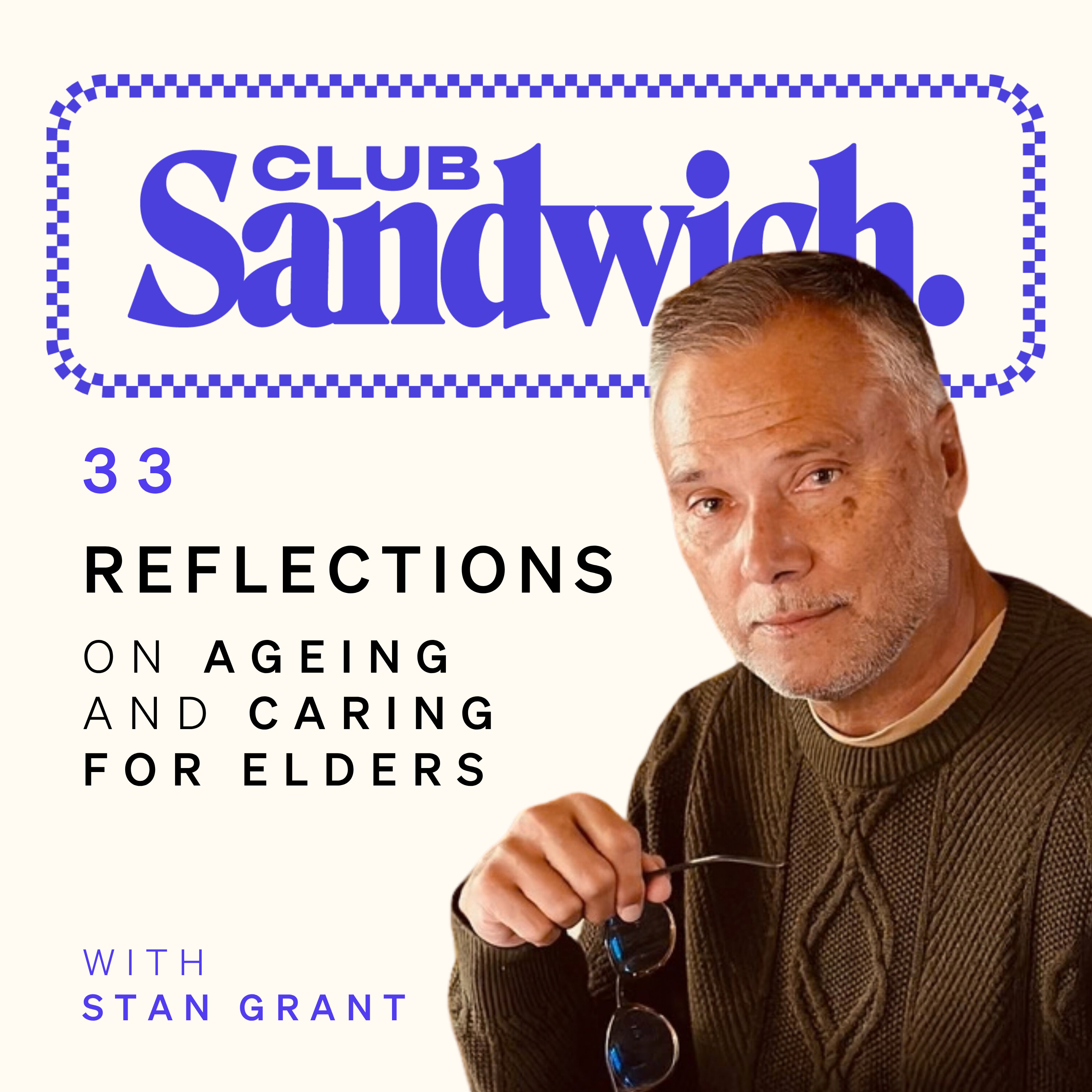
Reflections on Ageing and Caring For Elders | Stan Grant | Club Sandwich
Stan Grant, journalist, author and Wiradjuri and Kamilaroi man, joins Sarah Macdonald to talk about caring for his ageing parents, why he sees himself as a 'provider, not a carer', and what eldership really means. Along the way, he shares the process behind his new book, visions of John Coltrane, and wisdom gleaned from a lifelong love of music, books and family.
Ageing parents? You've got them. We've got you.
JOIN THE CLUB: Visit clubsandwich.community to join the tribe, access resources, and find our private Facebook community.
SEND US YOUR QUESTION: hello@clubsandwich.community
In this episode:
The Conversation: Stan on confronting his father's physical frailty for the first time, realising he's more of a provider than a hands-on carer, and what he's learned about eldership as he approaches it himself.
This Week's Reframe: Not everyone in a family is built for hands-on care, and that's not a failing. Knowing which role you play, and letting others play theirs, is what actually lets a family function without one person burning out.
Send this to anyone who feels guilty they're not the sibling doing the hands-on care, or anyone quietly renegotiating what role they play as their parents age.
Topics covered in this episode:
- Confronting a parent's physical frailty for the first time
- Why "provider, not carer" is a useful reframe for family caregiving guilt
- In-home support services and the role of extended family
- What eldership means once you're the one expected to carry it
- Forgiveness, and not expecting closure from your parents
Featured in this episode:
Sarah Macdonald — Veteran broadcaster and host.
Stan Grant — Journalist, author and Wiradjuri and Kamilaroi man. His most recent book is 'When Words Fail Us: Truth Beyond Time'.
Meet the regular Clubbers:
Melissa Reader — CEO of Vera and expert on Australia's ageing crisis.
Jo Lamble — Clinical psychologist specialising in guilt and family dynamics.
Dr Ginni Mansberg — GP and women's health advocate who tells it straight.
Dr Stephanie Ward — Geriatrician helping you understand when "old" becomes a crisis.
Kerry Milligan — Gogglebox star bringing humour and honesty to the sandwich generation.
This episode was supported by Australian Unity, home health and care services — australianunity.com.au/clubsandwich.
Vera is your candid companion as you care for an ageing parent. Have a look at https://vera.guide.
FACES (Families for Aged Care Equity and Support) is a family-led campaign asking for one honest count of the number of people waiting for their aged care funding and the people who die while they're waiting. Add your name at vera.guide/faces.
Put The Kettle On — Vera's free conversation guide: the five questions worth asking your ageing mum or dad, at putthekettleon.com.au
Credits:
Sarah Macdonald – Host + Executive Producer
Melissa Reader – Commissioning Editor, Executive Producer + Clubber
Justin McArthur – Executive Producer + Editor for P. Zinner Pods (https://pzinner.com.au)
Thanks and kudos to Sean Wayland for our theme music 'Club Sandwich' — hear more at https://seanwayland.com
See omnystudio.com/listener for privacy information.
Transcript
Club Sandwich is recorded on Gadigal Land, home of the EORA Nation. We pay our respects to elders past and present. Always was, always will be.
Club Sandwich is brought to you by Australian Unity Home Health and Care, helping Australian families keep their parents well, independent and at home for longer. Visit australianunity.comau/club sandwich. Welcome to Club Sandwich. Now, this is the podcast for you. If you are caring for someone who is an elder to you while you're possibly getting older and a little bit more elderly yourself. My name is Sarah McDonald. My mother has now turned 93 and she is an irrepressible force and sometimes I am the blunt object. Now, today, a very special guest for you on the podcast, Stan Grant. He is Awadjuri and Camilla Roy and Dharawal Man. He is a Recovering Journalist, a TV presenter and producer, has a PhD in Theology and a deep philosopher. His new book is called When Words Fail Us, Truth Beyond Time. But others include Murray Young's Song Of Time, which is really relevant, I think, for us Sandwiches because it's a meditation on aging and his parents and it's a beautiful, beautiful book. Hello. Thank you.
Gee, you got good genes, 93. I know you're batting well.
Yeah. But it's all about kind of, you know, what those ages and stages of life are like towards the end. And it's a lot to kind of, you know, a lot of care involved for this generation that's living a long time.
My parents are just into their. Well, my dad's mid-80s now, which is quite miraculous given the life that he led. He was a manual labourer for most of his life. His body is. He's almost every bone in his body broken. Tips of three of his fingers are missing. And, you know, he's. He wears Australia's history on his body. My dad and my mum's into her, you know, early 80s now. It's miraculous. They're. There's been one or two in their families that have got to that stage. I would say I'm older than both of my grandfathers when. When they died. So, you know, for a lot of Aboriginal people, for a lot of lifestyle reasons, historical reason, stress reasons, traumatic reasons, you know, our life, our life expectancy is lower and we're really experiencing for the first time an aging population. And that's brings. We can talk about this, but it brings a lot of cultural stresses and responsibilities and time demands that we've never really encountered before, we haven't had before and we don't have.
It's a good problem to have.
But it's a, it's a, it's a good problem. But of course, you're right, you're sandwiched as well. But we don't have the infrastructure. There are no, you know, there's certainly not many Aboriginal aged care centres and things. So where do my parents go for the sort of culturally appropriate care and community that they, you know, have grown up with? Yeah, it's, it's, it's very different. Not something I expected to have because I didn't see old people when I was young, apart from my great grandmother who was a force of nature and I mean, she was one step removed from contact and she was well into her 80s. She was extraordinary. But apart from her, I didn't see old people and now we are.
Well, yes, like I said, it's a good problem to have. But do your parents have good cultural appropriate care?
One of the good things that Australia's seen over the last, you know, few decades has been the emergence of Aboriginal medical services which can provide that support in home support and medical support, which has been a godsend. Fortunately, we have an extended family and so there are cousins and my brother has been extraordinary in the time that he's been able to give to them. I think one of the things, you know, and they do need a lot of care, but one of the things that I think you have to realize and you have to reckon with yourself. And this was very confronting for me when I first really confronted my father's physical frailty. He was doing incredibly well up until he was 80, driving, working full time. He's a cultural leader. He carried an enormous cultural load. And then he.
Bringing back language.
Bringing back language. He helped to write the first dictionary of Wiradjuri language. He set up language centers and taught them. He's got an Australian in Order of Australia medal for it. He was awarded the lifetime achievement award at the National NAIDOC Award. He's a cultural giant, my dad, and he was a real force of nature. But after 80, he had a whole lot of complications. That meant several surgeries, especially surgeries in the brain. He had a bad fall and that started to limit his mobility and he requires a lot of help. And the first time I ever encountered the physical frailty, you know, I used this word deliberately repulsive. You know, to feel the physical infirmity and frailty of someone you knew to be so strong and a very physical man with the work that he'd done when he was young was hard to come to terms with what you felt repulsed Or. Yeah, well, I felt the intimacy was, was something I wasn't prepared for, you know, the shaking legs, the physical frailty. And I thought I was like a little boy who wanted his dad back. And I had to confront the fact. I think we have to be honest about this. You confront the fact that you do have these different emotions and I'm not. You know, I've been a very physical person, reporting from different parts of the world war zones. I did a lot of sport. My dad had raised us to be physical men. And to be confronted like that was really confronting for me. And, and repulsed at my own feelings about that.
Yeah.
And I went outside and I thought, boy, you gotta get it together. You know, this is, we have entered a stage here and dad presenting himself in his vulnerability to you. One of the things that I realized, and this is okay, you know, that we all have different, you know, we're all different. We all have different things to offer. I am more of a provider than a carer. And I think if you realize that, you realize where you can be useful and fortunately, you know, having, you know, financial and other wherewithal to be able to provide things is something I can do and in a way that maybe others can't as readily and then others are very much attuned and have an aptitude for physical care. And, and I think realizing that about myself was, was very useful because we can't be all things and we are not all carers. That is a particular, there's a particular calling. It is a particular aptitude, a sensitivity.
And often it's just the ones. Yeah. And often it's just the one who's the closest as well. And, and you go back and visit your, your parents a lot, but it's often that person. Yeah, but different people in the family can have different roles and they're all really important.
Yeah. But I think also acknowledging that we can't, we're not superhuman, it doesn't come naturally or easy to us. We know as parents we all had different skills. Someone has a particular role to play, a mother, a father, and they're not gender specific roles. They are often roles that, you know, tell you more about yourself and who you are and what your children look to you for. They look to you for different things. And I don't think there's anything wrong in acknowledging that it's confronting because you think you can be all things to all people, but you can't. And, and I realized that I have limitations as a carer which, which, you know, I had to confront and then say, how can I be useful and allow others to be useful in their way?
You talked about it really beautifully. I think in the book you talked about his scarred grace.
A scarred grace, Very hard one. My dad was born into a brutal time. You know, he comes, he's two generations removed from the wars of Ba', Athist, as they're called. Martial law declared against Wiradjuri people. Huge numbers of people, through either disease or violence, just dying, disappearing. And the future of his people was on the line. And he's from the missions. He was born into an Australia that excluded you. Segregated. He, he, he is physically beaten from that. He has physical scars from that. The work that he had to do left physical scars. There are mental scars and, and just the sheer will of survival. But one of the things that has always astounded me about my mother and father is the grace through which they confront suffering and the generosity that they extend to others. And your scars can do several things. I mean, your scars can be wounds that you carry forever, open wounds. Or your scars can be places of healing. You know, there's a wonderful story that I'd read once about. It came from Native American law and it was about the story of the old hag. And the old hag waits for the warriors when they've passed over. And she eats all of the scars off their bodies to cleanse them for the next life. And those that have no scars, she eats out their eyes. Because you do see through your wounds, through your scars, and they can be places of healing. And those that have gone through life without the wounds are blind, often to the suffering of others. It was an amazing story, always stayed with me. And it's one that tells us a lot about. Tells me a lot about my parents.
Yeah. And that frailty that is so confronting for you and those scars he carries. How did you come to terms with that and that vulnerability?
Well, I don't think you ever do. And I don't think we ever come to terms with our parents or our lives really.
Those giants not being that giant, but it's also, I think about, it's confronting because it means we're getting older as well. Like you and you have the same name. You're the junior, he's the senior. And yet you're a 60 year old junior.
Yeah. And in many ways worlds apart. And those names, you know, being named after my dad was also brought its own issues. I think there was. My dad calls me mostly he calls me Dylan.
Why Dylan?
You know, he said I Used to love Bob Dylan when I was a little baby, listening to songs and stuff. So he calls me that. I've got son called Dylan. And. And there is a sort of differentiation, but he. Dad because of just having to survive. You know, you go to a sawmill, you come home. We moved from town to town. We didn't have permanent home. We were. We were, to all intents and purposes, homeless for the first 14, 15 years of my life. And you come home from the day at the mill and, you know, you've got a tepid bath and a meager meal and you're exhausted and children that depend on you and a family and often an extended family, and you get up and do it again tomorrow. Well, there's no rooms for Father Knows Best hugs and sitting on the knee and getting words of advice. My memories of my dad are often trying to avoid him or avoid creating stress, be quiet because he is so worn down, exhausted and. And more often, I mean, what he was teaching me really was how to survive in a very harsh world. I don't remember hugs or fatherly advice. I remember being taught how to throw a punch, how to box, you know, physical things. And he was preparing me for a very hard life. And our lives are very different. You know, I lived a life that is just unimaginable really, in so many ways from the way that I grew up. And so I think there's always that. The name that you carry, the relationship you have, and you never resolve any of those things. I think we're crazy to think that we will have, you know, closure as Americans. It's such a stupid. There's no closure and nor should there
be, because then you're closed off. Yeah.
And of course, regret, you know, things that you wished had been different, but they are what they are, and there's
coming to terms with things. Isn't there though?
Yeah. Yeah. Understanding. Forgiving is a very. A very big thing, I think. I think it's important. Forgiving the fact that, you know, our life was hard and there may have been a distance there because of that. Forgiving that I lived with incredible anxiety when I was a boy. I had constant churning stomach pains constantly. I would curl up by the window waiting to see the dust from Dad's car coming down the road. Because I was. I lived in fear he'd be killed in a sawmill accident or something. People died in this work. And I knew that we were right on the line. If dad wasn't there, we were done. We were done. We wouldn't eat, we wouldn't survive. And you know, that anxiety I carried, and that may have fueled many of the things that inspired me to do things in life out of that same anxiety. But forgiveness and finding a place to put that, and not expecting everyone to be superhuman. We're not the best parents, we're not the best children. We stumble through and if we're good. You know the line about the monk, Lord, I don't know that I please you, but the fact that I wish to please you surely pleases you. That may be how we go through life. I don't know.
And acknowledging those scars, I'm not the
best parent, I'm not the best son, I'm not the best husband. But the fact that I wish to be maybe pleases someone. Maybe that is. Maybe that's God's work. And so I.
And that's grace, isn't it?
Well, it has to be.
Yeah. But your mum, you say, is pure love.
Yeah.
Betty, is it? Yeah.
I mean, she was, you know, she's a wiry, tough woman, you know, she was what dad needed too. And she held things together for us. She'd get things done, Mum. And she would swallow any pride to get things done. You know, we didn't have enough food, which was often. She would go and knock on the door of the church and say, here we are, we don't have any food. And to get a food voucher, she would swallow pride to do those things. She'd find food, you know, even if it meant that we ate fried tomatoes for two weeks. We would do that and push food off her plate to feed us. One of the things that Mum did is that she saw in me early. I didn't have a great education. I didn't go to school often. I changed schools 14 times before I was even into high school because we were living this itinerant existence. But she knew that I loved reading. I loved it. It was my education. And when she went to get our clothes at the second hand shop, she'd just reach into those old boxes of books and bring home books she'd get for 10 cents each and I'd just devour these things.
She fed you? Yeah, on many levels.
And she's a mystical woman. She would see things, she would see ghosts, she would see spirits, she would tell us stories. The spirit world was utterly alive in our house. We did live in a magical place. And. And she used to write poetry and, you know, she had limited education, but she would at night write these extraordinary poems that when you get back and read them, you Know when people just cut through all the rubbish. I remember once, one poem that I read and she was talking about to this line that broken biscuits made me cry. All they could afford if they ever went. They used to get broken biscuits from the factory that was not, you know, properly made and she'd buy a bag of those. But what I realized when I read that line is that is it was her broken family. It was the broken lives and the poets ability to employ metaphor, to be able to speak to something so much more, so much deeper and the taste of something on your tongue that connects you to the pain of life and the small joys of life. Extraordinary poetic woman.
Explain. I mean, because you're so poetic too and you're writing and that comes through her.
I definitely got that through her.
Yeah. But also when you were little, you were quite mystical. You were very attuned to that. And now in this age and stage of your life, talk to us about how you're coming.
Oh, even more so because don't.
Yeah, so you turn 60 and there's a coming back to.
Yeah, I think yourself, I think you're alive to certain things and I think it's always there. I think the mystical is always just off to the corner of the eye, I think.
But we lose it when we're working.
Veil it with, with our rationality, our ambition, our ego, our desire to be in a truly mystical place. You cannot desire. You have to allow the world to speak to you. You know, I'm a traditionally religious person as a Catholic and also spiritually and alive to things. One of the great things about Catholicism is that at its heart it is a mystical tradition. That is what it is. Forget the bells and whistles and stoplights and you must stop. Go do this, do it. Is at heart a place of utter mystery. And so when I was young, I was open to that through the portal that my mother opened through her mystical experiences, through my own openness to what is mysterious around me. I would see things, I would hear things, I would experience things. And that's always stayed with me. But I push it to one side with all the other things we bring to life. As I got older, and particularly as I approached my 60s, something shifted in me and it opened me to that again and I started to be visited by things.
As Stan says, we all have our different roles in a family. And that's the case for Australian Unity's home health and care. In one line, the right support for the right role. It means growing older doesn't have to mean Shrinking, it means your mum or dad gets to keep doing the things that make them them for as long as possible. Visit australianunity.com auclubsandwich if you are waiting on a home care package, you know how hard that waiting is. 10 months on average and nothing funded in the meantime. It's hard on everyone, on them and on you. Now Vera is building something that lets eligible families start care straight away and it's looking for a small number of families to build this with. If your parent owns their own home, email helloira guide and you can be part of it.
Murray Young, the book you were talking about, which is a meditation on time, mortality, parents, culture, everything, music. It really began with an experience I had where the jazz saxophonist John Coltrane came to me. I was asleep, or thought I was asleep, and he sat on my bed and he said to me me, whispered into my ear, follow my music and I will lead you to the heartbeat of God. And murayang grew from following because Coltrane demolished time. He used to say, when I play music, I start in the middle of a sentence and I go both ways at once. You listen to A Love supreme, his famous work, and you read on the inside cover his. His prayer, his poetic prayer. You realize this is a man who is not confined by the limitations of what we define the universe by mathematics, time. He lives outside it in a mystical realm. And so I would have these experiences, Sarah, where it would call me back into this. And I find that that is where I'm at peace. And if I follow that rewards me. I'm in the middle of writing a novel right now, which has been an utterly baffling, utterly mystical experience that I cannot contain or control.
And sometimes it's come to you, like in so many different ways. Oh, in so many different ways. It's pretty out there.
It is totally out there. And sometimes I think too out there. But when I try to constrain it, when I try to corral it, when I try to explain, it falls apart. It dies on the page. The words just land with a thud. And when I take that out, when I just go, okay, you talk to me. And weird things happen.
Who's you?
Whoever wants to speak that day, whether
it's John Coltrane or whoever it is.
I mean, it grew out of the idea of a man who sees the end of the world and says, yes, yes, then what? And then there are a whole lot of other characters who move in and out of what we call time and lead us into a mystical realm where we may Truly find who we are, because we are a mystery. We are not rationality in science. We are not a Cartesian thought experiment. We are a mystery. The universe, the mystery. So I've allowed the novel to just reveal itself and to trust the reader to sit with the mystery, to just go where it goes. Because when I try to control it, it falls apart. And I find that in my life now and in my health while I've been writing the novels. There may be a psychosomatic element to it, but while I've been writing, I've had various nerve issues, like a little bit off kilter, bit of dizziness, pins and needles burning in my legs, different, you know, nerve endings. Just.
Are you a saint? Getting kind of, you know.
I know what it is. Yeah. Stigmata.
Or is this physical? Or is this letting go of years of stress?
It could be a whole lot of things.
And recalibrating your life do.
When I relax into it and breathe through it, it's gone. When I tense up, when I try to control it. I went to the physio and she's been releasing different parts of my body where the tension is and where the. Where the nerves grind against each other and send these various signals around your body. That's aging too. You know, we are carrying, you know, we have a medical history and stuff's catching up.
History, yes, from that history.
And what does history, what is history really? History is a cage. History never lets us go. If you live in history, you will never be free. Never be free. I don't buy this nonsense that those who do not remember the past will repeat it. I think if you remember the past, you are condemned. I love what T.S. eliot said in the Four Quartets. Time is no healer. The patient is no longer here. I think we hold on to history. I think as aboriginal people, we. We think that history is destiny. I think the truth telling can become a cage, as. As Kafka said, a cage in search of a bird. You are trapped in the very thing that you think will set you free. So much pain. I've come to realize in our bodies are the things that we have carried and do not let go.
And so this is the stage of life you're at. I mean, the. I don't know if this is in Buddhism so much, but in Hinduism you have stages of life, right? You have your teacher Brahmachari phase. You have your stage of responsibility, being a parent or a worker. And then you have the third stage, which is where people will often just go off and become mystics. Or sadhus. And I feel like that you are just so inhabiting this.
Are you in this?
Well, I think I'm getting there. I think that when you're released from full time work and that constant busyness and that scramble in your brain and that constant stress, I think it takes a while to release all of that.
How does that show up in your life?
Well, what, the stress?
No, no, no, you're getting there.
Well, I'm going back to meditation. I'm going back to yoga. I'm going back to just that sort of slowing down from that constant busyness and that opening up and that softening to the, to the world, to the universe.
And isn't this, I mean, you know, if we talk like this while we're in the midst of our careers and chasing whatever dreams. Yeah, well, it's all woo, woo, woo. Yeah, but of course, the more you realize, and maybe it is mortality, we're coming to the end of this and we have to, we have to deal with the idea of death. It shouldn't, it's. It is a part.
And having aging parents brings all this up. I think because you're closer to that. There's that anticipatory grief and that kind of. They're closer to the end. We are dragged closer to that.
Yeah, I think so. And I think one of the things you realize is that the mysterious may be the truth. All the things that we have put in to veil that are the things that make us sick. It is the mystery that is the truth. The mysterious experience.
So your parents aging and your own aging is really kind of dropping that veil between the.
And making it harder too. Right. Because we don't get to age on our own. We're caring and aging and we're the first generation, I think, to really experience
well for this long. That's right, for this long. For this. Because it's now an average of. I think it's like 12 years. Is getting to 12 to 15 years. I've been in space for 15 years. So it's very different for this generation than it ever has been before. And I don't think people really understand that we're in a whole new realm because people are living for longer with increased frailty. And our own frailty is a part of that. It's so confronting.
And are we allowed to have that frailty?
Well, you don't have time for your own frailty. Right. You know, that's the problem. You've got to soldier on and power on and then you're getting unwell yourself. So this is, it's, that's about what we're trying to do in this podcast. Trying to keep people strong and fed through this and seen and recognized and not feel alone in it. Do you, do you feel yourself now? I mean, you're basically an elder now yourself, like your dad's an elder. Well, your mum's an elder. Are you an elder too? What does that mean for you?
While dad's alive? I can't see myself that way. And mum, because I will inherit that. Eldership is a very, you know, it's a big responsibility. I think it shows up in different ways. For me, the eldership is to do is actually to give myself the space and time to do the work that I think others may need. Seamus Heaney's an elder to me. T.S. eliot's an elder to me. Toni Morrison is an elder to me. You know, Arvo Pert, the musician is an elder. Composer is an elder to me. The people who show me a way. That's why we go back to great literature and great music. And part of this is actually saying in the same way that I said, I'm a provider, not a carer. How can I be of most use as an elder? Some elders are going to show up and be very hands on, very active, very community driven. My sister is very community minded and I'm not that my eldership may be disappearing into a room to write, to put things out there that others are going to read and not just for Aboriginal people, but for all people who can come to that. I think I've become.
But then why don't you see yourself as an elder of Australia? And I don't just mean of.
No, I do.
You do, because you are. You've become a philosopher and I mean, you have been for some time.
To tend to the nation's soul, I think is a calling and I'm embracing in many ways. We bought a property in the country. I'm also very fortunate, Sarah, to someone who grew up in abject poverty to have a measure of financial comfort where that can support the work that I called to do, to be open to the presence of God and the divine in my life. God's such an overused word that we really don't understand, but let's just use it, the divine in my life and then to put myself in places where I can go into the space required to do the eldership work, which for me is the calling to find words that may speak to others in a time when, as my latest book says, when words often fail us and there's
too many words and not enough signs, too many words, and everybody's very judgmental thrum of what's going on at the moment. People are not well, mentally. People are falling into terrible distant.
And I've been there. The other thing about an elder is to know you have been there. You've been there, Sarah, and, you know, your advice, or not even your advice, your example to others in our industries who are going to be moving through the stages that you've been through, your example will speak. That's your elder work. This podcast is your elder work. It's an extraordinary and a beautiful time in our lives to be able to do that, but to be aware, again, that it's quite greedy in that we do need to demand the space to do that elder's work. If I'm doing everything or trying to be everywhere for everyone, I'm not going to do the thing that I am called to do and the use that I can be for others, and I think that that's part of eldership, too, is to recognize what your contribution is and to have a modesty about that. The modesty is in the gift, is in the offering. It's not going to be for everyone. Not everyone's going to hear it or want it, but here it is.
This is what I've got. This is what I can do, this is what I can give.
And my favourite song of all time is the Kink's Waterloo Sunset.
We've talked about this before.
I love that song. Such a great song because he's looking out onto a world and saying, there it is in the wistfulness of it all, in the touch of a hand and people meeting on a street at a sun, you know, a sunset over Waterloo Station. And there's something so magical about that. I remember the first time I heard George Harrison, My Sweet Lord, I was in Sydney and we were going to meet my auntie in the park in the city, and I heard it wafting from a trans sister, and I thought, oh, there's freedom. There's freedom in that. The expansiveness, the chant, you know, I really want to see you. I really want to see you, but it takes so long. And, you know, I'm really called into freedom. Not the construction of freedom that we see as being, you know, rights and democracy and liberalism and their cages in themselves. I'm saying the freedom to be as close as you can to the liminal space, what the Irish will call the Aisling, you know, the. The mystical space. The thin space, that's where we're free. And we know that. We know it. We know it when we're there and to hold on to that. So in terms of eldership, I don't see it as something I'm performing or gifting to any group of people.
All the best with this really powerful time of life.
Thank you. Thank you. We'll see where it goes. If I can get rid of the. The tingling in my body.
Yeah, rid of that tingling. I think perhaps it's messages from beyond that you're working through. Please send this podcast to someone you feel who is really at this stage and age of life where they are going through this new way of thinking and being and really embracing it, and I'd love you to do that. Also, be in touch with us if you would like us to cover a topic that you really feel we need to, and that will be helpful for you because you are not in this alone. You're doing a great job. And while you have got them, we have got you. Today's episode was supported by Australian Unity Home Health and Care, proactive local care that helps your parents stay independent and living well at home. Visit australianunity.com.
You make one phone call to get help for your aging mum or dad and suddenly you are drowning in acronyms and waiting lists. The aged care system, it's a bit of a wall of these acronyms, phone calls, waiting lists, and nobody's really giving you a map or a guide. Well, we see you. We want you to know that you're not behind, you haven't left it too late. And wherever you're starting from is the right place to start. You don't have to hold all of it this in your head on your own. And you can keep what matters most to your aging mum or dad right at the centre of every decision. That's what Vera is here for any time of the day or night at Vera Guide. It's free, safe and secure, built right here in Australia with families and the experts who know this journey.