

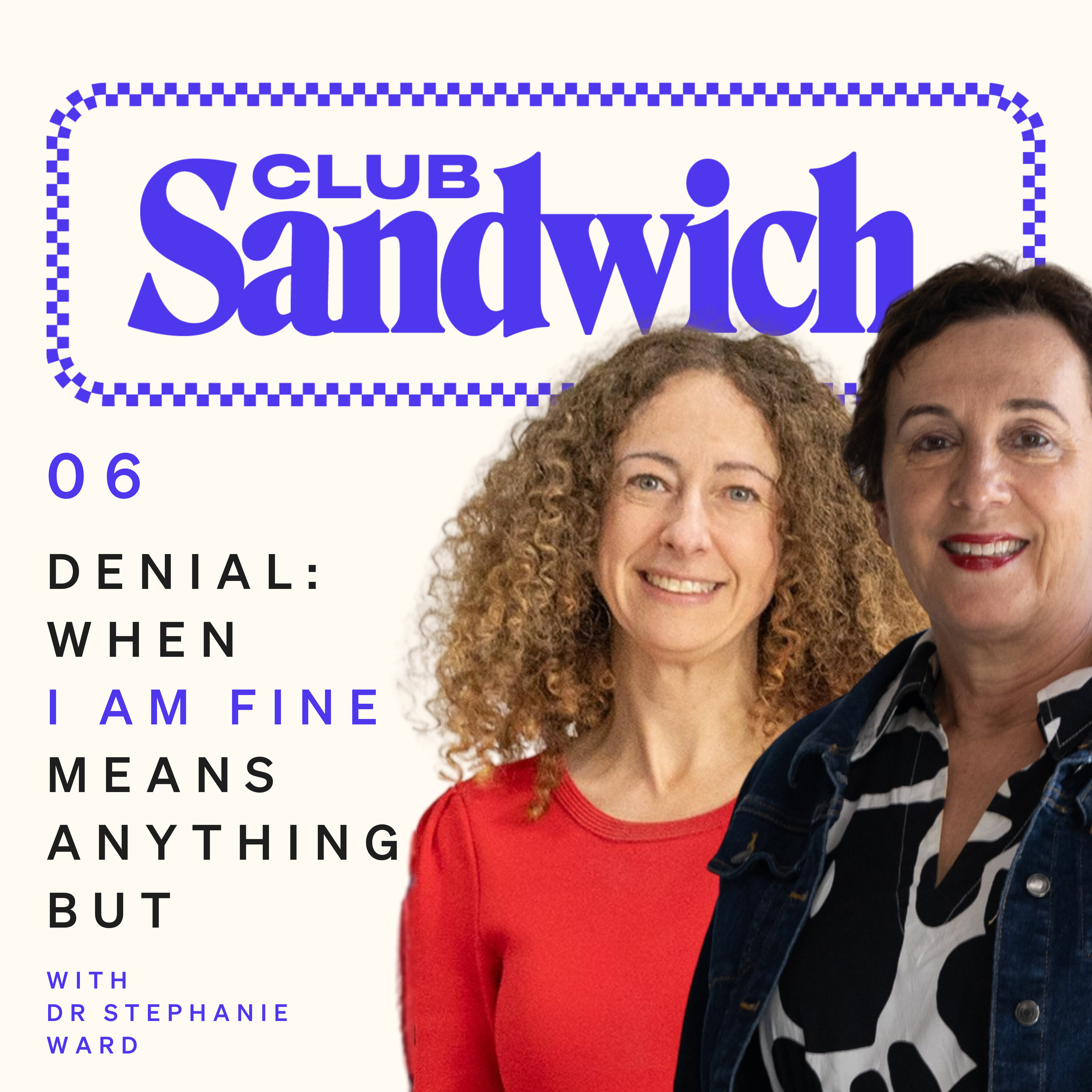
Denial: when your ageing parent says they’re fine | Dr Stephanie Ward | Club Sandwich
When your mum or dad insists everything is fine, but you can see the fall risk, the spoiled food, the missed cues and the slow slide, it can make you feel like you’re losing your mind. This episode is for the daughter who’s being called bossy when what she really is, is exhausted, worried, and carrying too much.
Ageing parents? You’ve got them. We’ve got you.
JOIN THE CLUB: Visit clubsandwich.community to join the tribe, access resources, and find our private Facebook community.
SEND US YOUR QUESTION: hello@clubsandwich.community
The Conversation: Sarah Macdonald and Dr Stephanie Ward dive into denial, resistance, dignity, autonomy, cognitive change, and how to help an ageing parent who refuses support.
This Week’s Hack: Don’t try to fix everything at once. Pick one concrete safety issue, revisit it gently, and frame support as something that helps you too: “Would you do this one thing for me?”
Listener Letter: Anjali, 58, is caring for her 84-year-old parents. Dad has had a fall. Mum can barely see the stove. Their house feels unsafe, but every suggestion of help is met with “No, we’re fine.” She wants to know how to face reality without destroying their dignity.
Hot Mess Moment: You’re over there four times a week, finding wilted food, mildew in the washing machine, and signs things are slipping, while the interstate sibling visits for a roast and says, “They seem fine to me.”
Meet the regular Clubbers:
Melissa Reader - CEO of Vera and expert on Australia’s ageing crisis.
Jo Lamble - Clinical psychologist specializing in guilt and family dynamics.
Dr Ginni Mansberg - GP and women’s health advocate who tells it straight.
Dr Stephanie Ward - Geriatrician helping you understand when “old” becomes a crisis.
Kerry Milligan - Gogglebox star bringing humor and honesty to the sandwich generation.
Topics covered this episode: ageing parents in denial, refusing help, loss of independence, dignity of risk, cognitive change, dementia concerns, My Aged Care, caregiver burnout, sibling denial, safety at home, autonomy, how to talk to resistant parents
Club Sandwich is brought to you by Australian Unity. Visit AustralianUnity.com.au/ClubSandwich
Credits
Club Sandwich is brought to you by Vera.guide, helping families caring for ageing parents navigate this stage of life so you don’t have to do it alone. Download Vera's free "home is where the heart is: how to keep them there - practical field guide to navigating aged care" at clubsandwich.community/resources
Sarah Macdonald - Host + Executive Producer
Melissa Reader - Commissioning Editor, Executive Producer + Clubber
Rachel Fountain - Executive Producer
Audio + video edits by Fountain Media Group
Thanks and kudos to Sean Wayland for our awesome theme music Club Sandwich - hear more from Sean at seanwayland.com
See omnystudio.com/listener for privacy information.
Transcript
Club Sandwich is recorded on Gadigal Land, home of the EORA nation. We pay our respects to elders past and present. Always was, always will be.
Club Sandwich is brought to you by Australian Unity's Home Health and Care, helping Australian families support their parents to stay well, active and living at home for longer. Visit australianunity.com au club sandwich hello. Welcome to Club Sandwich. This is the podcast for you. If you have a lot on your plate right now, you might be juggling plates in the air, caring for an aging parent, looking after your own family, you might have a job in the mix and sometimes you just drop everything. Well, we are here to help because while you've got them, we have got you. My name's Sarah McDonald. My mum and mother in law are in their 90s. I've got 20 year olds at and there's a lot happening for me but I want to hear your questions as well and I'll tell you here at the end how you can do just that. Today back in the clubhouse is Dr. Stephanie Ward. She is a geriatrician. You might have seen her on Old People's Home for four Year Olds and the wonderful one with the teenagers and she's a conjoint professor at unsw. And today, Stephanie, welcome back.
Thank you.
I want to talk about the big topic that I think most people grapple with the hardest. I think this is the really big one and that is denial. It ain't just a river in Egypt is the bad joke about it, but this one I think just sends the clubbers a bit crazy, really crazy. Like do you hear this as a big common thing?
A hundred percent, 100% or, or what, I guess what you call denial. It can be differences in opinion or differences in perception or awareness of what changes are taking place and perhaps what supports might make life easier as you get older. Because it's quite a common scenario where a person is getting older and older over time and certain things in day to day life are becoming more difficult, whether it's getting out of the house and accessing the community or just taking care of some day to day activities. And sometimes the caregiver can see what's happening and wants to help and wants to institute ways to make life easier, safer, perhaps even improve quality of life, improve health. But quite often, quite often the older person, the older parent, is not receptive to those suggestions.
Exactly.
And sometimes it can cause arguments and friction and it's a real, it's a real challenge and there's a lot underpinning it.
Yeah, let's start with this letter. This is really interesting. This is from Angeli, who's 58, in Melbourne. I need help before I completely lose my mind. My parents are both 84. Dad had a fall last month. Mum can barely see the stove anymore. Their house is a bit of a death trap according to them. Everything is fine, absolutely fine. I'm over there four times a week. There's a lot going on. The fridge has wilted food in it. I found washing that had sat wet and mildewed in the machine for a week. When my brother comes down for Brisbane and visits, Mum's made a roast, Dad's dressed up, everything looks good. Don't worry so much, mate. They're fine. But they don't see dad at 2am without his walker or Mum having a bit of a tear because she can't read her own handwriting. Whenever I suggest cleaners or my aged care, I get the same thing every time. No, we don't need help. I want them at home. Says our lovely Angeli, who's struggling with all this. But they need support. It can't be all on me. I work full time, I've got my own family, I'm exhausted and I'm worried and now they're calling me bossy. So how do I get them to face reality without destroying their dignity?
Yeah, great question. And first things first. Angeli, you are awesome.
Yes.
Doing an awesome job.
Okay, you're great.
And secondly, you're definitely not alone with this really tricky dilemma. And I think that sometimes it's going to be hard to get everything happening the way that you are, quite rightly thinking things should happen. So I don't think I'm going to be able to give a really quick fix.
No, no. But there's lots of stuff in there that she kind of points out that I think a lot of people go through. Right? Yes. And the first one is the denial on the surface. Right. Just this sort of like I'm seeing this, you're not seeing this, and your parent might be denying or minimizing it.
Yes.
Right. So let's talk about that. Why do they often not see that they need help?
I think it can be a lot of different reasons for different people, Sarah. So some of it can be denial and pride and grief at the loss of not being able to do the things it used to do. Some embarrassment about that as well. That can underpin some of the friction and arguments that stand stem from that. You know, the insult, like, you're bossy. Never been called bossy before.
I have been called bossy and I have never, no one's ever used that term with me before. And now my mum says I'm bossy
and it's really hard. And it's the paradox that it's often aimed at the person who's actually tearing their hair out and trying really hard to thoughtfully care for someone. Sometimes there is also a lack of awareness of the changes that are happening. There can sometimes be some changes cognitively that occur as we get older as
well that reduces kind of self awareness or reality.
Yes. So there can be some changes that happen in cognition with normal aging, but there can sometimes also be common age related conditions like mild cognitive impairment or dementia that are impacting upon the ability to make decisions that are in your best interest. You would have made a different decision 10 or 20 years ago. I don't want wilting food. I'm really struggling here. Yeah, I want some help. And then there's also just that, you know, terrible sense of losing control even. Imagine you've been living for 60, 70, 80, maybe 90 years and you've become successful in your career, you've cared for others, you've been the mother, you've, you've possibly cared for your own parents, you've done all of these super amazing things and now you're in this position in life where, yeah, it's getting harder day to day to organize your household, get the food in, keep the house clean. There's a lot of grief associated with that change in your role. There's a lot of grief associated with recognizing the independence is changing and having strangers or other people coming into your house. There's a lot of lack of control there. I mean, put yourself in that shoe,
it's your sanctuary, it's your home. Yes. And that loss of agency, it's a big change in self image, isn't it?
Absolutely. Absolutely.
I guess I suppose the other thing is we all have a self image of ourselves that's out of date. Like I will walk past a shop and I'll be like, who's that old lady? I, oh my God, that's me. Because in my head I'm still 25. So I just wonder sometimes for people who are older, like in their head, are they still 55 or something? Are they kind of like my age? Like I wonder if that it takes a while for us to catch up to what's actually really who we are.
Yes. It's a really common observation. A lot of older people will say, I still feel this age, or might either believe or wish Others to believe that they're still able to do certain things for a number of reasons. You know, if I ask you what you did in the last week, maybe you might try and impress me and tell me that, you know, you read 10 books or something like that. Because we want to present an impressive front to others and often to ourselves as well. So there's a lot of factors at play as to why we might be what you call denial or lack of awareness. And I guess another thing is that sometimes people's priorities might change in life, too. So at a certain point in life, you know, having an immaculate house and having everything organized might have been really important to us. But perhaps as we get older, we might trade off a little bit of that lack of cleanliness and organization in our life for what we perceive as a loss of control and a loss of agency. And so our priorities do shift because, you know, what's next is really frightening. And then a lot of people are very frightened about their independence being completely taken away. Maybe it's just a cleaner now, but maybe next, you know, six months, they're going to put me in an aged care facility. I don't want to go in an age. This is my home. This is where I want to be.
I mean, I don't really care about a messy home. That's fine as long as it's safe. But, I mean, if it's, you know, there's mould on food and things like that, it's different, isn't it?
Nutrition and a safety issue. And thanks for going back to that, because often when we want to try and effect a bit of change for our older parent, we've got to prioritize what are the biggest risks here, what are the things that we really can't negotiate on and what can we let go and how do I manage this and how do we get about this? And it's difficult. And every dynamic is different, particularly when an older person says, I'm managing, everything's fine, there's not a problem here. And there can be different ways to approach this, and I probably don't have all the answers. And I reckon a lot of people listening to this podcast will have their own. Have sorted out their own hacks.
That'd be great to hear. Yes. You can put them on the Facebook page and help everyone along. Yeah.
But sometimes it's just maybe focusing on one thing and just gently revisiting that. Sometimes as well, it can also be presented as a solution, not necessarily just for the older person, but for the caregiver. As in a lot of older people don't want to be a burden.
They say that, yeah, I don't want to be burden.
They don't want to be a burden.
I get that. That's the pride that you talked about. No one wants to be a burden.
And sometimes helping an older person to see, well, actually, I'm burdened by the worry about you. Would you do this? Not for you, but would you do this for me, please? Just this one thing for me. This would help me.
That's how I got my dad to accept a bit of help, because I was like, dad, I'm losing my mind. And he did it for me because he loved me and he was the most caring and beautiful man. But I think for. Actually, I wonder, I mean, maybe this is more for blokes and often the mums, they've done their own caring and sometimes they might go, yeah, I looked after you, you can help me out a bit. But I think for, for many men, they've sort of had that agency, they've had that sort of power in the workplace. They've been, you know, maybe running things. And. And so the loss of that is really hard to deal with. So how do you kind of give them to keep that agency and that sort of power of being useful and not a burden, but just a little bit of help on the edge of it?
Thank you for bringing that up. Because it's really important that we support people to have as much agency and autonomy as possible. And there's also this concept called the dignity of risk that people.
The dignity of risk?
Yes, the dignity of risk that comes along with us having our own autonomy and agency to make our own decisions, even if sometimes they might reflect some bad judgment or some risk taking. And, you know, we see that in people around us in our. In our society. But it's hard when it's a parent and you feel a sense of responsibility.
Well, I think it's hard when it's safety, because I get it, it's like, you know, oh, yes, kid, you can climb that tree, you've got to learn some risky behaviour. But with a parent, if they. If you think it's really risky, it's going to rebound onto you if they're going to end up in hospital as well and you might lose them and you love them.
Yeah, absolutely. And sometimes we have to be conscious of the fact that some people are making these decisions not necessarily in alignment with their value set, because some people, yes, do always take risks throughout their whole lives. We have base jumpers and all sorts of things. But if you've never been like that and then you start to take risks because you're not able to make good decisions anymore because you have, for example, a dementia or another cognitive disability. That is where we often have to step up and say, look, you're not making decisions that are consistent with your core values.
That's when you have to get bossy.
You have to get a bit bossy. But we also have to accept that people are allowed to make bad decisions throughout their life. And, you know, when we're older, we tend to get worried and there is that interplay between, but I love you and I don't want you to hurt yourself, and someone saying, but I know what I'm doing and I know the risks, but this is what I want to do. So it's a delicate, it is a delicate dance.
So that could be the conversation you'd say, like, okay, are you aware of the risks? Do you own them? Are you acknowledging them and you're happy with them, Great, I'll be happy with them too.
And sometimes they're risks that we wouldn't have taken for ourselves. We don't want our loved one to be taking, but we have to sometimes accept that that's consistent with their value set. And it's really hard. It's really hard. But there can also be risks with alternatives as well.
What do you mean?
Well, for example, one of the common dilemmas is, and I think we might have be good for another podcast, is when do we think about an aged care facility, for example?
That's a whole episode. Yeah.
Yes, but they're not necessarily always perfect solution without risks themselves. Everything is nuanced in life, right? There are benefits and there are downsides to every choice we make.
So I suppose about being clear eyed about what those choices are. So Angeli's parents, are they at risk? Are they in danger? It doesn't matter if the house is a bit messy. I suppose if the washing's a bit mildewed, that's okay. But I suppose getting the brother to kind of drop by when maybe they're not all prepared because they do fake it, they'll perform for the aged care assessment team or for that other child, won't they? It's amazing. They'll rally.
Yeah, they will, of course, of course. But it's also when you can work with other members of the family as well to get them to hear what you're saying and to get them on your side. And if there's a another family member in this situation, maybe a brother who isn't the bossy one, but can he reiterate some of those worries and some of those suggestions?
Well, he's in denial as well, though, in this case. And often that can happen.
Yeah, yeah, that can happen as well. But sometimes it's also just a bit of persistence and letting an idea take seed and you might not get the, okay, I'll accept help now, but maybe in a month, two months, three months, the idea has taken root and sometimes something else might. We don't want something to happen, but if something happens with health, it can also just crystallise what needs to happen and what. What are the priorities.
And that's what often does happen, doesn't it? I mean, you said that the first time we chatted that there'll be an incident, there'll be a fall or a medical episode, and that's when people will face the reality of what's going on. It'll bring everything, it'll crystallise everything to action.
And I think we have to, as caregivers, be at peace with what we can do and what we can't. So it's really hard for us to change our parents denial or their stubbornness or even if it's a cognitive issue, their cognitive impairment. We can't change all of those things. We can only do so much. And I would also suggest it's really important to get support when you're in that caregiver role, just talking it out with another person, particularly a professional. So a geriatrician like myself is a great place to start if you can make that happen, or another health professional or even another caregiver, just talking it out and seeing things from a different angle. And I can't stress how helpful that is. Even myself as a geriatrician, when I've had issues with ageing people in my family, I've sought out a conversation with a peer. And you're the expert, because it's really important to just have that support and sound things out with other people.
Do you ever get people say, hey, Dr. Ward, can you tell my mum that she can't drive anymore? Or can you tell my dad that he has to move into aged care? Do they sometimes try and get you to have those heavy conversations?
Yes, if it's clinically indicated. If I believe that somebody shouldn't be driving anymore, then I definitely will tell that person and I will tell the authorities. If I think that somebody needs to be in an aged care facility, I will very openly tell them. And it is my opinion as a professional. And I think it's really helpful when you do get that support for those bigger conversations because then it's not you nagging, it's. No, it's somebody else. If I didn't think that, if I didn't think there was a problem, then that's a conversation that I'd have. But then that can be reassuring to some degree to a caregiver as well.
Absolutely. Yeah. And sometimes maybe, you know, I think we need to look at ourselves and check ourself here. Like, are we overreacting?
Yes.
Because it is confronting to watch your parents age and possibly need help, isn't it? It's confronting.
It's confronting in so many different levels because either the people that raised you and for a lot of us have been our safe port, I think, about growing up and leaving home, but being able to come home, come home to mum and dad or mum or dad, and have all those familiar routines and, and have that support, have that person perhaps to sound things off. And it's.
They might even have your old bed with the old ABBA posters on the
wall, your old favorite.
You know, they've still got the arrows
that you might have done as a family. They're really special to us as we grow older. And for us it's really, it can be really heartbreaking when we say, oh, it's not out. Things are changing here, things are shifting. And we've talked about what that might be like for the older person, but we have to reflect what that can be like for us as well.
And do you think sometimes if we go at it too much at a bullet, a gate, it's to try and get it done really quickly because it's just so confronting. But we've got to allow time for that to, as you said, it's a gradual conversation, step through.
Yes. I think most people find that a lot of older parents are not going to be receptive to the idea of, you need a cleaning, you need a my aged care, you need some stranger coming in now to help you, you're not managing it. We might see that these are, these are going to make life a bit better. But it's often more than enough. People will not say, yeah, I agree with all of that. Often it's a process and a conversation, just repeating things over and over and getting the support of a professional. Particularly if we think that people, as I mentioned before, are making decisions not in their best interests because they've got a cognitive problem, because their thinking and judgment is changing, because of something like perhaps a dementia that hasn't been picked up. Because that's when we can be a bit more empowered to overrule. There are ways to help overrule things like being an enduring guardian or other types of powers of attorney that can help give the children the decision making role in the relationship.
Okay, here's some real talk. Before I made this podcast, my idea of organising care for mum often involved Googling something at midnight, panicking, then closing the laptop and pretending I hadn't and then I couldn't sleep. May sound familiar. Hey. Australian Unity's home health and care is what I wish I had found. First they have an actual human, a care partner whose job is to understand your parent, build a plan around them and have a local team who knows them. It's not a hotline, it's not a pamphlet, it's a person, a plan, a neighbourhood of support. So if you're up at midnight googling, do one more site, go to australianunity.com auclubsandwich. Hello clubbers, do you want to hang out in real life? We are doing a bit of a roadshow. This is connected with a film called Careless by Sue Thompson. She'll come along, we'll talk about the film and getting her mum into care and the help she needed along the way and the difficulties of the whole conundrum that's at the heart of this. Other clubbers will be there in the room too. We're going to five cities, we're going to Brisbane, Sydney, Melbourne and Canberra and Hobart. We'd love to see you in real life. The tickets are free, you can have a look in the show notes or go to clubsandwich.community or humanitix and come along, we'd love to see you share some bubbles of the alcoholic and non alcoholic variety and be in the room for club sandwich. Do you think there's also something going on? That they're a pretty tough generation and I don't think we acknowledge and realize that and allow for that and respect that. Like my mum walked around with a burst appendix for a week going, I've got a little bit of a sore tummy and it was like. And then we got to the hospital, you need surgery now. My mother in law lay on the floor all night with a broken hip and wanted my husband to carry her to the GP who was like go to hospital. They're so tough, they're so strong. I mean I'm such a wuss compared to them. That's the thing we've Got to allow that they're different, they come from a different time and they can put up with sometimes a lot more.
I think you hit the nail on the head. It's a very stoic generation.
Yes, they're stoics.
They've been through a lot during their life, haven't complained a lot. They're able to be resilient and withstand a lot of stressors and I think we touched upon this the first time we met. But getting older itself, that can throw up huge challenges for a person. You know, having to get up and do day to day activities when maybe you've got pain or you don't have energy or can't see or hear properly. We can't lose fat, lose sight of the fact that people aging, they're superheroes themselves, they're trying to deal with a lot on their own plate each day and we need to acknowledge that and respect that. And it can sometimes come across, or some people might perceive that offers or suggestions to help are an insult or not a compliment, not recognizing what they're already doing. But it's very tricky, it's really tricky.
And you've got to kind of work out when to overrule and when to let go.
Yes, that's right.
And so what are the principles on that, do you think?
So I think that firstly it's important to make sure that there isn't any cognitive change that's affecting decision making.
That's when you bring in the experts, like you said.
I think getting an expert opinion, just an outside opinion is really helpful. And secondly, it's also about sorting out, often with an expert, what are the risks and how can we manage them and what are they going to be? The least intrusive ways to help support mum or dad. What's the most least intrusive way I can to support, say, getting fresh food in and getting food cleaned out. Is it just getting one person in a couple of times a week to clean out the fridge and to help with shopping or put it under a different guise and you could also do it surreptitiously.
Oh, I accidentally made too much butter chicken. Can you eat it for me? I hate things going to waste. Of course I will, dear.
Yes. But it's important to get that help because it was Angelique who, you know, I'm tearing my hair out and it's all on me. Yeah, we can't expect caregivers. Oh yeah, well you just spend 40 hours or 60 hours of your life sorting all of this out. That's fine. It's not, it's not feasible in today's world where women like Angelique or us, we are working, we also have our own families to. We can only do so much. Right. We can only do so much in terms of changing our parents. But we've also only got a certain limited capacity ourselves. We've got to be compassionate to that. So often we have to make peace with the fact that things are not going to be quite the way we'd like them to be. They're not going to be ideal. We're going to make the best decision that we can. We're going to do the best that we can. And I promise you, I promise Angelique, she's doing an amazing job. And I promise you all, you're doing an amazing job given all the circumstances.
And I think sometimes you can get a friend to kind of help make it look like a social visit to them and kind of do a few little things. Yes. And so you're sort of sneaking it in quietly because as you said that sort of. They, we talked about us being confronted by that age reversal and the role reversal but it's confronting for them too. So sometimes when it's not us, it's maybe a bit easier to accept help.
Yes, absolutely. Because you're the baby. You are the baby. They changed your nappy, they looked, they helped you ride a bike and know you went through your teenage years and you know, you might be an award winning journalist and haven't got any awards, you deserve one but you are still a daughter and that can often be the way we're seeing.
Yeah, listen to this one. Someone sent me this just actually while we've been chatting and there's a lot in it. But another one that they were really struggling with, this is getting them to accept a new routine and that actual help because they hate the gradual erosion of independence and as you mentioned, the intrusion of paid carers in their home and you need structure but if they don't, how do you help your beloved parents maintain that dignity? I think we've touched on dignity but it's a really important one and I think that, yeah, this friend of mine's really aware of this about structuring that conversation to keep dignity.
Yeah, and it's, it's, it's certainly a perilous path to navigate because we do need to be mindful and of the dignity of the older person. And I think the first step is reflected in that text is actually being mindful of the dignity of the older person. If you've got that in your head that this is my amazing mum or dad or who did all these things. And I need to show respect and I need to respect the fact that they want to be autonomous. That's the first step. And then it's just a gradual introduction and conversation. Routines and new things take time to get used to. So going in with the mindset that maybe the first week or two, it might be, or three or four might be an adjustment period, trying to encourage someone, just give it a go. Just give it a go for me. Can we just try. Can we negotiate a short period of time of trying? Someone coming in and making sure that you're comfortable with the person coming in too and that they show respect and really acknowledge the dignity of older person. We don't want pejorative attitudes towards older people.
So pre chatting to them and saying, hey, here's, you know, it's like when you send a note with your kid to school, here's my mum and dad. This is what's important to them.
Yes.
Just know that they're feeling really funny about accepting help. So.
Yeah, because it's. It could be quite easy to walk into a room and. And see an older person and see, you know, perhaps an old, older, frailer person and not recognize that person. Could have been a captain of industry or a pioneer in science or a superwoman who cared for five children and had multiple grandchildren. We've got to see the person and help the people who are interacting with our loved one see that person for who they have been and what is still important.
Well, we need to do that too. See the person, not the problem.
Yeah, absolutely, absolutely. We're people as well. We've got our own problems, but we always have to see the person.
Yeah, yeah. And what they used to do and how they could do it and then. Yeah. What they've been through before and how that might inform how they're dealing with their own changes. Because the life they've had and all the patterns they've laid down and the issues that have happened to them or their own trauma or problems in their life will contribute to how they age, won't they? Won't it really?
Yes. That all has a bearing on how we experience life at older age and having a focus on really quality of life, making life better and better and keeping in our mind, well, how can I make life better for my parent? What still gives them meaning? What brings joy thinking about incentives and nice things as well.
I think meaning is a big one, isn't it? Agency. That's back to that not being a burden, being useful, being useful.
We all need to feel useful, Sarah. It's important. I think it's inherent to most of us as human beings to have a sense of purpose in what we do. And it's part of the reason why I love intergenerational contact, bringing older people and younger people together, because older people still have huge amounts to give.
That's what was so great about the show.
Right.
And with the teenagers, when they were just like, I don't know who I am, and the gentle way that that wisdom was imparted and about.
I just.
It's okay, slow down. You're so young. You've got this. That was just. So. Maybe asking them for help is a good thing. Maybe that's a good little trick. Hey, can you help me with this? Like, I was really thinking about how you could do that. What advice would you give me so that. Within a conversation about. Well, look, can I give you a bit of advice down the track? Let's just get it cleaner. They're gonna. Might be more open to it if you've said, oh, remember that time you really helped me with that. I'm really struggling with this at work right now. What would you do if you were me? Help me here.
Yes. Remember, there's still amazing person who might be able to help you out and just be there for you as well.
Yeah. How did you do that? And how did you look after your parent? Maybe that's something to bring up as well because you did that for your mum.
Yep.
Yeah. It's a good one.
Yes. These are other tricks. Adopt, always going to work for everybody. But quite a few people find that these different ways to have these conversations can bring about a better quality of life for both the older person and the caregiver. And that's what it's about, making life better for both people.
Yes. And you know your parent better than anybody, so you might know the best ways of going about it.
Yeah.
But what I'm getting from you is slowly, gradually, gently.
Yep.
With awareness and being mindful of dignity, agency, independence and how hard it is.
And getting support, reaching out, getting help
from someone like you, a doctor.
Yes.
An ally that can help you and be that and give that professional opinion.
Yep. So if you. If you have access, a geriatrician, another aged care clinician, nurse, social worker. But having someone that you can bounce something off if it's a cognitive concern. There are things like dementia Australia. Great free number that can be called. You can Google it. But just having a Sounding board and also with friends, other caregivers, and trying to get siblings on board when you can. And I think that's something we should talk about.
Oh, yeah. Siblings is a whole other conversation, let me tell you. I do think that we also normalize things. When we're the main carer and we've been looking after parent, we kind of normalize things. And sometimes when someone else comes in, they see it more clearly. And so you can say, am I going crazy or what are you seeing here is really useful, isn't it?
Absolutely. It's great to just have another set of eyes and sometimes another suggestion can come up with something you hadn't been seeing. That happens for me. And I've always really appreciated just that opportunity to bounce ideas off people.
Thank you. That is so useful. Now, before we go, clubbers, what have you done for yourself this week? Stephanie, what have you done for yourself this week?
I made a batch of lemon cupcakes.
Wow.
Yummy. Yes. Well, I like to bake, but I don't often have time to do it. But I just find it very rewarding. And I was hungry for lemon cupcakes. And I will tell you that they were absolutely delicious.
Excellent. Yes, fantastic. I'm trying to think of something I've done for myself this week. I bought myself some flowers.
Oh, that's beautiful.
Yes. Because all my garden died in the heat and the, you know, I was away and so I bought myself some flowers and put them on the table.
Oh, that's beautiful. What did you buy?
I just bought some white lilies and I bought some for my mum at the same time.
Very elegant. Yeah, two for one. Elegant choice.
Exactly. Very kind of, you know, cool and chic, just like us. Not.
You mean not.
Thank you so much for all your fabulous help and we'll speak to you again in a few weeks.
Yes.
Okay, clubbers, we would love you to suggest some ideas for us of podcast episodes. What would you like answered by our experts, such as Stephanie? Or if you have a little question, you can put that on. Or you can actually also give advice to to other clubbers as well. What's worked for you in this space? You can do it on our Instagram or on our Facebook club sandwich community. You can also email us. It's hellolubsandwich.community. and while you're there, please give our podcast a rating and share it with someone that you think is in that sandwich generation, is feeling a little bit overwhelmed or a little bit squished by all the responsibility. And would rather be on a dance floor right now. Please share the podcast with them. Stay strong. You are amazing. Today's episode was supported by Australian Unity Home Health and Care Services, Proactive local care that helps your parents live well at home. Less stress for them, less worry for you, and more time for the good stuff. Visit australianunity.com auclubsandwich.
Vera75 is a free 15 minute AI voice conversation that gently looks at both sides of the picture, where your parents stands and how you're coping as you care for them. It's not just about risk, it's reflecting what you're carrying. And then it gives you a personalized guide, a clear sense of your situation, and some steady next steps and support that's chosen specifically for you. Because sandwich Jenners you matter in this story too. Have a Look at the Vera 75 link in the show notes or visit Vera Guide.