
Why Is Aged Care So Hard? A Former Inspector-General Explains
Aged care is hard because the system was built to regulate providers and is still administered that way, while the law it now sits under promises something else entirely: dignity, kindness, and an older person's right to keep living their life at home. The gap between those two things reaches families as a wait of around a year for care, co-payments that fall hardest on the people with the least, and an assessment algorithm no clinician can override. None of that is your failure to navigate it properly.
This guide is about Australia's system. The rules, the money and the wait times below are Australian and current as of September 2026. If you are caring for a parent somewhere else, the pattern will be familiar and the acronyms will not.
It is also not a how-to. If you need to know how to register a parent, how the assessment works or what your parent is eligible for, the government owns that ground and does it properly: My Aged Care is the front door, and our Australian systems guide maps the services and what they cost. This page is for the other question, the one nobody official will answer: why is it like this?
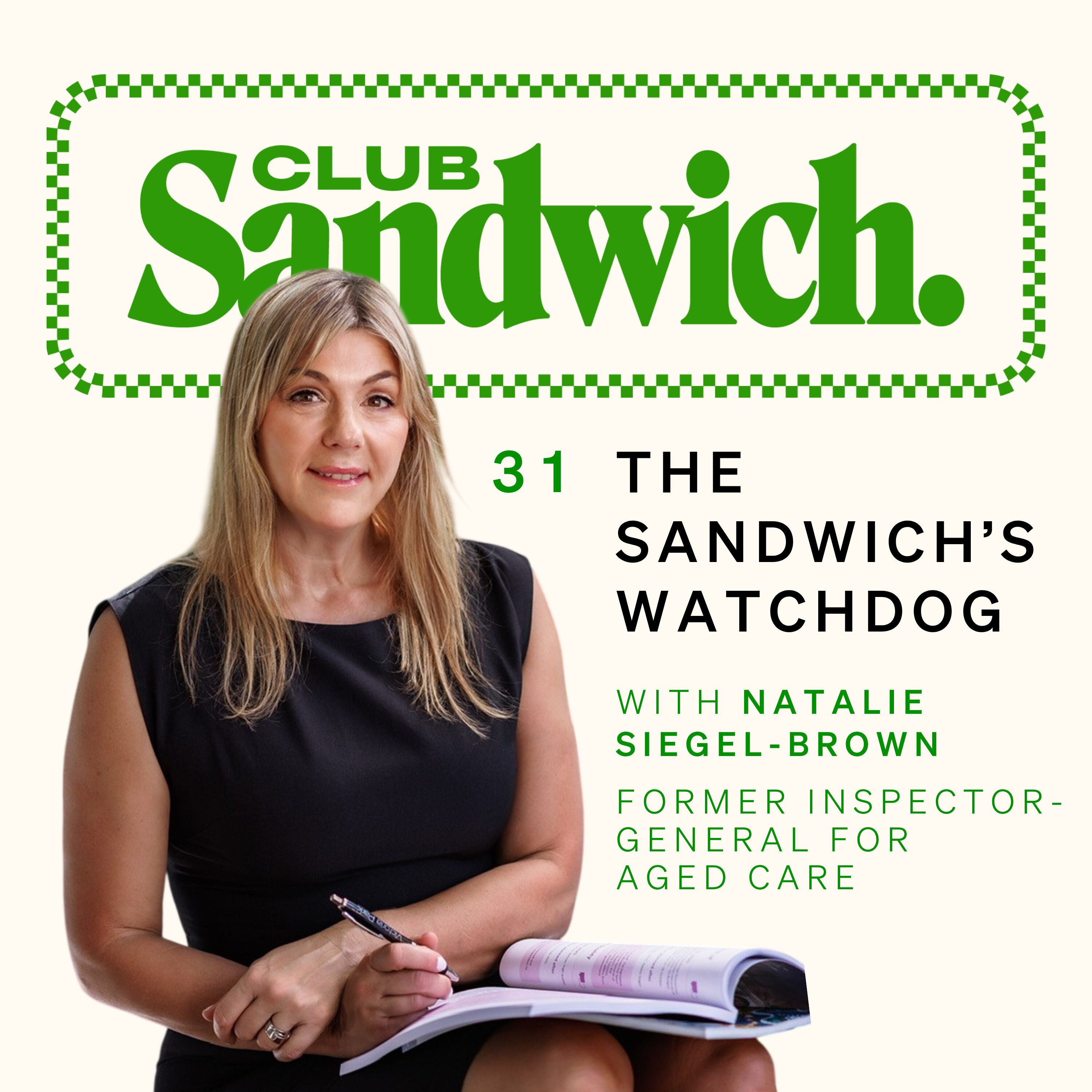
The person answering is Natalie Siegel-Brown, formerly Australia's Inspector-General of Aged Care, the independent Commonwealth office that holds the federal government to account for how aged care is funded, administered and regulated. She left, in her own words, because of the sandwich generation: an 11-year-old, ageing parents, and a statutory role she was trying to do four days a week alongside international work. She is now an adviser to UNICEF on child rights and youth justice law across the Pacific. Everything below is her assessment, given on Club Sandwich after she stepped out of the job.
It is not you, and it was not designed to break you
Sarah Macdonald asked the question most families arrive at eventually, usually at about the fourth phone call: is this system gaslighting us? Is it built to be so exhausting that we give up and pay for care ourselves? Natalie Siegel-Brown spent years with the evidence in front of her, and her answer is careful.
"I definitely have never seen any evidence that it was designed to alienate you. It can feel like that"
No design, then, and no malice. What there is instead, on her account, is a government that over-complicates and over-bureaucratises, and rarely has the appetite to stop and rethink the whole thing. That produces two specific places where families give up, and knowing which one you are standing in is genuinely useful.
The first is My Aged Care itself. Her office reviewed it and found it "incredibly onerous, hard to navigate", to the point where whether you reached the end of the process at all could come down to luck. Her summary of the feedback she heard over and over: "I've got a PhD and I still can't work out how to use this bloody thing". If that is where you are, the problem is the interface, not your competence.
The second comes later, and it is crueller, because you have already done the hard part. You get through the assessment, and then either the wait is so long or the co-payments are so high that the care is effectively out of reach. Families at that point often step back from the system. Natalie's point is that stepping back does not save anyone anything, including the government.
"Now you might think, oh, well, that works for the government, but it doesn't. It doesn't work for the government when people drop out of the system because those people don't leave the system. They come back months later, sicker, frailer and in a situation where they're far more desperate. And actually that costs a whole lot more."
Read that as permission, not as a scolding. The system does not forget you while you privately hold things together. Dropping out is the one move that reliably costs your family more later.
The wait is the crisis, not the thing before the crisis
Start with the money, because the money is the part that makes the wait indefensible on the government's own terms. Natalie's figures: keeping someone ageing well at home costs the taxpayer between $30,000 and $40,000 a year once their support is actually flowing. Residential aged care costs the taxpayer around $123,000 a year. As she puts it, "one cost three or four times the other".
Now add the wait. She describes average wait times of around a year for care. In the same conversation Sarah put the published picture to her, more than 100,000 people approved and waiting, roughly 98,000 more waiting just to be assessed, and averages approaching 300 days, and she did not dispute any of it.
The reason a year is not merely frustrating is who is in the queue.
"Let's not forget most people come to the assessment process in desperate need at that time. So if you're coming in desperation and you've got a year's wait, chances are decline will be quick."
Almost nobody starts this process early. People start it when something has already gone wrong, which means the queue is full of people who were at their limit on the day they joined it. Twelve months later they need considerably more than they were assessed for, and a proportion of them have gone past the point where home is still possible. In her phrase, "we're paying more money for accelerated decline".
She is blunt about what she suspects the wait is doing inside the budget. Her fear, she says, is that the 300 day waits are "being treated by government as a measure to manage a budget", when in the medium term and possibly sooner they "create a great deal of cost by making greater care costs".
A queue that saves money this year by producing more expensive people next year is not a saving. It is a deferral, and the deferral is paid for in your parent's mobility and in your own year. Meanwhile the notice of decision that starts your wait does not tell you how long the wait will be. Natalie has never heard the intention behind that silence stated openly; her guess is that the government is hoping the number will be smaller by the time yours comes up.
If you are in that gap now, our guide to staying home vs aged care covers what it takes to hold the line at home while you wait, and how to tell when home has stopped being safe.
Why an approved package can still arrive at 60%
This one confuses everybody, including people who work in the sector. You reach the front of the queue, the package is released, and it arrives funded at 60% of what your parent was assessed as needing.
The background, as Natalie explains it: after an inquiry into why the government was not releasing more aged care packages, it committed in late 2025 to releasing thousands more to keep up with demand. To make that commitment work financially, the packages released fastest attract an interim funding level of 60%, intended to rise to 100% once the money is available. When she last looked, that step-up was running at roughly eight to twelve weeks.
So it is temporary, and it is not a downgrade of your parent's assessment. It is also not harmless. Sixty per cent, as Natalie puts it, "will go some way, but the remaining 40% doesn't suddenly disappear out of your needs. You still urgently need those things. So decline will still occur when you don't have that 40%." The assessment said urgent. The funding says wait a bit longer.
Two practical moves follow. Ask your provider, in writing, when the package is expected to move to full funding, so the interim period has an end date you can hold someone to. And spend the 60% on the things that slow decline rather than spreading it thinly across everything on the care plan, because the eight to twelve weeks is when the missing 40% does its damage.
Why the co-payment feels like a punishment for being sick
Support at home has three limbs, and the co-payment works differently in each.
- Clinical care. The government pays in full, no co-payment.
- Independent living. A co-payment of roughly 5 to 15% of the cost of that care.
- Everyday living. Things like transport, or simply getting out into the community. This can be 50% of the cost.
One change is coming, and it matters: showering and wound dressing have sat outside the clinical category, so needing help with them attracted a co-payment. From October 2026 they move into clinical care and stop attracting one. Natalie was explicit that this had not happened yet at the time of recording, so if your parent is paying for showering now, that is the change to watch for.
Here is the design flaw underneath it. Aged care subsidies are means tested, which is a sound and well-proven principle. But means testing everywhere else in Australian policy caps what you pay at a proportion of your income. In Natalie's words: "the way it works in every other system is that you never pay more than a particular proportion of your income towards care. That's no longer the way it works."
Because the charge is attached to each type of care rather than to your parent's capacity to pay, two full pensioners on identical incomes pay very different amounts, and the sicker one pays more. Around 75% of people receiving support at home are full or part pensioners. Natalie works the arithmetic through as if she were one of them: the more items she needs, the more she pays, until she is handing over about $350 of a $600 weekly pension. Then the real decision arrives.
"Now if I have to decide whether I'm paying the electricity bill or turning on my air conditioning versus receiving care, what am I going to choose? And so what happens is the sickest and the frailest give up the care amongst our pensioners so they can pay the electricity and eat."
Sarah put to her the theory most families hold, that the squeezed middle carries the load while the wealthy buy what they need and the poorest are looked after. Natalie shares the instinct but has seen no hard evidence for it. What she calls her most standout observation from the whole oversight role, and the one the evidence keeps confirming, is the opposite end: the people with the least means are bearing the greatest impact. The people who cancel care are pensioners choosing between care and the electricity bill, and they are also the people least able to absorb the decline that follows. This is where adult children step in with their own money, and it is worth naming that as a systemic transfer rather than a private family choice.
The algorithm nobody can override
An algorithm sits inside the assessment process, and the original intention was modest and reasonable: help clinicians make a decision. That is not where it ended up.
"And where we've been at in aged care is that it's one of the few areas in Australia where clinicians do the data entry but don't make the final decision about care."
In most other areas of Australian health care, the clinician decides and human judgment is the last word, on the understanding that there are things no algorithm will ever pick up. In aged care, the assessor enters the data and the tool produces the answer. Numerous reviews have found it biased towards particular things, and it has never had clinical validation. Calls for it to be reviewed have been aired on ABC's Four Corners, and a researcher has reverse engineered it well enough to show where its decisions are going wrong.
A decision can be remitted for review at the department, and after the pressure built the government committed to reviewing the algorithm, funded that review, and committed to sending decisions a clinician disputes to another decision-maker. But the algorithm is still running, and the missing piece is still missing. Sending a disputed decision to a different decision-maker, Natalie notes, "is not the same as having a clinician able to critically assess the algorithm's decision and determine whether it's nonsensical or not".
What that means in a family's life is worth stating plainly, because it explains an outcome that otherwise looks impossible. Natalie recalls a case brought to her office by a provider. A man was receiving medication support at home for Parkinson's disease and was declining, so the provider helped him get reassessed. The reassessment halved his medication support. He spent months asking for another reassessment. He died the day before the process was due to start again.
She is careful about what that case does and does not prove, and so are we: it is one case, and reassessments that reduce support are now part of what the review has to examine. But it is the mechanism that matters. If a reassessment can cut support for someone who is visibly deteriorating, and no clinician can look at that output and call it wrong, then asking for help can leave your parent worse off than not asking. That is not a system a family can be expected to trust on instinct.
It has been done differently, including here
The useful thing about comparisons is not envy, it is proof that the outcome is a choice.
Denmark runs an aged care system with much the same ingredients as Australia's, home support plus a lighter entry-level program, and started from a different proposition: residential care cannot be everybody's destiny. So it front-loaded the support at home. It also removed the part Australian families find most demoralising, the need to notice decline, persuade your parent to admit it, and then reapply for a reassessment and wait. As Natalie describes it: "In Denmark, there are people constantly moving between the homes to ensure that people's decline hasn't accelerated, to keep an eye on whether the level of care is right".
Denmark's population is ageing at least as fast as ours. Its numbers in residential aged care have gone down, while the refrain here is that we could never build beds fast enough to keep up.
Singapore has had an ageing strategy running for 11 or 12 years, built on keeping older people living among younger ones, down to small government bonuses of five or ten dollars for a young person who collects a neighbour's medication on the way home from work. Trivial money, deliberately aimed at the thing no funding formula captures: that a great deal of care runs on love and ordinary neighbourliness, and none of it on obligation.
And then the one that undercuts every "we are not the Nordics" objection. Australia already runs a program like this, largely out of public view: the Veterans' Care Nursing Program, which despite the name is heavily built on social support in the community. A Sydney University researcher evaluated it. Australia has one of the longest average stays in residential aged care in the OECD, roughly two years. In this program, people stayed about 13 months, entering right at the end of life when they genuinely needed it, and the rate at which people entered residential care at all was roughly halved. They stayed for less time because they were able to live at home for longer.
Which brings her to the bottom line, and it is not the one you would expect from someone who spent years auditing the sector. She will not criticise the amount of money Australia spends on aged care, which she calls quite phenomenal. Her argument is about where it lands: front-load it into prevention, early intervention and support for carers, and "we could make it go a lot further".
"We have great intention legislated now in our new Aged Care act, but I think what we have is a fundamental design problem in the way we're administering that funding."
What you can actually do about it
None of the above is fixable by one family. These are the moves that follow from understanding the mechanics rather than blaming yourself for them.
Start before you need to. This is the single highest-value thing on the page, and it follows directly from the cost of the wait. If the queue is roughly a year, then joining it while your parent is stable buys you the one thing nobody in crisis has: time that is not spent declining. Start at My Aged Care now, before you need the outcome. Our guide to signs your parent needs help covers what "before you need to" actually looks like, and when your parent refuses help covers the conversation if they will not hear of it.
Do not drop out. Staying in the queue while you privately cover the gap is not a waste of effort. Leaving is what produces the version of this that costs your family most, and the system does not credit you for having coped.
Ask for a reassessment whenever things change, and say so in writing. Australia has no Danish nurse dropping in to notice decline for you. Noticing is your job here, and a reassessment starts only when someone asks. Get your parent's provider to support the request; providers can and do escalate.
Get the co-payment schedule itemised. Ask which items are being charged as everyday living at up to 50% and which sit in independent living at 5 to 15%. If your parent is paying a co-payment for showering or wound dressing, check that against the October 2026 change.
Use the free advocates, they are not a last resort. The Older Persons Advocacy Network (1800 700 600) is free, independent and will help you challenge an assessment or a provider decision, which is exactly the fight nobody should be having alone at 11pm. If the problem is a provider's conduct or quality of care, the Aged Care Quality and Safety Commission takes complaints, and complaints are part of how the evidence gets built.
Claim the support that is for you.Carer Gateway provides respite, counselling and peer support for family carers, free, and many sandwich carers never claim any of it because they do not think of themselves as carers. The system, as Natalie describes it, relies heavily on you while making no structural room for you at all.
Add your name to the count. Nobody publishes an honest figure for how many people are waiting for aged care funding, or how many die while they wait. FACES (Families for Aged Care Equity and Support) is a family-led campaign asking for exactly that one number.
Frequently asked questions
Why is aged care in Australia so hard to navigate?
Because the system was designed to regulate providers, and it is still administered that way, even though the law it now sits under promises something different: dignity, kindness and a life lived at home. Natalie Siegel-Brown, who held the federal government to account for aged care as its Inspector-General until she stepped down, puts it as a fundamental design problem in the way the funding is administered rather than a shortage of funding. Her office reviewed My Aged Care and found it incredibly onerous and hard to navigate, to the point where reaching the end of the process could come down to luck. She has never seen any evidence the system was designed to alienate families, but she accepts that it can feel that way.
How long is the wait for aged care at home in Australia?
As of September 2026, Natalie Siegel-Brown describes average wait times of around a year for care. In the same conversation the published picture was put to her as more than 100,000 people approved and waiting, roughly 98,000 more waiting to be assessed, and averages approaching 300 days, and she did not dispute it. Your notice of decision will not tell you how long your own wait will be. Her reading of the silence is that the government hopes the wait will have shortened by the time yours arrives. My Aged Care (myagedcare.gov.au) holds the current official figures.
Why did my parent only get 60% of their approved package?
After an inquiry into why more packages were not being released, the federal government committed in late 2025 to releasing thousands more. To meet that commitment financially, the packages released fastest carry an interim funding level of 60%, intended to rise to 100% within roughly eight to twelve weeks. As Natalie Siegel-Brown points out, the missing 40% of assessed need does not disappear while you wait for it, so decline can continue during the interim period. It is worth asking your provider in writing when the package steps up to full funding, and prioritising the assessed needs that hold decline back.
Why does aged care at home cost my parent more when they need more care?
Because the co-payment is charged per type of care rather than capped as a share of income. Clinical care is paid for in full by the government. Support with independent living attracts a co-payment of roughly 5 to 15% of the cost of that care. Everyday living, which includes things like transport and getting out into the community, can attract 50%. So the more kinds of help someone needs, the larger the share of their own income they pay, which is the reverse of how means testing works elsewhere in Australian policy. Around 75% of people receiving support at home are full or part pensioners. From October 2026, showering and wound dressing move into the clinical category and stop attracting a co-payment.
Can an aged care assessment decision be reviewed or overridden?
A decision can be remitted for review at the department, and the federal government has committed to sending contested decisions to another decision-maker. What does not yet exist is a clinical override: aged care is one of the few areas in Australia where clinicians do the data entry but do not make the final decision about care, so no clinician can look at the algorithm's output and rule it nonsensical. If you think your parent has been under-assessed, say so in writing, ask their provider to support a reassessment, and get free independent help from the Older Persons Advocacy Network (opan.org.au, 1800 700 600) rather than arguing it alone.
What should I do if we cannot afford the wait or the co-payments?
Do not quietly drop out, which is what the system makes easiest and what costs your family most. Natalie Siegel-Brown's observation from inside the oversight role is that people who give up do not leave the system, they come back months later sicker and frailer. Ask for a reassessment whenever your parent's needs change, get the co-payment schedule itemised so you can see which items are charged at 50%, take free advocacy help from OPAN (1800 700 600), and use the Aged Care Quality and Safety Commission if a provider is the problem. Carer Gateway (carergateway.gov.au) covers respite and support for you, which is the part families forget to claim.
Where to next
Understanding why the system behaves this way is most useful next to the decisions it forces on you. These guides sit closest to this one, or you can listen to the full conversation with Natalie Siegel-Brown.