
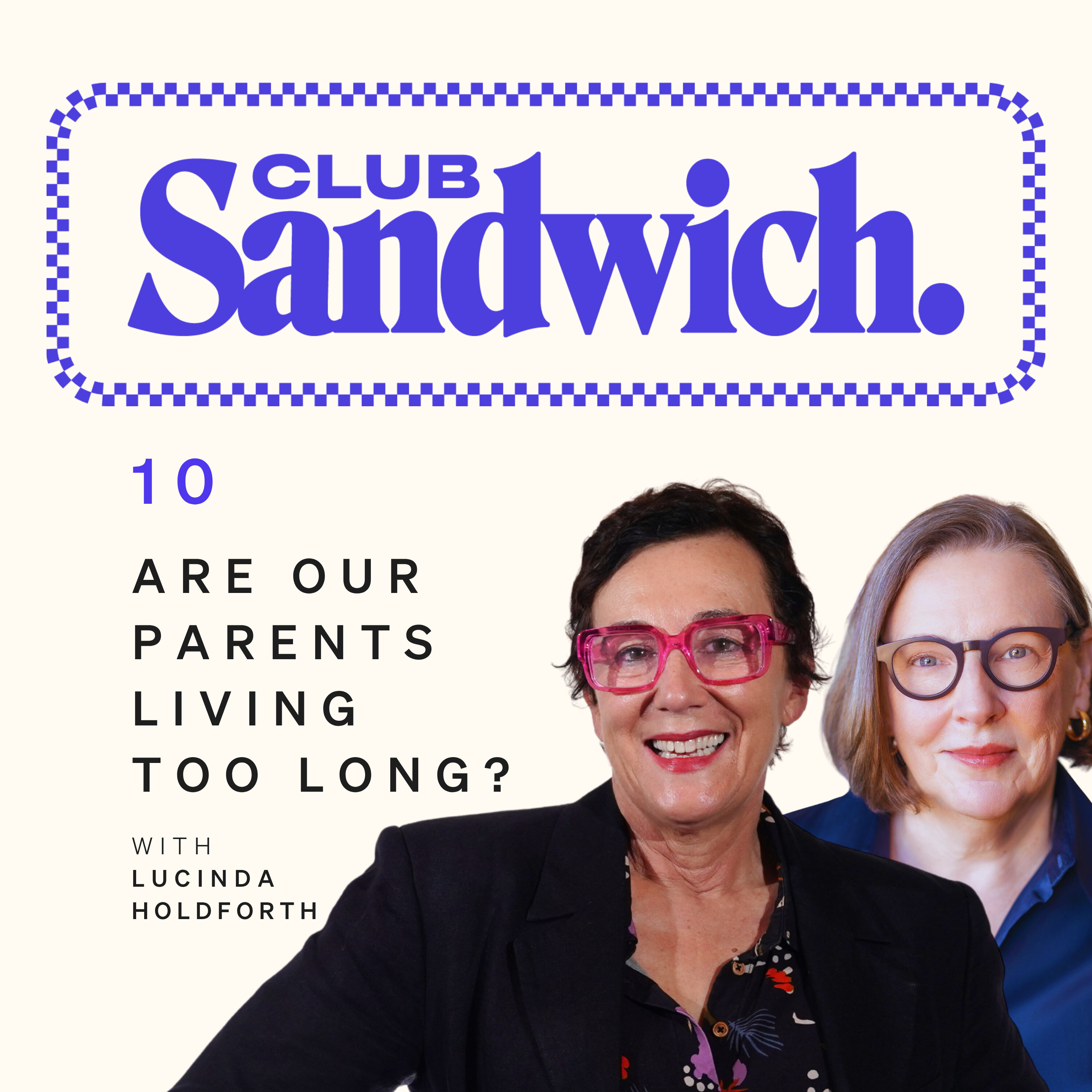
Are Our Parents Living Too Long? Lucinda Holdforth on frailty, dementia and dying well | Club Sandwich
Are your parents living longer, but not necessarily living well? In this episode, Sarah Macdonald talks with author Lucinda Holdforth about the private thoughts many carers have but rarely say out loud: what happens when old age stretches on, frailty deepens, dementia changes the person you love, and the caring role starts to swallow your own life.
Ageing parents? You’ve got them. We’ve got you.
Join / contact
JOIN THE CLUB: Visit clubsandwich.community to join the tribe, access resources, and find our private Facebook community.
SEND US YOUR QUESTION: hello@clubsandwich.community
In this episode
The Conversation: Sarah Macdonald and Lucinda Holdforth unpack the emotional, practical and political reality of longer lives: dementia, chronic illness, caregiving overload, driving, advance care directives, assisted dying, and the urgent need to move from life at all costs to live well and die well.
This Week’s Hack:
Do the advance care directive early, but do not stop there. Make sure your family knows what it says, where it is, and how it will actually follow your parent into hospital or aged care when a crisis hits.
Listener Letter:
This episode speaks directly to the clubber who loves their parent deeply but is quietly wondering how much longer they can keep doing this, or who has heard Mum or Dad say “I’m done” and had no idea what to say next.
Hot Mess Moment:
Your parent is back in hospital after another fall. You are exhausted, scared, trying to make sense of medical language, and having the thought you feel ashamed to say out loud: are we helping them live, or just helping them go on?
Topics covered in this episode
- why Australians are living longer and what that means for families
- the 12-year burden of chronic illness and disability
- dementia, frailty and the long goodbye
- the emotional toll of years of caregiving
- the administrative burden of advocating for ageing parents
- when driving becomes dangerous and taking the keys feels impossible
- ageism versus the structural tilt of wealth and policy
- whether sandwich generation women ever get to “live their own life”
- assisted dying, a “completed life”, and end-of-life choice
- why advance care directives often fail in practice
- how hospitals default to treatment and intervention
- the case for moving from “life at all costs” to “live well and die well”
Sponsored by:
This episode was supported by Australian Unity, home health and care services. Proactive local care that helps your parents live well at home, less stress for them, less worry for you, and more time for the good stuff. Visit australianunity.com.au/clubsandwich.
Need more clarity at 3 AM? Vera gives you a structured 15-minute voice conversation to help you understand where your parent stands and what to do next. Find it in the show notes or at vera.guide.
Credits
Club Sandwich is brought to you by Vera.guide, helping families caring for ageing parents navigate this stage of life so you do not have to do it alone.
Sarah Macdonald - Host + Executive Producer
Melissa Reader - Commissioning Editor, Executive Producer + Clubber
Rachel Fountain - Executive Producer
Audio + video edits by Fountain Media Group
Thanks and kudos to Sean Wayland for our awesome theme music Club Sandwich - hear more from Sean at seanwayland.com
See omnystudio.com/listener for privacy information.
Transcript
Club Sandwich is recorded on Gadigal Land, home of the EORA Nation. We pay our respects to elders past and present. Always was, always will be.
Club Sandwich is brought to you by Australian Unity's Home Health and Care, helping Australian families support their parents to stay well, active and living at home for longer. Visit australianunity.comauclubsandwich. Hello. Welcome to Club Sandwich. Now, this is a podcast for you. If you're in the middle of your life, but you're not middle of the road, you are still cool, for sure. Yep. Just ignore those young people who say you're not. My name is Sarah McDonald. I'm in that sandwich generation, caring for an elderly parent. I've been doing this for more than 12 years, which is the average time today. A bit of a provocative episode, but one that hopes to address some whispering, I think, in our hearts and our homes. Are we living too long? How long is too long? And what is quality of life when you are old and frail? I've got to tell you that over the last few years, I've had people in their 90s say to me, and I quote, how do you die? I think I'm done. We shouldn't be here this long. And when I've heard them, I honestly don't know what to say. But usually I just say, well, what do you mean by that? Why do you feel like that? And it's confronting. And I really wonder sometimes about what they're saying. I've also had messages from clubbers who have been caring for more than a decade saying, I'm just not coping with seeing my parents so frail. They're a shell of who they were. And I just can't keep doing this. Lucinda Holdforth is a special guest on Club Sandwich today, and she is not holding back on this conversation. She is leaning right into it. She's written a book called Going on and why Our Longevity Threatens the Future. Now, Lucinda's been a speechwriter. She's written about women who have shaped the culture of Paris. She's written about manners. She's written about leadership. She's written democracy. And now she's taking on old age. Hello, Lucinda.
Hello.
You're a brave woman.
I am a brave woman. One reason is because both my parents have died. I could only write this book because they're not with me anymore.
Yeah.
Wow.
Isn't that amazing?
Yes. Well, that's so true, because it is going to be, I think, confronting to some people. Do you think it would have hurt them, this book?
I could not have written it. While they were alive. There's no question why, because it would have hurt them. It would have seemed too personal. I think that's the main thing. They're a generation that cherish their privacy, and I invade their privacy somewhat. And even though it's enormously loving about them, it's also very honest about those complex feelings we all have when we're caring for our parents and trying to live our lives as well. So, yeah, I couldn't do that. And in fact, I realized just today that after mum died in 2022, this is my second book. This is my second book since then. So my sense of creative liberty, my sense of my personhood and capability has just expanded enormously because they're no longer with me. And that's just. That's my experience as well as missing them, feeling guilty, feeling love, feeling kind of joy, remembering things, good things. So it's a big mix up of stuff.
That's the thing. I want to get to your parents, but you've already attracted big attention for this book. What are people saying to you? You're getting big reaction and lots of messages, aren't you?
I am. There was an excerpt in the Guardian, and that was specifically about this question of caring for your parents and the toll that it takes on you, even if you love them. And I wrote very honestly, I tried to write very honestly about my own feelings about it and to say truthfully that my life is better because they're no longer with me. And I got such. I was shocked. You know, I've received messages from Hamburg and from London and from America, from women, saying, you are describing my life. Literally, you are describing my Life. And I'm 52 and I feel like this is my last chance and I'm not going to have that chance because I think my mother could live for another 15 years.
Chance for what? To live. To live.
To live my life. And the line that I wrote in the book, and it was really picked up everywhere, was in the book I wrote at 59, I was at last an orphan. And so many women wrote and said, I would like to be an orphan because I'm too. This is too long to wait for. For that transition. And, you know, part of my book is around this question of generational change and handover. And I think it's very hard for us to grow up properly as long as our parents are alive. We're always children for that period.
And yet our parents are living.
Our parents are living for a lot longer.
And look, this is exactly why we started this Podcast because we are a unique generation. Our parents are living for a lot longer than parents have before. You know, I was just reading Jane Eyre and everybody was old when they were 40. More than doubled our lifespan.
That's absolutely right. I mean, yes, I've looked at. And not just that this longevity trend is only going to continue. I looked into that, you know, I was trying to figure out what it was. And in Australia, our longevity is due to a number of things. After the Second World War, so in 1968, you know, someone would probably live till 70 people retired and died a minute later, basically. So what happened to make this longevity phenomenon happen? And it was peace and prosperity. First of all, you're not sending young men off to war. But also medical health, medical science, enormous advances underway that have happened and that are still happening in genetics in all kinds of areas and public health. So when I watched RFK Jr getting rid of vaccinations and things in America, I think you are crazy. All of us grew up with a whole public, public health environment, with Medicare, the greatest health system in the world. So we Australians are all in the top 10 in the world for longevity easily now. And my parents were born in 1929 and 1932 and they wouldn't have expected to live till 80 in a fit and they both live till 90.
Yeah, and that's the thing. It's a much longer period of being frail and unwell while they're children, are in their 50s and are working more as having full time jobs and maybe have had kids later, which we talk about on the pod all the time. This sort of crash of cultures and generations that's happening at this point in our history as the first boomers turn 80.
Well, the other factor was when you think, oh, well, we were in, you know, the top 10 of the world for longevity. And that sounds fantastic. You know, it's a national achievement at one level. And then you discover that 1 in 12 Australians over the age of 65 has dementia and that we are second only to the US for that number of years spent with chronic disease and disability, which is an average of 12 years. 12 years. And that's where the sandwiched generation of women come in. That's an enormously long time, whether it's falls, you know, those intermittent falls, whether it's cancers that cured dad. I've got a list in the book that goes on for sort of half a page of things that my father had. He had water on the brain, he had various kinds of cancer, he had falls. And our medical the irony is our medical system is so good, it can keep people alive far longer than once would have happened. And there's also a culture in our medical. In medical circles still of life at any cost. Not living well and dying well.
Okay, well, let's talk about your parents. Because I could argue, look, 80 is the new 70. 70 is the new 60. 60 is the new 50. And we are. We're staying young. For although we all want to live forever, but we none of us want to get old, you say, and that's so true, and we fight it so much. But perhaps we'll get to that because this really came home to you with your parents. So your dad was unwell for a long time.
Yes, he was the first one to sort of. You see the big steep decline. So, look, it's the same story that all of your club will know. You know, we were living. I had the peak of my career responsibilities, and I'm the breadwinner, various work things. And then dad would have some kind of medical incident. We'd have to drive from inner city Sydney to Avalon in the Northern beaches. Mum, very soon after dad got frail, wouldn't ring an ambulance herself. So what would happen is I would get a call and she'd say, hello, darling. And I'd say, hi, Mum, what's happening? And she'd say, your father's in the bathroom. I said, okay, how's that? And she said, well, I don't know. Cause he's on the floor. And I said, have you. Can you go in and just see if? He said. She said, well, I can't because his head's in the door. I said, okay, Mum, let's hang up and I'll ring the ambulance. And then of course, we had to rocket up to the hospital then to go and get Mum and then come back. That's just one example. There will be so many others. And it's stressful and you feel sick and you feel inadequate because you can't navigate the system well, your heart's just
beating a million miles an hour.
You're so stressed. And we've all been there.
We're all doing it.
You're all there. And then I think the other part of it with Mum and Dad was finally we found. So my brother, my husband and I went around trying to find a nice aged care facility near us so we could be there for them. And of course, they hated it as soon as they moved in. But the other part of it all was that just enormous administrative burden. So they were there, but your Job as an advocate, as a kind of bureaucrat for the. You know, all the paperwork continued. And then, of course, you're trying to be loving and caring and just spend time. Spend pleasant time.
And not just the bureaucrat shuffling pages. Yes. Not just cleaning up.
Yeah. Not just bossing.
Trying to be the child.
Yeah. And the love sort of friend, especially as I was with my mother. So when you're in that, it feels as though it will never end. It did feel like that to me, and it wasn't even that hard. You know, I don't have kids, so I had it easy. Compared to many of the women that are listening to you now.
Yeah, but you had a big job. This is the thing. A lot of women don't have a big job now, but they have big jobs and big responsibilities.
And, you know, the other thing I was thinking about was it's not just about whether you have a big job or a small job. In fact, that's kind of the least of it. It's just the having your own private life. You're having your own life to yourself. It's hard to explain, but it was definitely for me, this feeling that I could never really just explore who I was fully, fully, independently, whilst I was responsible for them. It sounds strange, I know, and I didn't exactly know it at the time of those final few terrible years, but afterwards I was like, oh, it's not just that I can work hard or I can write another book. It's that I can somehow express myself fully in a way that I hadn't before.
That's interesting. I mean, that's you. It might not be other people.
It might well not be other people. Right.
But people are gonna say to you, people have been doing this for years. Our parents looked after their parents, their parents looked after their parents, and their parents looked after their parents. But it is different. Now is the length of the time, as we've established. It goes on for longer. And the needs.
Yes. And it's multifarious, you know, ailments and illnesses and issues. And I think it's very much complicated by this modern scourge of dementia. And I don't. I still haven't found anyone that's explained to me why we have this epidemic. It seems.
Well, because we're living longer. It's one thing we haven't been able. We can make bones stronger, we can treat cancer, we can do all these things, but we haven't found the cure for dementia. And dementia's. You know, we're gonna do a whole Couple of episodes on this. But it is a particular power of grief, of watching someone you love just fade away in front of you.
Fade away, or in my father's case, become aggro, paranoid. So, you know, and yeah, I think that's. That makes it so difficult and I think it makes. What it really made me think is how sometimes I have flashbacks and it's so harrowing, actually. A flashback of dad accusing my husband of trying to steal his car. And I don't want to remember him like that. I want to remember my other actually delightfully good natured, cheerful, beautiful father. But it really makes me think I don't want to be. If that happens to me, I don't want to be remembered like that. And I would like to have the choice not to be remembered.
It's trauma, basically, about his dementia and about what happened to him and witnessing that, trying to navigate that, trying to navigate it.
And of course, when you've got your spouse who's trying to. Is doing his absolute best, as so many men are, that's also very confronting and it just adds another layer of stress on the whole sort of situation. It's different with my mother and she was very peaceful and she was really ready to go at the end and, you know, that was quite a different experience and a very loving experience. In her final days,
there's a call that every sandwich generation daughter dreads. It's the one where dad can't explain what has just happened and Mum sounds different, or you can't put your finger on why and suddenly you're googling aged care at 11pm Wondering how you missed it. Australian unity home health and care is the thing you set up. Before that call comes a local care team, a dedicated person who actually knows your parent. A plan that moves with them, proactive, not panic. And that's the difference. Visit australianunity.comauclubsandwich. You're not traumatised by that?
No.
Yeah, That's a terrible generalisation. But I feel a lot of men fight their decline much more than women.
They rage against the dying of the light, don't they? They really do.
Because you've had that power and that
status more or I don't know. But it's. With dad, it was the car. It was so weird. Oh, my God, the car, the car. And, you know, in the end, we've got a system now which is very anxious about ageism. And so dad was driving for years longer than he should have been. And honestly, he would go on the road and we'd Think, oh, please, God, let him not have killed anyone or crashed into the front of a chemist's.
That's so strange.
And I know other people that have that too. I even know of one guy who rang and dobbed his father into the police because he was so worried. And that's because we have a very strong anti ageism culture. And the way it works isn't that your driver's license is taken off you automatically at a certain age, but that you can perhaps apply to have it back.
You have to do tests.
You do have to do tests. But dad did several tests that he should not have passed.
Look, we're going to do a whole episode on this and we've heard there's one guy who passes everyone, like the driving test for the peas. And all these sort of rumours abound and it is a really hard one because you always think as a child, what if they kill someone? I'll never forgive myself. But if I take that car away, being awful, I'm taking away their rights.
Absolutely.
And it's a really tricky one. I once talked about this on the radio and oh my gosh, people got so angry and upset at me. But we have to keep people safe. And they were like, well, P platers are more dangerous and you let them drive. So they have tests as well. So I think there needs to be the testing. But they can also go in a certain radius. And then I know one guy who's going outside his radius cause he's got dementia and he's forgotten he has a radius.
Yeah, yeah. And there's. I know there is that argument about P platers, but there is a point at which common sense and social benefit has to override. You know, I do think it should be that the licenses are taken away and then can people apply? Because I think for driving instructors and testers, it's much harder to say, look, you're not going to get back in, than it is to say you're stopped from driving. That's a psychological, human thing. So I think that's much easier. And if we were to start looking at young people, I mean, who are the dangerous drivers? They're young men, it's not young women. So we're discriminating there against young women drivers, in fact, who may be perfectly fine on the road. So we make discrimination all the time in the sense of trying to look at what the broader public good is and public safety.
I think some of the times, though, if you take out in your book old age and put in disability people there would Be an outcry. So you argue that there's too much of a focus on ageism. I think there's so much age. Ageism. I think it's the most accepted form of discrimination. Oh, you silly old bag. We're seen as old. We're dismissed as being middle age. Young people who. So aware of racism and sexism and everything else.
Yeah, I would say that that may be a very legitimate perception. But the reality is our entire economy is now skewed to old people and wealthy people who are the same people. So I grew up. Maybe you did too. Free university. You could rent a house. We could buy a house. We have now an entire society skewed to the benefit of old people. That is the broader structural discrimination.
Because they've got their houses.
Yes, because they have home ownership. Because things like superannuation, subsidies. I'll tell you the other figure. It's not just in the. There's the tax system is one area. I think the government has talked about an intergenerational lens and I think they are going to make some moves. But 40% of future additional spending by the government over the years till 2063 is going to go on aging. So that's aged care, end of life care, pensions, all of that. So you have an entire society now that is a massive burden. And when you think about that, when I did an interview the other day, someone rang up and said, well, you know, you're very rude about old people and you know, what about all the childcare we do for free? And I saw an article the other day talking about that. But that ignores the fact that for older people, their alternative is leisure. For younger people, they are on, they are struggling along. There isn't enough affordable childcare. So that money that's going to prop up older Australians is not going to things like childcare and those other services for women, education and so on.
Well, I think in a good society we should be able to do both. I mean, I think everybody worries about the next generation. Will my children or nieces or nephews, if you don't have kids, be able to afford a home? I think we do worry about them. I think there is a bit of intergenerational theft. But at the same time, if people are strong and living a good life, that is their right and it is their right to be looked after. If they've paid taxes all their life.
Of course, absolutely. And there's no argument about that. And that's why that enormous amount of government expenditure is going to go on. That the Question for me as an individual is, do I want to hang on and on.
Yeah. Well, I was gonna ask you so for you. Cause you've had your own health challenges, haven't you?
I have.
You're in your 60s now.
I'm 63.
You know, you just got that free education.
I got the free education and other things like government departments would have internships. You know, big, big cohorts of young people would come to Canberra. I went to Canberra. The ABC would. Had all those things. It was just a much more graduated, beautiful system for getting young people to the next level. And I know so many women in this generation whose kids sort of finish university and then they're on their own and they're working at Dan Murphy's with some amazing degree because there's no kind of system for that. So, yeah, I think we were really lucky. And a period of prosperity and when we got jobs, we got jobs that had, you know, benefits, not just gig economy.
I think there's greater forces at work, though, than an aging population. It's not so AI and all of that sort of stuff.
There is, exactly. And of course, of course, I, you know, as an older woman, I'm certainly not promoting ageism. I'm simply saying, let's get it into perspective.
Okay. So for you, you're in your 60s.
Yep.
You've had some health challenges yourself. Right. And so you are thankful for this fabulous medical system that is keeping people going into their 90s and now hundreds. What do you see as like, how does it kind of, you know, when your parents died, were you unwell before that? Or when did you have your health challenges compared to when they were living? Because this must have informed. You were thinking, when do I get to really live? Because I think it's a great fear of the sandwich generation is will I get to live after my parents have died? Yes. Or will I get unwell?
Yes. Interesting. So, in fact, my health has been very good for years. So I had triple negative breast cancer in 2000, so I was 45.
So your parents were still around?
Yeah, they were around and then. And. And really they didn't have that much to do with me at that time. So they weren't caring for me. I was sort of managing myself with my husband and friends and so on and living in the city and they were living outside.
Thank God that didn't happen when they were frail.
And oh, gosh, for women that are going through their own health problems as well, what a nightmare.
It's a nightmare.
It's a nightmare.
There's another episode ahead.
And then some years later I developed a serious heart condition. So I've had two stents put in my heart and people theory, the doctors said they thought it could have been because of the damage the chemo did to my heart because it was very severe. And yeah, and then I had. That was all very hard and painful and trying to earn a living and work and trying to write and, you know, just exactly what every other woman is like trying to express myself and have my own life and do all the other stuff. So it was hard, but I was lucky. You know, I have good health now and as you say, I am absolutely a product of a first class medical system and I did it all on Medicare. I didn't have private health.
So now that you've had that brush with mortality yourself, how does it make you feel about old age and how long you want to live? Because you must have asked your questions to yourself as you were writing this.
Yes, I did. And it's very simple for me, which is I would like to, I think there should be medically assisted dying available for people and I wouldn't want to say what age exactly, but I think there should be a recognition that once you near the end of your, once you're 80, medical assistant dying isn't the sort of scary, you know, dangerous phenomenon that it is when someone's 25. You know, it's your. Towards the end of your life. People talk about it, there's a lot of work being done, people talking about a completed life and when you feel that you've completed your life and for some people, that my father would have lived forever if he could. My mother was done, she was ready to go and I think she hated being in that state and I think that was a very sad few years for her. And for me, I think I'll be one of those people that thinks, gosh, if I've got, especially if I've got dementia and there's really no mechanism now because once you've got dementia you can't ask, you're not allowed to make the decision and that's just got to change.
Yeah, I mean, people make jokes about it like, oh, I'm gonna, you know, do this and you know, it's sort of this black humour about it. But I think it also, when you get to that old age, something kicks in. It's this mechanism to stay alive and to fight it and to. It's scary. And so I understand that as well,
you know, but it's not everyone that has that. So there's a great guy called Daniel Kahneman, a very eminent American intellectual. He wrote that book thinking fast and slow. And he'd nursed his wife, who' had dementia, Alzheimer's, in fact, for years. And it was obviously extremely loving for him and harrowing for him. And when he turned 90, to the shock and amazement of all his friends, he just caught a plane to Switzerland and went to one of those clinics and he said, you know, I've had my life, I'm ready to go. And the interesting thing is he also came up with this notion called peak end experience, which means that we often judge the value of an experience by how it ends. And when I think about the shape of my life, I've been enormously lucky if I think about the shape of my life. For me, I don't want people to remember me in a completely debilitated state at the end. So for me, I think I would. I may not. If it was an option. I'd love to have the option, though, because I think you become so powerless in those final years. It's so lonely and you're so powerless that if you knew that if you really needed it and wanted it, you had the option to leave, to give up your life, I think that would make a lot of people actually feel better. And I suspect most people wouldn't use it. And that's probably me.
Yes. That's what happens, I think, with people who have a terminal illness. Just knowing they have that option, a voluntary sister dying, gives them great comfort with that total existential angst that they feel.
And the powerlessness is so awful when you've run your whole life and modern living, we are also responsible for a million things. We have choice, we're expected to take charge. And yet at this end of your life, you're suddenly kind of at the mercy of a medical system which is very benevolent in one way, but highly controlling and interventionist in another.
Yeah, well, there's often so much done in the last years of a person's life, and I think the doctors often will compartmentalise the person, won't they? They won't see the whole person. So their job is to fix to. And that's what kind of happened with your dad. You had to bring up the D word with your dad's doctor.
I did. I had to. Well, this was very interesting because I know that there's efforts made to address this problem of what happens to older Australians, and one of them is the advance care directive. And so what a great idea. We Filled out those forms. Mum and dad had them both. Mum and dad separately were in their aged care home and fell over. And on each occasion they went to hospital. I rushed to the hospital and there's no advance care directive with them. The doctors are there ready to. There was no mention of an advance. Of course I was beside myself, so I didn't even mention it. It was only later I thought, what happened to the advance care director?
Yeah. Cause you can't think straight in that moment.
You can't.
You should have gone to the hospital. No.
And you feel like, you feel. Yeah, you're devastated. And in the case of dad, it was quite clear he'd had a fall. It was his head, he was so frail. And I, and I, you know, I think at one point I said, is he, in fact maybe it was with mum. And I said, is she going to die? And he just looked at me like I just said something so terrible and wrong.
And I must have looked at you like that. Yeah, he flinched.
Flinched.
And he's a doctor. And he's a doctor and he's with an old. And then he said, 90 something year old.
Yeah, 90. And he said to me in this very stern, teacherly way, well, it is an end of life event. It's like, oh, okay, if I'd said end of life event, would that have been okay?
Sanitizing, desanitising.
And especially with my mother, who was plain spoken, you know, she would have hated that. You know, there's an old English word, can't, which means just that kind of, you know, euphemistic language. And you think, I don't need that from a doctor. I think, I don't think my mother deserved that either. Yeah.
Yes. Well, I think, I think a lot of old people are worried about this and they worry about the system really treating them and over treating them. And yet when you get on that kind of conveyor belt, I think a lot of people in the profession call it, there's this conveyor belt of care and you have to find the person in the hospital who says you can tell them to stop. And it's very hard because you're stressed, you're anxious, you're crying, you're devastated, you don't think straight.
No.
And very imprecise.
Imprecise. And it's especially the case, I think, because, well, certainly my parents generation were brought up doctors were gods. When doctors said, you know, you do this, you don't say no.
A lot of them are fabulous, a
lot of them are fantastic. They think that and when I was going through my health things, I mean, once you're in it, I agree with you. It is like a conveyor belt and you feel. You become quite passive because you feel very much in their hands and you also. You want them to like you. You don't want to question. You know, there's a whole relationship that's complex in that, and certainly with Mum and Dad and they were passive and they would just do what the doctor told them. But what I think's different for us is, well, why can't we have more agency in this process for ourselves?
So what is the answer then, do you think? Because there's other bits I totally agree with. Where was it really Barack obama who said 80% of the world's problems are caused by old men who won't let go of their power? Yes. Yeah, something like that.
He said that in 2020, 80% of the world's problems are caused by. By old men hanging on, fearing death and insignificance, and they won't let go. Hello. Look at the world, Right?
It's so true.
Look at the world. It's just horrifying.
Hashtag notallmen. But yes, you can think of. You know, we know who we're talking about now, don't we?
Really?
We do.
Really. Well, there's a few. There's Putin presidency, Benjamin Netanyahu in Israel. He's 74. They're all in their 70s. Trump, obviously, is the uber example of this. Now, fear of death.
Fear of death. Everything comes back to fear of death.
Or.
Yes. Or insignificance, as you said.
Yeah, as Barack Obama said, insignificance. I thought that was really interesting, actually. Power. I think the notion of relinquishing power is very difficult because those guys.
Yeah. And the whole problem is, I think we are aware that you can't discriminate, but you have to have people who are able and what is going on for them. But look, that's a whole other conversation. I guess what I think is important to finish off with, though, is what is the answer? You're not advocating Logan's Run kind of thing?
No, not at all.
But where are the steps we can take with this? Is it more about the conversation, about people really thinking about this, thinking much harder and deeper and facing that ultimate denial, which is the end?
I think there's a couple of things. I think the first thing is, you know, brilliant doctors like Dr. Atul Gawande, and in. In Australia, there are some really good doctors as well, talking about, let's move away from life at all costs, because the medical system can keep you alive indefinitely and move to an ethos of live well and die well too. And I think that's the gap. That's the big gap for me. With my parents, I felt as though the medical profession had sort of just turned into this conveyor. The conveyor belt service over just massively servicing. And I think, I don't think we're going to get that conversation against unless people like you lead this conversation, actually, because we'll just continue on as we are. So the first thing is have that conversation. The medical profession in its kind of entirety, the health system needs to kind of focus on this as well. I think we do need. I think we're going to have to look at some of these other issues around choice. But as it's true, I'm not here to be an activist or a crusader. I'm just here and I deliberately wrote this book in a way that was provocative and that was very truthful and honest. I thought, well, I can say things that other women particularly can't say, and that's something useful I can do. And when you look at all the data and all the statistics and where this is going, it's an economic necessity, it's a social necessity, and it's about a compassionate but honest society looking at our challenges with a clear mind and making decisions about the way ahead.
Yeah, well, there's lots of work to be done because as the baby boomers start getting into their 80s, there's not gonna be the beds for them. We're gonna have to do the hospital system better and we're gonna have to have a lot of really important and big conversations. So thank you for taking part in one today with us here at Club Sandwich.
Thanks so much, Sarah.
Please share this episode with a friend who you really talk to about this stuff. There must be one or two, right? These small, quiet conversations. We'd love to hear from you as well. You can email us@hellolubsandwich.community and please follow us at YouTube, Apple, wherever you get your podcasts. And we do have Club Sandwich events from time to time, so check out our website, clubsandwich.community and follow us on Instagram and Facebook too. And remember, we know what you're doing. You don't have to navigate this alone. You're doing a great job. And while you've got them, we've got you. Today's episode was supported by Australian Unity Home Health and Care Services. It's more than just a helping hand. It's care that adapts as needs change, helping your parents live healthier, happier and at home for longer. Search for australianunity.com auclubsandwich.
Club Sandwich is brought to you by Vera hey, here's what no one says out loud. The call always comes as a shock, even when you knew somewhere deep down that that call was coming. A fall, a diagnosis, a moment that changes everything. I'm Melissa Reeder, co founder of Vera and I've spent the last decade working with families as they care for their loved ones in the later seasons of life. You know the hardest part, the thing I've heard the most? It's that quiet fear that people recognise they should have been more prepared. And when your parent turns 75, it's not a number, it's actually a window. Vera 75 is a free 15 minute AI phone conversation and it's designed to help you understand where your parent really is in their journey of ageing and what to do next. You can take the call anytime, whenever it suits you, on a walk in the car, at the end of the day, when you can finally let out a big breath. Vera is a candid companion that you can turn to wherever, whenever, because the best decisions are never made in a crisis. Have a look today. Vera Guide.