
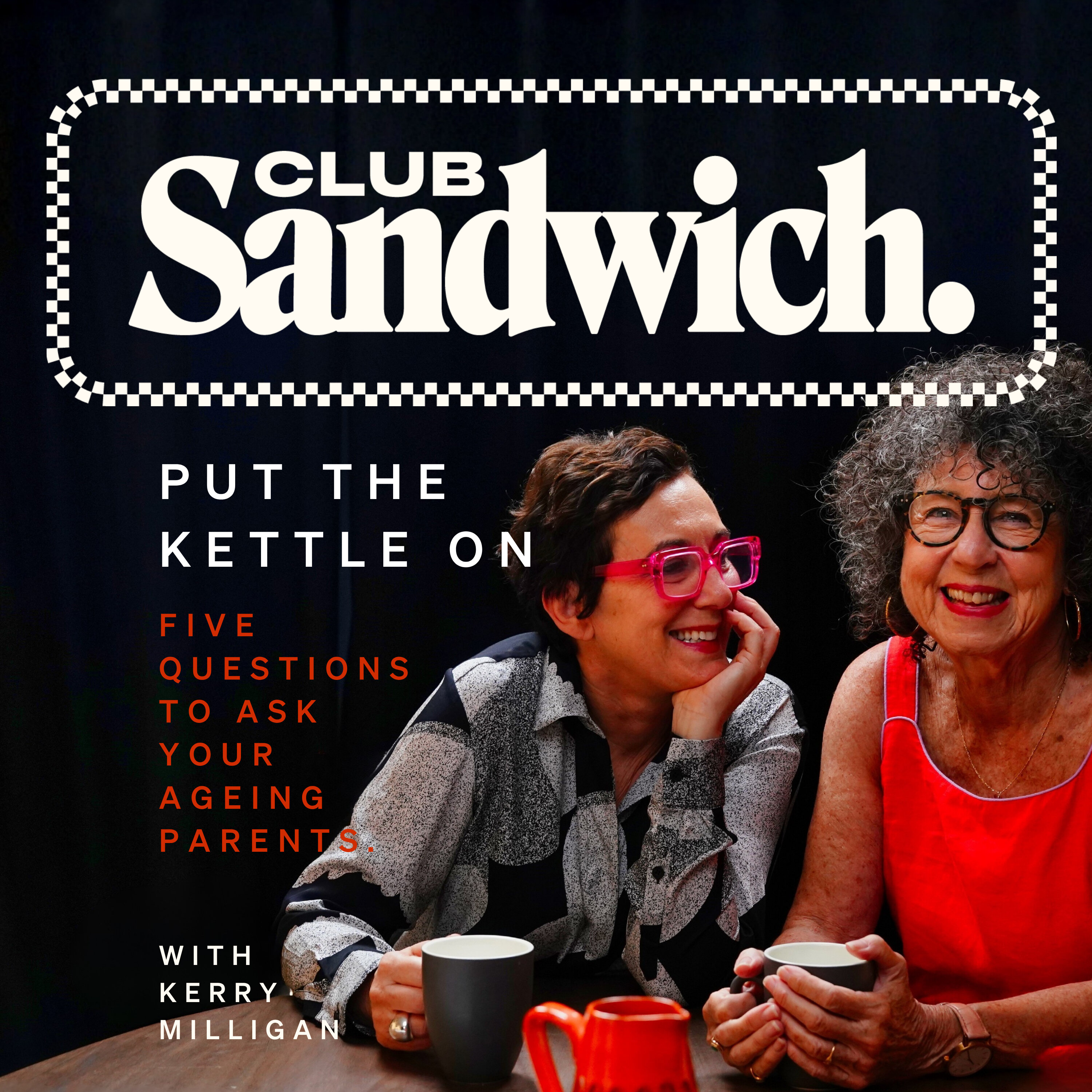
Put The Kettle On | Five Questions To Ask Your Ageing Parents | Kerry Milligan and Jo Lamble | Club Sandwich
86% of us never have this conversation with our ageing parents. So we built you a way in. Free guide at https://putthekettleon.com.au — and a podcast episode to walk you through it. Ageing parents? You've got them. We've got you.
JOIN THE CLUB: Visit https://clubsandwich.community to join the tribe, access resources, and find our private Facebook community.
SEND US YOUR QUESTION: hello@clubsandwich.community
In this episode:
The Conversation: Sarah Macdonald and Kerry Milligan model the five Put The Kettle On questions live — what makes a good day, what independence looks like, who can help with decisions, the life-matters stuff (will, advance care directive, power of attorney, enduring guardianship), and the story you'd want remembered. Then clinical psychologist Jo Lamble debriefs the conversation — where Sarah pushed too hard, where Kerry blanched, and how to keep it a kindness instead of an interrogation when you do it at home.
This Week's Hack: Start with the good. "Tell me what a good day looks like for you." Don't open with the will, the aged-care plan, or what they want at the funeral. Open with the bit they want to keep. The rest gets easier when they're already leaning in.
Listener Letter / Send-this-to: Send this to your siblings. Before any of you turn up at the kitchen table, agree which one of you is going to lead the conversation. Five voices around the table is an intervention. One voice with a cup of tea is a chat.
Hot Mess Moment: Kerry's idea of a good day — start in bed, swim, dance class, walk the dog, coffee with the girls, and then the "fancy man" for "a bit of horizontal tango." Sarah: "Probably too much information if you're doing this with a child." Kerry: noted.
Meet the regular Clubbers:
Melissa Reader — CEO of Vera and expert on Australia's ageing crisis.
Jo Lamble — Clinical psychologist specialising in guilt and family dynamics.
Dr Ginni Mansberg — GP and women's health advocate who tells it straight.
Dr Stephanie Ward — Geriatrician helping you understand when "old" becomes a crisis.
Kerry Milligan — Gogglebox star bringing humour and honesty to the sandwich generation.
Topics covered in this episode:
- Why 86% of us never have this conversation — and why 70 is a good time to start
- The five Put The Kettle On questions, walked through live
- What makes a good day — and what your parent would hate to lose
- Independence, driving, and the dings on the car that tell you it's time
- Showering, toileting, packaged dinners and who you'd let help
- Who could speak for you when you can't speak for yourself
- Wills, advance care directives, power of attorney, enduring guardianship — the bits everyone skips
- The "I don't feel old enough yet" block — why even the most organised among us put one thing off
- Forever-young baby boomers and the trouble with imagining yourself at 87
- Why one sibling, not all of them, should lead the chat
- Reading the room — when to push, when to put another kettle on
- A free guide so you can do this at home — https://putthekettleon.com.au
Mentioned in this episode:
Put The Kettle On — free guide at https://putthekettleon.com.au
Stay For Supper with Dr Kathryn Mannix — Tuesday 2 June, Sydney. Tickets at https://clubsandwich.community or search "Stay For Supper" on Humanitix.
Credits:
Club Sandwich is brought to you by Vera, helping families caring for ageing parents navigate this stage of life so you don't have to do it alone.
JOIN THE CLUB: Visit https://clubsandwich.community to join the tribe, access resources, and find our private Facebook community.
SEND US YOUR QUESTION: hello@clubsandwich.community
This episode was supported by Australian Unity Home Health and Care — proactive local care that helps your parents stay independent and living well at home. Visit https://australianunity.com.au/clubsandwich.
Sometimes you need a debrief. And sometimes you need a plan. Vera is your candid companion as you care for an ageing parent — turns the system into a few clear next steps, and walks beside the conversations that are hardest to start. No forms. No pressure. Just plain words and a steadier next step. Have a look at https://vera.guide.
Sarah Macdonald — Host + Executive Producer
Melissa Reader — Commissioning Editor, Executive Producer + Clubber
Justin McArthur — Executive Producer
Audio + video edits by P. Zinner Podcasts (https://pzinner.com.au)
Thanks and kudos to Sean Wayland for our awesome theme music Club Sandwich — hear more from Sean at https://seanwayland.com
See omnystudio.com/listener for privacy information.
Transcript
Club Sandwich is recorded on Gadigal Land, home of the EORA Nation. We pay our respects to elders past and present. Always was, always will be.
Club Sandwich is brought to you by Australian Unity Home Health and Care, helping Australian families keep their parents well, independent and at home for longer. Visit australianunity.comauclubsandwich.
Hi, clubbers.
Melissa here. Just a quick note before we get started. Today we've got a different kind of Club Sandwich episode. It's about the conversation we know we need to have with our aging parents, but we never know how to start. How can we care for them if we don't know what matters most, what they want for the years ahead and also what they don't want. And we know this can be really hard, but we've got you, clubbers. We've built you something that is really going to help. It's called Put the Kettle Five questions for the Kitchen table, created with Jo Lamball, our clinical psychologist here on the pod. The questions cover who your parents are as people, what they want for their future care, who might speak for them if they couldn't speak for themselves, and what they want remembered. You can find it all@putthekettleon.com free, safe and secure. The link's also in the show notes. So today, Sarah and Kerry are going to walk through the questions live and then Jo's going to join us to debrief. All of this is here to help you to use the guide this weekend with your own mum or dad, two cups, your attention, nothing more. Then you can come back to putthecettleon.com and share what you've heard. You'll see that we've given you a way to keep that information safely and be able to share it with others who care about your parents, too. We'd love to hear how it goes for you. We might even bring some of those stories back to the pod.
Hello, welcome to Club Sandwich. This is the podcast for you if you actually look forward to a general anaesthetic so you can get a good sleep. It's about midlife and layers of caring. My name is Sarah McDonald and look, I love a chat. God knows I love a chat. My entire family love a chat. But we have a rule that we only do it when we're on either side of walls and scream at each, and it drives our partners crazy. But in this episode of Club Sandwich, we're gonna talk about the chat that you should have with your parent or someone who you care for, who is getting elderly, ideally when they're around 70, but it can be done at any time. We're calling it Put the Kettle On. So put the kettle On. Make a cup of tea, sit down with the person you care for or may care for in the future and ask these five questions. Now we say just one of you because it's too confronting if there's lots of siblings at once. Get together with your siblings first. Agree on who's going to do it, agree that it's going to be done, but you don't want to kind of have a lot of people ganging up on them. What we're going to do today is we're going to model the conversation that you can have with the parent or someone you help look after who is elderly as a guide for you of how it may go. Of course every parent and every child or every carer is different. But with me to do the chat is Carey Milligan who is a regular podcast star on Club Sandwich. And you may know her from Gogglebox as well. Hello, Kerry.
Hi Sarah.
We're going to have the chat.
Am I elderly?
Well you're in your 70s so this is a good time to do it in your 70s.
Right before the shit hits the fan.
Before the shit hits the fan. So what we're going to do away is, is we're gonna put away our phones and we've got the old lady flap phones, which my son always laughs at that we've both got the same one. We're gonna put them away and we're gonna have our cuppa, right? It's a nice chat to have over a cup of tea or a coffee and we're gonna have da da da da da, the conversation. Now you're not a typical 70 year old, I think in some ways is you're very, very organised so you'll be different to other people. But we're just modeling this today.
Yes.
Okay, lets go. Question number one. Yes, Kerry, what makes a good day for you?
Oh, my idea of a good day is waking up when I want. Making a cup of tea and a bowl of muesli and sitting up in bed and having my breakfast and reading in bed. Always in bed. Bed is my favourite place. Having my breakfast, looking out at my view. Cause I'm on the top floor of my apartment building and just leisurely taking in the news of the day. I start with letters to the editor.
Really. Okay, right. So a good day starts. Well, it starts in bed. And then what would the rest of the day like? What's important to you in terms of a Typical day of what you'll enjoy the most from after you get out of your favourite place, which is the bit.
Okay, so once I get out of my favourite place and that takes me a few hours, is I'll either go for a swim or I'll do a dance class or I'll take the dog for a walk along the beach. And after that I'd like to catch up with some girlfriends for coffee and after that I'd like to see my fancy man and have a bit of horizontal tango.
Oh my God. Love it. Okay. Probably too much information if you're doing this with a child, but you know, hey, they're your parent if that's what's important to them. Sex is important. Write that down.
Absolutely, yes.
What out of those things would you be the most concerned about losing? Like what are the most important.
The problem with aged care that my mother noticed was that they would come in and wake her up when she didn't want to wake up. She like, mum was like, oh, well, I take after my mum. Mum loved her bed and loved sitting and reading in her bed. So that was the one thing she didn't like was that morning wake up call and going to breakfast.
So if you went into aged care, you'd want to find one that let you sleep in and have a morning in bed.
I'd put a do not disturb sign on the door like in the hotels, you know, where you turn it around.
And what do you reckon are the kind of activities or parts of the day that you would really hate to lose within those?
The getting up part and the seeing my fancy man part, they're the most
important things to you right now in your life.
And the girlfriends too?
Yeah, friends.
Friends. Very important, yeah.
So sleeping in, hanging out, socialisation. And are they any particular people that make you feel really good apart from your fancy men?
Yes, my oldest girlfriends that I've known since I was at art school. Yeah.
So you go back a long way?
Well, we go back a long way and we understand each other and we're very empathic with each other and we've all been through the trials and tribulations of life about the same age. So yeah, my girlfriends makes a lot of sense, does.
All right, question two. What does being independent look like to you? What are the things that most matter in terms of independence? Probably
going where I want to go, having the independence to either be able to catch public transport where I want to go or if I can't drive, that is. I mean, I'd love to be Able to drive to a certain age. But I realise that there is a. When you're losing your sight and you're losing your hearing and you're not as alert as you should be when you're driving. So being able to use public transport or the community bus to take you to the shops or the library or
something like that, you'd catch that?
Yeah, I would, yeah. Okay.
But yeah, so being able to get
out and about and not be isolated. Yeah, that would be horrible, being isolated.
But you would be willing to give up your licence if you felt. Yes. How will you know that it's the time.
Oh, I reckon you'd know. I reckon. You know, I think I had an aunt many years ago who had so many dings in her car and we just knew that it was time for her to give up her license because she was just smashing into things all the time. It was her eyesight. So, yeah, I think the dings on the car would be telling you.
Okay, alright, if you get dings on the car, we'll tap. Tap. Yeah. So if you needed a bit more help over time, what would feel okay to you? Like what would be okay and what would be possibly feel like too much?
I think toileting would be too much. Showering would probably be too much for me, but having my food cooked for or prepared for me. I remember with mum I used to get prepackaged food from the local deli and when I wasn't there cooking for her and she would just heat it up in the microwave, that sort of thing. Cause I'm not a cook. I'm a good eater, but I'm not a good cook.
So you'd be okay with packaged food, frozen curries, all that sort of stuff in the freezer? Easy to do, but. So when you say showering and toileting, you don't want anyone to ever help you with those things?
Well, not a family member. No. A person who was like a nurse or somebody like that, or an aged care worker.
That'd be okay.
That'd be okay.
Because never a family member.
No, no, I think that would be awful.
Just you don't want that kind of interfering in your relationship.
Well, awful for them and awful for me. No.
What about staying in your own flat? Like, how important is that to you?
Very important. Yeah, I'd want to be completely ga. Ga. If to be taken off. To be taken away? No, I'd like to. I want to stay in my apartment for as long as I can.
And so to do that you're willing to have People to come in and help you with cleaning, cooking.
Absolutely.
Showering.
I mean, I'm not a great cleaner either. I've told you, Sarah, I'm basically a lazy person. So, you know, that's good.
So cleaning's not that important. You don't care if it's a bit messy?
No.
Great. Okay. That's really good. And so if you needed help from someone, what would make that respectful and okay, how that's done?
That I get to choose who it is. That it's not a random person every week or every day. That you know that I know the person and I trust the person and that they are respectful with me and don't treat me like an old person who can't look after themselves.
Yeah.
Their tone and.
Yeah.
Okay. All right, question three, Kerry. We all have, you know, so many decisions we have to make through life. And they can be really big ones and really small ones and they matter at every age. So as things change over time, it can be really helpful to have someone to talk about things with. Right. As your needs change and your thoughts on things, who could help you along the way if you ever needed it, and what would that look like for you and who would be good to help with that? So who would that person be to help you make decisions?
Probably Isabelle, my daughter, I would say. Yep. It would be a very fraught conversation because we might have opposing views. But I think eventually we'd come around to some sort of a compromise about what suits her and what suits me.
Yeah. So you feel that she'd be able to help you with what you want?
Yeah, I do. I think that she would listen to me because we've had the experience with Mum already, so she's already been through that. So she understands the dynamic around that and the need for respect and listening, good listening skills.
What if she was overseas or not available? Is there anyone else?
Yeah. Yeah. One of my closest girlfriends I could trust to do that for me. Yeah.
Yeah. She's your ride or die kind of friend.
Yeah. I've got a couple like that and they know three. Yeah. I'm very, very lucky.
That's so lucky.
I've got three girlfriends that I could be completely, and am on a regular basis, very frank, honest with.
And so is there, you know, anything you'd be worried that the people who love you might get wrong about what you actually want as you get older?
Not really. No. No. Because we don't with my friends and with Isabel, we don't. There's no secrets. We don't Hide things or pretend things are okay? We speak very honestly to each other. So, yeah, I'm sure that that would work.
Okay, question four. This one is around life matters. So this feels like a bit of a dry topic in a lot of ways. We're going to do kind of talk about wills and powers of attorney, but having these things sorted is really important. It's one of the kindest things you can do for yourself and for the people that you love. So this will mean your wishes are protected. Nobody is left guessing. So have you had the chance to put any of these things into place or has this been something you've just been meaning to look at?
No, no, no. I've got my will all sorted. That's been sorted for quite a long time.
Is the will with a lawyer?
Yeah.
Is it somewhere safe?
Yeah. Isabelle knows where it is.
Okay.
Well, she's an only child, so it's not a complicated will.
Yeah.
And my advance care directive is incomplete as we speak. So we've started it, but we haven't finished it yet.
And why is that?
Other things took over. Other caring responsibilities took over. Yes, so we haven't finished it yet.
So tell me about that advance care directive. So this is something. And they're different in each states, but they will be a document that says what your wishes are towards end of life.
Yeah. And of course that changes too. So we did one with mum probably about 10 years ago when she was lucid and hadn't been diagnosed with dementia. But of course, once she got the dementia diagnosis and she was in care, we had to redo it, which was great, actually, because the care place where she was living prompted me to do that. They said you need to update her advance care directive and it was a much more simplified one to the one that we originally did.
So what's it like? What kind of things are in yours and what do you want to add to it when you have time to.
Well, things like, you know, when I'm on my deathbed or I've died, I don't want religion involved. And that's what Mum put down when we asked Mum that question. Because it comes up on your advance care directive. Well, certainly the one in Victoria, Mum just said, fuck, no, I don't want any ministers or priests.
She just. And you don't want a priest at your bedside when you're dying or anything like that?
No, no. And things like, you know, really important things, because when a family's grieving and you're, you know, if you're having that 3 o' clock in the morning, conversation in the hospital corridor. You want to know that everything's sorted. You don't have to make these awful decisions on the spot, like a funeral director. Or does she want to be buried? Does she want to be cremated? You know, what kind of a fuss does she want? We had it all sorted out with Mum and that's what I want with as well. I don't know.
But have you done stuff about before that, about whether you. If you had a massive stroke, whether you'd want to be revived? All that kind of thing?
That's right. No, that's in the advance care directive, but yes, I don't want to be revived. I just want to go.
Right, but you said you haven't finished it, so what more do you want to add?
It depends on what the questions are. So I haven't looked that far ahead yet.
Okay, so the advance care directive is something down the track. You've kind of got some ideas. We've got it started, but you'll do it later. You're in your 70s, you're really healthy and well.
Yeah, but anything can happen, Sarah.
Well, yeah. So when do you think you'll finish it off?
Well, she knows. Isabel knows. Verbally. Cause we've discussed it many times. It's just not in a written document yet. But she'll have power of attorney, you know, she'll have all that.
Well, that was the other thing I was going to ask you about. So, power of attorney. This is where you appoint someone to manage your financial and legal affairs. If you're unable. And you have to set this up when you've got capacity, it can't be done afterwards. So have you already done a power of attorney? So you've got that. So that's with the lawyer as well?
Yeah, yeah. And I did that with Mum too.
Right, so you were her power of attorney.
Yeah. And it's a really good position to be in because when the aged care place calls you, you can actually make all the decisions about what needs to happen. So there's no debate, there's no negotiation with other people. It's all down to you.
And you need to have that signed. You need multiple copies that have been witnessed often, don't you? Because you can take them into what, Centrelink? The bank?
Yes.
All those sort of places. Yes.
So I ran Mum's bank account, paid all her bills. I could do all of that because she wasn't capable of doing that.
Right. So Isabelle can do that for you?
Not yet.
But you said you've got it.
No, but she's not running my finances.
No, I know, but you've said you've got the power of attorney. If you became incapacitated, she could do that.
She could take over.
Right, okay. What about enduring guardianship? So that's when you can appoint someone to make decisions about your health and your lifestyle if you can't make them yourself. Because the power of attorney is about the finances.
Well, actually, is it only about the finances? Because I was Mum's power of attorney. I think the lawyer did the enduring power of attorney at the same time. So I could make all the decisions about Mum's medical treatment as well.
But have you done that?
Not yet, no.
Yeah. Are you thinking about doing that? Someone wanting to speak on your behalf about.
It's funny you should ask me that question because I actually don't feel old enough yet. It's weird, isn't it? Yeah. That, you know, we're talking about doing this in your 70s and, you know, maybe it's because I'm a baby boomer and we're forever young, like the song, but I don't feel you're gonna live forever.
You're not gonna be forever young.
No, I know. It's something I'd seriously be thinking about towards my 80s, but now in my early 70s, I'm not thinking about that yet.
You don't want to do that yet.
Well, I don't think I'm elderly.
Yeah. Okay.
I don't see myself as elderly.
So enduring power of attorney, not yet down the track. Maybe when you're 80s, you'll think about that a lot more.
I'll probably do it. You know, I'll probably do it. Now that you're prompting me.
Sarah, I'm not saying you have to do it.
No, I know, but you're making me
conversation around the kettle.
You're making me think about it.
Yeah.
Which is good.
Yeah. So it's interesting, isn't it? Kind of there's this psychological thing holding you back. Cause it's a giving in to feeling older than you are.
Yeah, that's interesting.
But it can't come into being until you can't make a decision for yourself anyway.
That's right.
So it's kind of just a good thing maybe to have in your back pocket.
I think so.
But it's confronting.
It is confronting. And considering that I'm a very well organised and pragmatic person, it's really interesting that I haven' broached that yet.
We found you one kink in the armour because A lot of people will be quite challenged by a lot of this. But for you, this is the one.
Yeah. That I don't feel old enough yet.
Confronting.
Because of course I could have a stroke at any time and be incapable. Don't worry, Sarah, I'll get onto it.
Okay. Will you? Yeah, I will. It's interesting. It's like, I'll do that later, but then what if I need it and what would happen? Because it can make things really messy if you don't have it.
Yeah. And distressing for Isabelle in particular.
Yeah. Have you talked to her about it? The enduring power of turn?
No, not yet. Well, you know, mum's only not even been dead a year yet, so we're still kind of dealing with all of that, the aftermath of all of that, scattering the ashes and things. So. No, haven't approached that one yet.
But I suppose for your mum having the power of attorney and the enduring power of attorney and the directive about her medical wishes, do you think it helped make it less traumatic and stressful?
Definitely. Yep.
So you want to do that for Isabel?
Yeah. Yeah.
What about if your health changed significantly and you needed full time care? Do you have strong feelings about what that would look like?
At my age now 72, I wouldn't be very happy about going into aged care. I wouldn't be happy at all about that. I would hope that depending on what the medical condition was, of course, that I could stay at home.
Even if you needed full time care. Yeah.
But I'm not sure how that would
work if you could get that much care in the home. But if you could, you'd like it to be at home.
Yeah.
If you couldn't. It's a confronting thought, isn't it? Because you liked where your mum was and you've always said, oh, I'll book myself in there.
But like, what's the sort of barrier?
When do you think that would be right for you? Like, isn't it a matter of more about when you need the care rather than how old you are?
Yes, I know. Gosh, Sarah, that's a really tough one. Look, if I ended up like my mum, which is possible, I suppose, you know, with a dementia diagnosis, because my grandmother had dementia as well. I suppose when I'm at that point where I would be confused and stressed because mum would get stressed and get a little bit panicky because she wasn't following things, she couldn't do things, she'd try and cut something like an apple with a massive carving knife, you know,
that kind of stuff that's getting unsafe.
That's getting unsafe, Yeah. I think when it gets to that point. Yeah.
So you'd rather be at home. But if you. If it really wasn't safe at home, you know that you've got that aged care place that your mum was in that you've liked and you'd be happy to go there.
But then who makes the decision about not being safe?
Well, that's a conversation that your daughter would have with you and your GP and anyone she gets to help her through that conversation.
Because we had that conversation with the geriatrician who diagnosed Mum and I actually asked him outright, is it safe for Mum to be at home with me? And he said, no, she needs to go into care. So, you know, that's how we made the very difficult decision. And it was a hard decision. It was hard, but it was easy at the same time. You know, it was confronting and sad. But you knew it was the best thing for Mum at that point.
And I suppose for you, you'd want the same sort of things all taken into account. Or did they let you sleep? Will they let you sleep in, in that one? If you want to be able to.
Oh, I don't know.
We better check that out.
I'd have to check the contract and put it in.
Not waking up in morning.
Leave me alone.
Have slow start to the day.
Yes.
And eat when you want. Yeah. It's confronting thought, but, you know, we do. I mean, I think it is. You know, you can kind of look at your parent and think about what happened with them and it's likely similar things may happen for you. So it's a good thing to be aware of. Okay, let's move on to question number five. Cause I've done sub questions within each one. Every person has a story and yours is so worth knowing and it's not just the facts. And I know you've, you know, talked about your story a lot and written the book, but it's also about the texture of your life and what shaped you and what you're proud of and the things that might surprise people. So what would you want people to know about you? The people that come after you?
What they don't know already.
You mean, you're such an open book. Is there anything?
Is there anything? Oh, there might be some indiscretions that I've made in the past that I really am not that proud of.
You don't want us to know about that?
Well, it would depend on my mood,
given that that you are such an open book. What would you most want people to remember about you? Is it that openness?
I think so. I think I really exposed myself and all my vulnerabilities in the book. I was brutally honest. And some people weren't very happy about it. But, you know, that's their problem, not mine.
But it's lovely you've done that, isn't it?
Because.
And people don't have to write a book. They can write a personal book to their family of some of the things they'd like people to remember of them and some of the stories from their life, maybe their childhood, different points in their life that can be instructive and insightful and powerful memories.
And I think the thing about the book, the really important thing about the book that we wrote together was that it's the experience of women's lives seen through the lens of three generations. So it's all those important topics like marriage, child, children, money, divorce, you know, all those really important things. And the three of us have experienced very similar experiences, but handle it differently.
Is there anything you'd still like to do? Still like to experience? Do you have kind of. You know, people talk about the bucket list, but what about for you? Do you have things you haven't done, you'd really like to do that you regret that you haven't done?
No, I don't believe in regrets. There's no point in regretting. It's gone, it's past. I don't have a bucket list. I'm just open to whatever life throws at me. And I have a terrible habit of saying yes to everything. Yes to everything, as long as it doesn't hurt me or somebody else. But, yeah, I always say yes.
So no bucket lists, no places you want to go, things you want to do, achievements you want to tick off. You sound pretty content.
Yeah, I think I am. I'm a very content person. I don't really want for anything. I've never been a person. What's the word? Is it avarice? You know, I've never been an ambitious person. I've just always gone with the flow, taken things as they come. I hope I get back to France one day because I lived there for a while with Isabelle when she was younger. I'd like to get back there because I've got friends and family over there that I hope I can see. But with today's situation, it might not be possible.
Who knows? That's right. So that's possibly one thing you'd like on the horizons to fly towards that horizon, towards France, and get back there and, you know, live different parts of your life again that you spent so many years over there. Use your French. Have some fun. So what do you think? What do you think, Kerry? Do you kind of ever think about what life might look like in 5 years, 10 years, 15 years?
No, I don't really think that far ahead. I take each day as it comes.
Yeah, but you've also a very planned person.
Yeah.
But not interesting.
Yeah, well, I'm a Gemini.
Me too, girl. Yes. Yeah, we can kind of skate along different sort of personality types. So, I mean, what do you think if you did. If I did say to you, close your eyes and think about in five years time and what it looks like, what would you.
It wouldn't be any different to now? I don't think it would be any different to now, of course, depending on my state of health. But, no, I think I'll just, you know, truck along, do the same things I'm doing now. Say yes to people when they ask me to do things or go somewhere or experience something. Except drugs. I don't do drugs.
No drugs?
No.
What about if you were really unwell, Would you do.
Oh, that kind of medical stuff.
Yeah.
But not, you know, recreational stuff.
Okay. You never want medical marijuana or anything like that.
No, that would scare me. No, that would really scare me because once I had a. Recently I had a mammogram where they do the. Inject the dye into your hand, and I didn't know that they were going to do that. And the nurse puts this cannula in, and I said, oh, what are you doing? She said, I'm just putting some dye in. And. And I felt it go up my arm and into my head, and it was horrible. And I just looked at her and said, now I know why I've never taken drugs, because I don't like that feeling in my brain of not being in control.
So that's a really interesting one because if you needed drugs for a medical condition or anything like that, you don't get it from prescription drugs. It's just from other sorts of drugs. That sort of feeling of not being in control.
Yeah. Prescription drugs, you know, supervised by a doctor. And I would tell them, yeah, that would be all right. But nothing recreational. No.
No magic mushrooms or medical marijuana for.
I'm a scaredy cat, I really am.
You're not a good boomer if you're like that. Aren't you meant to be into that stuff?
No, I was always. I'm a good Methodist girl, the eldest daughter, the responsible One? No, I was the one that pulled my girlfriend's hair back when they were vomiting in the gutter. No.
Well, that's really good to know. So what about 10, 15 years? Can you see that?
10, 15 years, I'll be 82. In 10 years I'll be 80 something. I'm not good at maths. 15 years, 87.
Can you think about what that would look like?
I don't know. No, I don't know, actually. No, I can't visualize it. I actually can't. It's day to day.
You can't or you won't?
I just can't. I can't actually see that far ahead. No, I don't know.
Fair enough. So they're the five questions we've done. I mean, there's sub questions within the questions. How did that feel for you?
Weird. Some of it I was, I could, I could answer you quite candidly, but there were other things where, like, you know, project into the future where I just. Cause I don't feel old, I don't feel elderly. And actually, in a way, as a baby boomer, I quite resent that term elderly. Elderly for me is 80 plus 70s are the new 50s. Is that the right way of saying it?
Well, 70 is meant to be the new 60. 60 is meant to be the new 50, but yeah, whatever. I mean, so what do you resent the word? Well, I didn't use the word elderly unless I was saying imagine your future. Yeah, but even then you were bristling about imagining yourself in your 80s. Yeah, yeah. Cause you are forever young. Laboomers.
Yeah. And I think we will be.
You know you can't stop time, right?
No, you can't. No, I mean, in our heads, yes.
But do you think that's going to make it a bit trickier? Because, Kerry, you are. I mean, in some ways you're a great role model for this, but in some ways you're too good. Right. Like, you have done a lot of the things that we've mentioned in this and you've thought about it a lot and you've. Because of your experiences with Emmy, you're a good planner for a lot of the things we talked about, but it's still confronting to have this chat and to think about yourself as older and when you'd go into aged care, if you need help.
I think it's about the vulnerability because I'm an educated, professional woman, you know, I've always been extremely capable. And to think that there could be a time when I'm not When I'm not capable, either physically or mentally, to make important decisions about myself and my life, that vulnerability is not a good feeling. I'm happy to be looked after, don't get me wrong. But decision making, to give up that
decision making is gonna be very hard for you.
Because one of the advantages of being a single woman. The advantages of being a single woman is that you don't have to ask anybody's permission to do anything. You know, I've got full control of the remote for the tv. I actually watch tv, Sarah. I know, that's so last century, but, you know, I do watch tv and that's wonderful, you know, to be able to live your life the way you want to without any encumbrances. Is there such a word? Don't know.
But it still felt confronting for you. You felt a vulnerability you're not used to and you don't enjoy.
No.
Do you think it was useful, though?
Well, it's useful to give me a bit of a jolt, you know, to make me think, oh, Kerry, come on. You know, you're very well organized. Why haven't you organized this?
The enduring power of attorney. I think it's the only one you haven't really organised and you haven't really thought about. I suppose you've kind of gone, oh, yeah, aged care, if I need it. Down the track, of course, but I don't need to think about it now. But what if something happened that you needed more full time care? Yeah, the brain doesn't want to go there.
No. It's interesting, isn't it? Even with me, you know, I'm so capable and so well organised, but I haven't thought about it. I haven't wanted to think about it.
Did you feel upset or that you wanted to run away?
No. Avoidant, probably. And, you know, objecting to the word
elderly, even though I'm not calling you.
Even though you weren't. No, even though it wasn't directed towards
me when you were elderly.
Yeah. Because, you know, I would never want a medical person to look at me when I'm in their room and think, oh, she's 72, you know, she's old. Cause I'm not.
You're young.
Forever young.
Forever young. And you're young at heart. Well, thank you for being our model, because every conversation's gonna be very, very different. I've modelled the five questions and then I've taken different sub questions within it. It's all on the Vera Guide. You can download it in the show notes if you would like to have this conversation with a loved one. Of course, your conversation will go very, very differently and we'd love to hear how it went for you. But it is important and I must say for me, I felt a little bit, I felt a little bit intrusive. I could tell I was pushing some buttons for you, but I also wanted to keep going because I think it's really important.
Yeah.
So I had to sort of play that line of, am I pushing Kerry too far? Should I back off now? If you were getting upset, I would have stopped. I would have said, let's have another cup of tea and we'll come back to this another day. And I think that that's really important. It doesn't have to be done all at once. If people get upset or kind of go point blank refusal, then you can come back to it another time. And I suppose you need to set it up like we're gonna have this chat.
Put the kettle on.
Put the kettle on. Tell me if it's too much. But I think this would be really helpful for you. Be really helpful for me. And we're trying to think down the future and that's really important. And it can also help because if you had a bucket list of, say, wanting to go to, I don't know, Antarctica, I'd be like, well, too bloody cold. Take me with you. I could go for you for two. Cold.
Oh, you could go for cold.
I'll do that for you, Kerry. I hope this conversation with Kerry's been really useful for you. The five questions are on putthecettleon.com and you can have a look at them. But stick around cause in just a moment we'll debrief with psychologist Jo Lambe. Hey, Sydney. Friends, here's an event that I've been wanting to do for a long time. On Tuesday 2nd June, I'm hosting an evening with Dr. Catherine Mannix. She is an incredible doctor, author and global expert on tender conversations. The evening is called Stay for Supper. We'll have club sandwiches, we'll have bubbles and we'll have a real conversation about the questions you need to be asking your mum and dad. Now if you can, every guest will take home Vera's Put the Kettle on guide. And yes, you can get copies of Catherine's book signed on the night. It's $35 at clubsandwich.community or search stay for Supper on Humanity. It's going fast. Get them quick. If you're the one in the family that's lying awake worrying whether Your mum or dad is okay. Australian Unity Home Health and Care was built for you. Its neighbourhood care model puts a dedicated care partner and a connected local team around your parents. People who actually know them, who know their community and can anticipate what is needed before it becomes urgent. It doesn't replace you, but it means someone you trust is there when you can't be. Visit australianunity.com auclubsandwich hello, welcome to Club Sandwich. Put the Kettle On Debrief. So have another cup of tea for this or some chocolate, because I know you've been listening for a while, but what Put the Kettle on is designed to do is to make these conversations a little bit easier at the kitchen table before they have to happen in a hospital corridor. Jo Lambe helped draft the questions that we put to Kerry and here she is to debrief the conversation with Kerry because she's had a listen. Hello. Hi. Interesting, wasn't it?
Really interesting. Really interesting. And it just shows that, you know, no matter how prepared we are, there's always something that we don't want to think about. Yeah. Because any of these ideas about end of life planning is confronting and what we humans do when we're confronted, we avoid. We're very good at avoiding.
We're so good at avoiding. And that's what this is all actually about, this episode. It's all about trying to get around that avoidance behavior and really sit down with a parent to help you help them about this next phase of life. So we're recommending you have it at about the age of 70 to start this chat when things are changing. They're in a different season of life and isn't it better to start when they're confident and happy, I suppose, in their life like Kerry is?
Yeah. If they're confident and competent and feeling healthy, then they can have a really clear idea of what they want and what they don't want. So that is a good time. But if you haven't, if your parent is much older and they're, you know, 75, 80, 85, it's fine, you know, you haven't missed the boat. It's still, it's still time.
It's like exercise. It's never too late.
It's never too late. So, yeah, this is not about, oh, dear, well, you've missed it. So it's going to be terrible. This is about giving you a framework to say, okay, when you're ready now, start soon, start, be gentle. And it is how to have those conversations in a way that is easier for you and much easier for your older parent.
So this is not about end of life, is it?
It's about living life well and living well. I mean, I think the fact of the matter is why we're suggesting 70 is because in our 70s and 80s, things do change. You know, we do get frailer. You know, our bodies change, our minds change. And so that is a. This is when it really matters. So it is a good time to do it then because you're talking about, okay, in your 70s and 80s and 90s and beyond, but how can you live well? That's the whole conversation. That's. It's a very positive framework because you're trying to help your parent to get the best out of the rest of their lives.
And we're talking about you living, we're not talking about you dying.
That's right. That's right. And that's, yes, there's some end of life things in there in the advance care plan, but most of the conversation is about how can we help you live well.
Yeah. And because 86% of people don't do this, it does have a huge impact. And you can actually improve living as well as dying.
Oh, absolutely. Because you don't want to wait until, you know, there is a diagnosis of dementia or there is a terrible fall and there is, you know, cognitive decline another way or physical decline. And then you're making different decisions and they're different conversations because you're not then necessarily talking about really living well. You're talking about managing, managing things as best you can. But this is a really important element and that's. They're the decades to do it in the 70s and 80s. That's when you do want to embrace living well.
Yeah. Not at the 70th birthday party, but if you can do it, then that would be great. But it's never too late as well, is it?
No. And that's why. Yeah. We really want to stress that because many people have not done it by
76% of people haven't done it.
Yeah, that's right. So you don't want to say, okay, well, I haven't done it, so forget it. No, now's the time to start, you know, whatever age your elderly parent is, now's the start. Time to start having these series of conversations. Yeah.
Now, as we said in the beginning, Kerry is not your typical person, I suppose, or parent to have this. She's very alert and aware of this conversation.
She's only 72. She's very young.
Yeah. And that's why it's good to start there.
That's right.
And she has thought about these things a lot because she was a carer for her friend, her mum, Emmy, who she's still grieving, really, but it's still very front of mind for her about what wants to happen, what she wants to happen for her. That's not what happened to Emmy, but she also knows that Emmy was in a great place and she'd like to go there, but not yet, not yet, not yet. Long way down the track.
And she's also thinking about her daughter. She's also thinking, okay, this is what it was like for me. She spent 12 years caring. So this is what I'd like to, you know, this is how I would like to make it easier for my daughter in the future. So, yeah, that is a good time. And that's why she was a really good person to test these questions on.
Yeah. Warning it may not be as easy for you with your parent. Like this would be rare for it to be this easy, don't you think?
No, I think it is. But again, the way this is all set up, I mean, even if you take the wonderful first question, which you've put the kettle on, so you've already indicated this is a casual chat. This is a really casual chat and you've put the kettle on and you've said, hey, tell me what a good day looks like for you. You are putting it right out there. This is about you talking immediately. This is about starting with something really positive. And I want to know more. I want to know what makes a good day for you. So that is already, you know, setting the tone. So you're not saying, listen, Mum, we've got to talk about the future because it's coming fast and we better prepare for it because that anyone is going to find that very difficult.
They're going to reel back.
They're going to reel back. Yes, exactly. Yeah, exactly. Whereas if you say, tell me about a good day, then they often love that idea and say, oh, well, my favorite time of day is this. And I love to do that. That's awesome. That's a great question. They're leaning in.
And who doesn't like to talk about a lovely day?
That's right. Nobody.
Yeah. Okay. So it is. That's why we put that as the first question. And as you've said, it's all about the approach. It's a kindness, not an interrogation. It's a leaning in and an interesting, lovely chat where you're interested in them.
Yes. You're Saying tell me and then tell me more and then whatever you've told me, I'd like to hear more about that. So then again, see how the parent is not going to feel interrogated when you are not saying, yeah, but what about this, Mum, what about this? You're not asking, you're just asking the open question for them to tell you more. And the other thing, I want to make it really clear, you did all those questions in one sitting and that's fine. And that might be what you find with your parent, that it is just one long conversation, but often it's not. We're talking about a series of kettles being put on.
Yes, there can be lots of cup
of tea and there probably needs to be. And especially you look for signs. If your parents getting distressed and they don't want to talk about it and they're not answering the question, then don't push them and say, come on, come on, we've got to get this sorted. You want to say, hey, this looks like it's a bit much. It's a good chat, let's chat again soon.
Yeah, let's change the topic, change the
topic and start talking about the weather.
Another cup of tea next week?
Yeah, absolutely.
And you might go start in on question two.
Yes, but can I also, I like to give the little warning, don't make every conversation you have with them over this little period about this because then they think, oh, here she comes again.
What, that? No, no, I'm hiding, I've run out of tea, I've run out of tea,
we can't have it. So you want to mix up and you also don't want to ambush them. You say, hey Mum, I just want to talk a bit more about, you know, what we chatted about a couple of weeks ago. Does that suit you? If I come over on Saturday at 2, you know.
Oh, so don't just bring it up, have them to be prepared.
Yeah, well, especially the follow up questions and don't make every conversation about it.
Yeah, so as we said, Kerry's probably more organised than most and Emmy helped to get ready, but she's also a very open and honest person. So she has a will, she has her power of attorney, she's already downsized, so she's got herself really ready for this next phase of life. But it was interesting, she said she'd started the advance care directive but she hadn't finished it. So we kind of, you know, realised then and there that this was getting to a tricky area for her.
That's the bit she's avoiding.
Yeah. Yeah.
And that is the hardest bit. I think making a will feels quite. You know, that's a responsible thing to do. And we do that often as soon as we have kids, or so that's quite understandable. And power of attorney. That's often okay. This is a person I trust, so I can do that. But when you're talking about what happens when I'm this age and I get pneumonia, do I want care or do I want to be resuscitated? Then suddenly you think, oh, excuse me, I'm only 70. I'm only 75. Why are we talking about this into life? So it can be very confronting and as I said, quite typical that even someone as organised as Kerry is still avoiding that particular part.
Don't you think it was interesting? Cause she'd say things like, oh, I've started it, but haven't finished it. I'll do it later. And then she was like, but, you know, I could die anytime. I could have a stroke and die at any moment. So there was sort of this push, pull within her own head. She recognised that life can go in any minute. And yet it's almost like you think it's superstitious. Well, if I do this, then maybe something will happen. That can kind of be a weird sort of thinking, I think.
Yeah. Cause we can know something is true and possible, but we don't wanna think about the fact that that could actually happen. So we can acknowledge it. We know the logic to it. But, yeah, that doesn't mean that. And especially someone as youthful as Carrie, you know, she's so. She's so competent. So the idea of thinking, you know, through these, you know, because those advanced care directors are very specific. And that's why they're good, because they make it so much easier later.
I know.
Because as long as you have lots of copies.
Yeah, they should. Exactly. And know that they're there. I mean, she also said I didn't have time because I was caring so much. So there you go.
There's the sandwich again.
I haven't done an advanced care directive, but. But I think I will do one as I approach 70. You said she'd done the power of attorney for Isabel, which she had. But what she hadn't done, and she really blanched here, was about the enduring guardianship. So this is if she was incompetent. Is that the right word? Yeah, in some ways.
Physically or mentally.
Yeah. If she. If something had happened that she couldn't communicate herself, or if she got dementia or that she had a stroke or one of these things where it's enduring, where that person can make big decisions for you. And this is, I think, where we really found her point. We really found that soft spot. Like, it was almost like pressing and it was like, ouch, right? She was just like, I'm not old enough yet. Yeah.
And that was when. In the same thing, when you're talking about we found that same spot or you found that same spot when she was talking about, what, in five years time, 10 years time, 20 years time, she had real trouble. She said, I live in the moment. I'm just. And that is another sign of very common avoidance, very common denial that that's coming. Not wanting to look at that. Why would I want to look at that when that doesn't look as good as today? So I just want to focus on today. But, yeah, that's why, if we start this conversation with what's a good day look like now? And the second question is, what do you want to keep about that good day? You know, what do you want to hold on to? What wouldn't you mind letting go? And then you're moving towards. Let's have a think about 5 years time, 10 years time, 20 years time.
So the brain couldn't go there.
She couldn't go there.
But isn't it really hard for the brain to go there? Imagine yourself. It's almost like the older person is not you. Isn't. Aren't we very. Like all of us find that really difficult.
That's why these messages, health messages to young people to say, this is a consequence of that behaviour, they don't work. Because we're not very good at looking at the long term. Yeah, we're not. We're not good at looking at the
quality of the Bad Bunny. Did he dressed as himself in, you know, 20, 30 years at the Met gala? Right. So maybe he's practising.
There we go.
Be like Bad Bunny. Imagine yourself in the future. But that was hard for Kerry.
It was hard and it' hard for a lot of us. So, again, it's very normal. But that's why I love the way this put the kettle on these questions go. Because they're saying, let's not. We're not just looking at 10 years, 20 years time in a negative, as in, okay, look, come on, it's gonna hit us all. And you've just gotta get used to the idea because I don't wanna get used to that idea. Right now. We're far more talking about, okay, in 10 years time, what would you still want to be doing? You know, who do you want to be hanging out with? If you can, what activity do you want to hold onto? What do you not want to be doing? So you're actually getting them to look at it in a far more, I don't know, positive way than saying, come on, we've got to prepare for the worst.
Yeah, I better get my knees done. So I can still be playing pickleball. That's right. Maybe we should move to a place with a lift.
That's right.
Because of the stairs.
Yes, because I still want to be able to have my independence. So, yes, in 10, 20 years time, it would probably be good to be on one level that's good because you're thinking about the independence you still want. So it's still. The aim is still positive. What you can do, what you can
do, not what you can't do.
That's right. That's right.
I do think that though, that she said, you know, I'm a pragmatic person, but I'm a baby boomer. We are forever young. See, I think the baby boomers, they've had such agency in their life. They've been the bosses. Right. They're so used to being competent and in charge and confident. I think they're gonna have a tough time.
Yeah, it's gonna be confronting, isn't it?
Yeah, they are forever young. Like they're at Woodstock. We're not gonna. We're the flower papa, but we're not gonna get old. I think that it's gonna be unusually hard for their generation. Yeah.
And I think they know that, you know, they're feeling, you know, when they were children and definitely when we were children, you know, 70 did sound old. And then they reach that time and they think, no, it's not. Not old at all. I'm still living my life exactly how I was. So therefore, I don't know what. I can't Even picture what 80 or 90 looks like because my whole image is different to how it used to be. And particularly for the boomers, I think they really, yes, just feel forever young. So it is just really hard.
They were the first teenagers, so it's hard for them to see themselves as. And so, yeah, they'll have different music playing in the aged care centre. But I did think that that was a really interesting barrier for her, that the brain just couldn't push behind and beyond. Although she was very clear about, I don't want anyone wiping my butt. That is a family friend and That's a good one, isn't it? Like, she was very clear on that. So Isabel will know that. Nope, someone else has got to come if that ever happens.
So it's good for Isabel, isn't it?
So she knows that my mum's like that too. You will not do that.
That's often the way we make decisions, Sarah. So a silly example, but if we go to a restaurant and we've got a menu, the first thing we do is, I don't want that, I don't want that, I don't want that, I don't want that. And then we, you know, limit it and say, yes, well, there's only these, then I can choose. So, again, if your parent is finding it hard to say, to picture the future and say what they want, then say, okay, what don't you want? So there's a good little nuance that you can shift it that they might be able to find that easier to answer. So there's a good example with Kerry. She found that easier. I don't want anyone to wipe my butt. So she could do that, but she couldn't really articulate how else it looks right now.
And it's all academic, you know, at this stage. Very much so.
Another good example where you might leave that part of the conversation for now. You don't want to keep forcing. Come on, you've got to think about this. Come on, let's talk about. Have a think.
So when she was saying, look, I can't really go there, I'm forever young, in a normal situation where we're not doing it for a podcast. That is a good point, where as a daughter or a son, you would go, okay, let's leave it there. Look at your geraniums. Aren't they great today?
Absolutely. And you also want to validate. So totally understand, totally get it. You want to normalise it. You don't want them to feel like they're being, you know, scolded for not being able to answer a quiz properly or a test. You're just saying, no, fair enough. Yeah, we'll talk about. Have a think about. Yeah, if you ever think maybe we'll come back, chat about it again in a couple of weeks.
Oh, they might bring it up with you if they do start thinking about it. Yeah, I did check in with Kerry, actually. I emailed her. Let me see if I can find the email back. I said, so have you done? Because remember, she said, oh, okay, well, I'll do the advance care directive and I will get onto that enduring power of attorney. And she said, yes, I have finished the advance care directive because of the conversation it made her actually, yeah, right, exactly what you want. And I said, what about the enduring power of attorney? She said, oh, I'll have to ask the lawyer about that. I'm off to the beach. Picture. How Carrie is it? Mermaid. And I'm like, okay, queen. Fair enough, fair enough.
See, little bits some people can only deal with. No matter how organized they are or how competent, they might only be able to deal with little bits at a time. And that's absolutely fine. That's why you want to try and start the conversation as early as possible. So you've got lots of time to have these choices.
70, it's good.
Yes, yes. What they do towards the end, which is really lovely, is asking your elderly parent, or even if they're still young at 70, how would you like? What's your story? How would you like to be remembered? What are the things you haven't told me about your life? Now's the time, let's start talking about these things. Not the secrets and shame. Not exactly, but more, oh, did you know that I used, you know, I was paragliding?
So again, that's about the approach to it. Yeah. And Kerry's lucky, she's written a book, so she felt really good about that. The bucket list stuff was interesting. Is there anything you want to do? She said she might want to go back to France. That's great to know, isn't it?
Really nice.
That's really lovely to know.
And lots of, I mean, I think you've done this, you know, lots of people take their, you know, elderly parent on a trip for a bucket list and that's a lovely thing to do. You know, it can be really hard and confronting, but a lovely thing to do that you can plan if you know that that's on a bucket list. So they're nice conversations to have here. On the most part, these are nice conversations to have. They're gentle. They should be. They're gentle that you learn a lot. You can get closer through them. So it's not something to be put off because it's going to be really, really hard. We're trying to make it as easy as possible because it's gentle and you do it as early as you can.
So if people have listened to this and they're thinking, okay, I'm going to put the kettle on with my parent, you can go to the website and download the actual plan and the five questions. And of course, within the questions, there's more that you will go to depending on what your parents says. But do you think in. You said there's probably. I probably should have stopped, you know, if it was in real life, I would have stopped. Any other things about what people should do that I did wrong or that, you know, you would suggest I didn't do, you know, in terms of how much I pushed and how much I sat back or things to think about while people are doing it?
No, I think, I think the only thing, because it was in this setup of you doing a podcast. It was quite quick, you know, you're going through. I don't want anyone listening to this thinking that they have to do it that quickly. So you'd slow it, you'd slow it right down. So give them plenty of time to talk and you chat. I loved your tone. I thought your tone was spot on. I think they marks for tone because it was gentle. And also humour. You do want to have a laugh with your parent. You want to be able to, you know, find the funny in all of this, find the light hearted. So I think your time is great and you're a perfect person to do it. And Kerry's an easy one to do it.
She was easy.
Yeah. It's just the timing. It's just the timing. It takes a lot longer than this to get. It does to get.
And it might take five or six or seven cups of tea. It might take longer than that. It might take months or years to even do this.
That's right.
And that's fine. And if it goes off piste and you go down other tracks, that's lovely as well. Lovely. You know, ski along those memories.
Oh, and the other thing about the. I just want to put in there only one person should be doing this.
Yes.
You know, don't have all the adult siblings sitting down with a cup of tea and let's all confront Mum or Dad. That will feel like an interrogation and intervention. So you just want to be, you know, choose one person to have these conversations and then that person hopefully can communicate with everyone else to let everyone know what was said and what decisions are being made. But, yeah, don't have it as an intervention.
No, no, no, no, no. That would be far too confronting. Yeah, it was really fascinating. I did feel a bit intrusive at times, I must say, when I kind of pushed it past those vulnerable parts. But as you said, we were condensing it for the podcast. So yours is very different. And she's not my mum. She's not your mum.
And I Think when it's your own parent or a client, relative or friend who you're really close to, then it won't feel as intrusive because it will feel. It will feel like a, you know, a lovely gift.
It is a gift.
Yeah, it's a gift.
This is a gift, this conversation.
Yeah, yeah. So it will feel different. I mean, yes, you feel, you know, intruding at times, but that's when you back off.
Yeah, that's when you put the kettle come on.
But other times it's going to feel. Feel like a gift. And I could pretty much guarantee most people will find it easier once they follow this sort of framework and they will be surprised at how much better they feel afterwards and how much better their elderly parent feels.
Yeah, because you've got the information, you've got ideas about what they want, you feel forearmed and forewarned. And it's a lovely chat to have. So, yeah, put your kettle on, Clubbers. If you would like a copy of it, it's@putthecettleon.com AU we'll put some links in our show notes as well. Do send this to a friend who really should have this conversation with a parent. As we said, 70 is a good time to start, but it can happen at any stage. But just go calmly, gently with that lovely cup of tea. We suggest chocolates and biscuits as well, don't we? We do, yeah, definitely. Thanks, Jo. Thank you. So, thank you for listening to this episode of Club Sandwich. Check out the website, give us some feedback, let us know how you went in this conversation with a parent and you can do that via Messaging us on clubsandwich.community on the Facebook page, the Instagram, wherever and however you get in touch with us and remember, you have got them, we have got you. Today's episode was supported by Australian Unity Home Health and Care, proactive local care that helps your parents stay independent and living well at home. Visit australianunity.com auclubsandwich
Clubbers, you know how this goes. You've debriefed with your sister, your best friend, your hubby, the dog. Everyone has an opinion. Some of them are even a bit helpful. But you still go to bed without knowing what you're meant to do tomorrow. Vera is your candid companion as you care for an aging parent, it kind of does what the family chat can't quite do. Helps you make sense of what you're seeing, turns the system into a few clear next steps. Vera walks beside the conversations that are hardest for you to have. No forms. No pressure, just plain gentle words and a path forward. Sometimes you need a debrief, and sometimes you need a plan. Have a look at Vera guide links. Also in the show notes.