
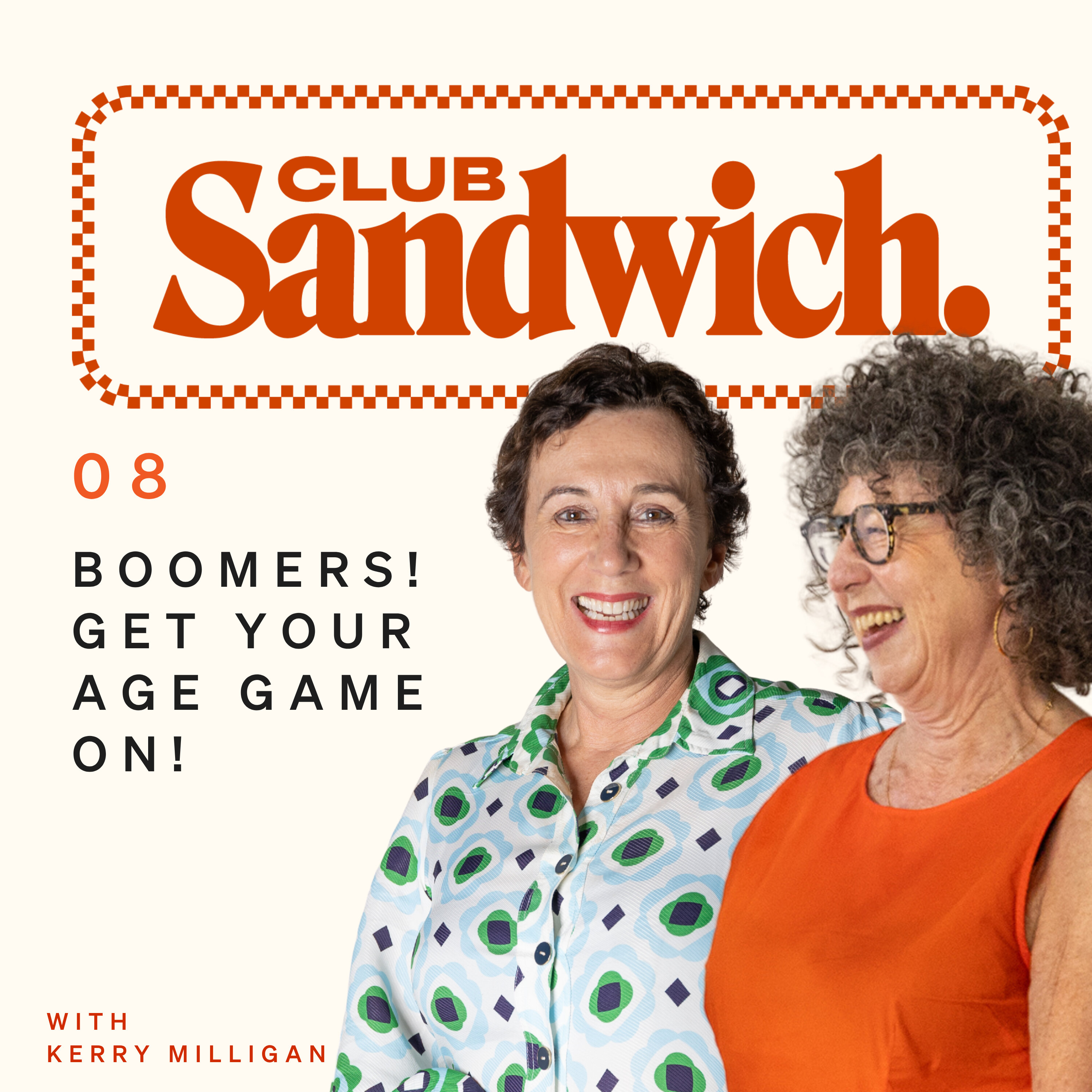
Boomers! Get your age game on! With Kerry Milligan | Club Sandwich
If your parent is ageing and still saying “I’m fine”, this episode is your nudge to stop waiting for crisis. Sarah Macdonald and Gogglebox's Kerry Milligan talk about the conversations families avoid until it is too late: downsizing, wills, advanced care directives, aged care, death planning and the cost of denial.
Ageing parents? You’ve got them. We’ve got you.
JOIN THE CLUB: Visit clubsandwich.community to join the tribe, access resources, and find our private Facebook community.
SEND US YOUR QUESTION: hello@clubsandwich.community
In this episode
The Conversation: Sarah Macdonald and Kerry Milligan dive into what it looks like to get on the front foot with ageing, and why future planning can make life easier for both parents and kids.
This Week’s Hack:
Do one piece of future planning this week: check your will, sort your advanced care directive, or get yourself into the aged care system before you urgently need it.
Hack #2:
Kerry reveals she already got herself assessed and into the aged care system after shoulder surgery, so support would be there if she needed it again.
Meet the regular Clubbers
Melissa Reader - CEO of Vera and expert on Australia’s ageing crisis.
Jo Lamble - Clinical psychologist specializing in guilt and family dynamics.
Dr Ginni Mansberg - GP and women’s health advocate who tells it straight.
Dr Stephanie Ward - Geriatrician helping you understand when “old” becomes a crisis.
Kerry Milligan - Gogglebox star bringing humour and honesty to the sandwich generation.
Topics covered in this episode
Why 2026 is a turning point for Boomers and Gen X
Why denial makes ageing harder
Downsizing before the family home becomes a burden
Why Kerry says she will not live with her daughter
Wills, advanced care directives and making your wishes clear
Getting into the aged care system before crisis hits
How to make ageing less chaotic for your kids
What a death cafe is and what a death doula does
Why Boomers may need to reinvent aged care
Why asking for help actually makes things easier
Club Sandwich is brought to you by Australian Unity. Visit AustralianUnity.com.au/ClubSandwich
Credits
Club Sandwich is brought to you by Vera.guide, helping families caring for ageing parents navigate this stage of life so you don’t have to do it alone.
Sarah Macdonald - Host + Executive Producer
Melissa Reader - Commissioning Editor, Executive Producer + Clubber
Rachel Fountain - Executive Producer
Audio + video edits by Fountain Media Group
Thanks and kudos to Sean Wayland for our awesome theme music Club Sandwich - hear more from Sean at seanwayland.com
See omnystudio.com/listener for privacy information.
Transcript
Club Sandwich is recorded on Gadigal land, home of the EORA nation. We pay our respects to elders past and present. Always was, always will be.
Club Sandwich is brought to you by Australian Unity's Home Health and Care, helping Australian families support their parents to stay well, active and living at home for longer. Visit australianunity.comauclubsandwich. hello, my name is Sarah McDonald and this is Club Sandwich, the podcast for you. If you are squished between layers of love and caring and there's an ageing parent who needs your assistance, here's what's really interesting about this year. 2026, the oldest boomers will turn 80. The oldest Gen Xs will turn 60. And these are the generations we're mostly talking about now. The baby boomers were a big population. The population boomed after the end of the war, so they're gonna need a lot of facilities and they're gonna need to do things differently. And this is the generation that can. Because while we're meant to often be at war, I don't believe in all that stuff. I love and admire and respect the boomers and I want them to take charge of this stage of their life, and they're going to have to, because they've done it with every other level of their life. So joining me in the club today is Kerry Milligan. She is retired from gogglebox and teaching, but not retired from life. She's a dancer, she's a diva, she is a boomer. And this is what we're going to talk about today. Hello.
Go Boomers.
Go Boomers. You are a big population and you have always changed things and been around change at the forefront of big changes.
Yes. Yeah. It's fascinating, isn't it? I was the first person in my family to get a university degree, to go to university. Thank you. Gough Whitlam was free. Was free.
Yeah. Right.
I was actually on a studentship. I got paid.
Wow. Yeah. So that was revolutionary within your family.
Oh, yeah. And a girl.
And also, you kind of revolutionized sex and drugs and rock and roll like the pillow. Yep.
We went on the pill. We had lots of sex. Some of it good, some of it not so good.
Yeah, right.
Yep.
You had good music.
Had great music. What's happened?
Oh, no, no, we're not gonna do that. Oh, we won't do that today. It's no good. No, no. You had your great music, but it was a time that musicians could make money from music, even if they weren't kind of big. It wasn't corporatized. I think that the industry is very corporatized now. But basically the thing is, you've always taken charge. You kind of had the hippie, anti Vietnam era, all of that sort of stuff. So there is going to be a need for you to take charge of this next phase of life because we're headed for a real mess if you don't.
Yeah, I know.
There's just not going to be the resources, the money and the staff to look after you all.
And we need to be thinking about the future too. You know, we need to be doing, you know, making sure we've got a viable will that's up to date, making sure that we've got our advance care directive all sorted and everybody knows what we want. You know, the whole death and dying industry. We're not buying in into the $12,000 coffin and the plot at the cemetery like our parents and grandparents did. No, we're going a different way completely.
Well, let's talk about some of those things for you. You looked after your mum. She lived with you, Emmy. And then she went into aged care before she died. How did that change about how you're gonna think about this next phase of life?
Well, the one thing I know is I will not be living with my daughter.
Really?
That's not gonna happen.
Not gonna happen?
No, absolutely not.
Why?
Well, because we live very physically, very close together anyway, so I've got my apartment, she's in her house with her kids and I know that if I need her, she's close by, so I don't need to live with her.
My mum had her mum living with us and mum always said that to her. She said, I'm never gonna live with you because it does. It adds a closeness and it's beautiful and it's how we used to live. But it also adds a bit of a strain to the family sometimes.
Well, I had, when I was a kid, I had my grandparents living with us in a unit attached to our house. Then mum came to live with me. But I'm a baby boomer. I'm not going to do that with my daughter.
Because you want to be independent.
Yeah. And so does she.
Yes. So you've already downsized? Yeah. From the family home?
Yeah, already.
When did you do that?
Ten years ago.
Because you thought, I've got to jump on the front foot of this.
I had a terrible divorce and I ended up staying in the house. And I was lying in bed at night worrying about the blocked pipes, the rotting weather boards, the overgrown garden. I just got so anxious and so upset. I thought, this is ridiculous. I need to move into an apartment where it's worry free. And that's what I've done. And it is worry free.
Yeah. And also kind of. And I know a lot of people want to age in place and in the family home because they're so connected to it and they love it so much. But it has got its real issues and I was.
I was very emotionally attached to it. I really struggled to think I didn't want to move. It was my refuge after this horrible divorce. But practicality came into. Into the fore and I just thought, no, this is ridiculous. I should. I want to be living somewhere that is stress free.
And how do you feel now? My mum still mourns the family home.
No, you don't. Nope.
You never look back.
No. But Isabelle did. She knocked on the door and said, can I have a look around my house? And she did. But no, I've never, never looked back.
Really?
No.
Yeah. So it's kind of about the practicalities of life are massive though, aren't they? Like in terms of happiness, Just not having to sweep and look after a big garden and things like that. So you'd advise that for people who are struggling about that.
It's just so stress free. Like you pay lor insurance for your car because it's undercover, you know, it's just. And something happens and I ring the caretaker and say, you know, whatever has happened and he comes and fixes it, I don't have to worry about it.
Is there a community?
Yeah, it's lovely actually. The building that I'm in has got several courtyards, public courtyards with a barbecue and seating and people have their grandkids over and they have barbecues together and I take my grandkids down to the pool and it's just lovely.
So would you advise that if people are kind of chatting to their parents about moving or getting older themselves, the downsizing is like sort of act when you've got the energy to deal with all that stuff, those layers of life that keep. And they can kind of tie you down. Like, do you feel lighter getting rid of stuff?
Oh, yeah. Oh, yes. Because I had an old Edwardian house full of dark furniture. So that. Gone, chuck it out, give it away. It's gone. And it was so liberating to say goodbye to all of that stuff, that burden of stuff that didn't suit me and my lifestyle anymore.
And did you need to convince yourself, like, what would you say to people who are trying to get their mum and dad to think about downsizing or if they're thinking about it themselves.
Well, the strategy I used with my own mum to move her out of her little flat, which was really hard for her. But I just said. I said, realistically, mum, you're gonna get older, you're gonna get sick, and I want to be able to look after you, I want to be nearby, I want you. I want that you're safe and you're happy. And I've bought an apartment where you can have your own section, your own bedroom, sitting room and bathroom. And it'll be like it's your flat and it's got a door between you and me. And when I want to come in, I will knock on the door and you can say, go away or come in.
Respect privacy. Yep.
So much so that we had this plan that if she brought home a fancy man or if I brought home a fancy man, we'd put a little note on the front door.
Oh. Or a little signal.
Yeah. Like a sock on the handle. A sock.
Now I'm thinking of the Red Hot Chili Peppers and what they do with socks. So you were kind of ahead of the curve there. You were forward thinking on that. Have you done things like made sure you've got a will? You've got a will. Yep, yep.
That's easy. I've only got one child.
Yeah, right. Okay. No arguments there. What about thinking about things like advance care directives and stuff? You've done that already, too.
Yeah, I've made.
You're only 72, Kerry.
Well, anything can happen. The event horizon, it's just there. Yes, And I've made it very clear to Isabel, I don't. As my mother said to Isabel and I when we did hers, no fuss, no $12,000 coffins, no funeral, no. No burials. None of that. Cremation.
A funeral.
Well, a memorial.
Right.
Not a funeral with the casket and all that in a church. No, thanks. Simple, clean, awake, you know, like a coffin. Oh, I thought you meant like awake.
No, you won't be awake in the coffin, Kerry. You'll be dead.
Yes, It'll be like an Irish wake.
Like an Irish wake with a bit of a knees up. Yeah, but what about before that? Like when I said advance care directive. That is where you can stipulate. And there are different things in different states where you can say, I will not. I don't want to be revived if I've all that. Have you gone through all of that for yourself?
Yes.
And did you do that after going through that with your mum?
Yeah, it's really important. It's important to have it all written down. I mean, is it a legal document? I don't know. Isn't advance care actually a legal document?
Well, I think it has to be taken into consideration by the hospital. But I think they still call you if they. Even if they have it and the family are there. And I think if there's dispute in the family, then it may not always get followed. Yes. Which is always a really tricky one. So have you.
Yeah.
You've just made sure everybody's clear and on the same page through that? Yep. Was that confronting, doing that?
No.
Really?
Well, you have to accept that the most inevitable thing that's going to happen in your life is that you're going to die. That is the most inevitable thing, and that's something you can plan for. Sarah.
I think there's so much denial, like, you know, there's so much denial around aging about kind of infirmity, about. I think sometimes cognitive, like, this is the biggest thing that people talk about in club sandwich. That my parents just won't accept that they need help. How do you get around that, like, for yourself? You're obviously a really practical person, but going through it probably with your mum helped as well.
I think it did. You know, I was very pragmatic with mum, as you said, that. That I made sure she went to all her appointments, that she had her hearing done every year, her eyes done every year. And I'm doing it too now. I have my hearing test every year. And so that when Isabel says to me, what do you mean you don't want to go to that restaurant? Cause you won't be able to hear me. You must be going deaf. And I say, isabelle, my hearing is perfectly all right. I have it checked every year.
It's just a noisy bloody restaurant with hard surfaces.
Awful.
Yeah. So you're very proactive. I mean, that is. I mean, you're also very organised. Like, not a lot of people are really on that.
I'm organised when it counts. You haven't seen my bedside table.
Good. You're not a clan freak, then.
No.
Yeah. Right.
No, no, no.
Okay. But yeah. And you had that good living arrangement with your mum where you had that sort of independence, but then the care and the looking after it. But you wouldn't do that with Isabel. So would you? Like, how are you going to. I suppose the self awareness thing is a tricky one. How do you think you'll kind of know when you actually do need more help or when you might have to go into aged care. How do you kind of keep that present in your own brain?
I think it's the self awareness and it's the confidence and the lack of denial too. You know when I had double shoulder surgery, because I am the sandwich generation, and I went to see a surgeon cause of my sore shoulders, and he did the MRI and looked at me straight away and said, you're part of the sandwich generation. That was the first time I'd ever heard of the term.
What, because it had weighed you down? It was cracking your system.
I completely ruined, wrecked, tore the tendons in my shoulders. Lifting prams, lifting bikes, lifting walkers, lifting old people, lifting babies constantly. I just wrecked my shoulders. And he could see that straight away why that happened. But I knew then, because he said to me, you won't be able to do anything. You're gonna have your hand like this for, you know, six weeks. I couldn't even dry myself after a shower. I had to stand out on the balcony in the sun, naked, and just turn around in circles until the water had all dried off me.
Do you have a crowd gathering by the end of it?
No, my balcony's very private. But I knew that I would have to register myself for aged care. Aged. You know, what do you call it, where you get the help from the council?
Yeah, that's an aged care assessment.
An aged care assessment?
Yeah.
So I had an age. This is only four years ago. Five years ago.
What, you can do that in your 60s?
Yeah, I had an aged care assessment and I told her, the assessor, that I was gonna have to have this shoulder surgery and I wouldn't be able to do anything. And so she organised for somebody to do my shopping and somebody to do my cleaning, and the cleaner changed the sheets on my bed because I couldn't do that.
So you already have an aged care assessment number. You're in the system. That's going to make it so much easier too, if the wheels fall off or something goes wrong because you're in the system already.
Well, it means that if I have another operation, God forbid that I do, but if I do, then I go back on the books and they can send somebody in to help me do whatever needs to be done.
It's like, you know, I'm a real procrastinator, but then I'm also a procrastinator, where you do things before you forget to do them or before you need to do them. You're really doing that. Like, this is a great gift to Isabel.
Well, tell her that, hopefully.
Does she know that she'll appreciate it.
Probably not.
Because these are things that most people just think I'll do tomorrow, I'll do down the track. And they don't want to kind of deal with a lot of this stuff and then it ends up being the daughter often or the son who has to help them.
I think for me it's an anxiety about chaos. I don't handle chaos very well. I like things, you know, I always buy the same sushi roll, salmon and avocado. You know, I have my habits that I regularly do and I. I don't mind chaos if it's good, if it's positive, if somebody says, you know, fly to Singapore with me, yeah, I'll come. But it's the, it's the uncontrollable and very stressful, distressing chaos I don't like. And that's what aging can bring. If you're not properly organised and you don't plan properly, I don't want to be sprung, you know, I could get breast cancer, something terrible could happen to me and I. But I want to be prepared. So I have my mammograms, you know, I do everything organised just in case.
But that's interesting because I think the baby boomers have been in control. They've been, you know, in terms of the economy, in terms of the workforce. You're a generation who has had a lot of power and a lot of influence and are used to being in control. And so that then needs to carry forward. And if there's awareness with that, then that kind of control freakism can be used for good.
Well, you know, thinking about aged care for us as a generation, baby boomers, I think the architects and the town planners need to be thinking seriously about remodelling the whole concept of what aged care is going to be for us. Because we want to have communal activities, we want to have entertainment, we want to have good food, to have our private space, but also social space as well. So they need to be. The architects and town planners really need to be rethinking.
Well, a lot of them already have those sort of things. I mean, the music will be different. You'll have sort of Patti Smith and instead of Neil Diamond.
But if they'll allow us to have drugs while we're in there.
Wow.
I don't think many baby boomers take drugs anymore though.
Well, I don't know. But you know, smoking spliffs on the aged care facility balcony sounds pretty good to me. I wonder. Probably not. I don't think they'll let you break the law?
Probably not.
It depends where you are. Medicinal, Personal use. Medicinal. That would be impressive, wouldn't it? The problem is that they're not building enough aged care facilities for your generation and they need to giddy up on that too.
But isn't the plan that we're supposed to be cared for at home?
Well, that's what they're saying. They want people to stay at home longer because the aged care is so expensive and they haven't got enough of them. So people, if they can stay at home as long as possible. But you know, there's a lot of beds in hospital that are causing blocks in the system because people have a crisis, they go to hospital and they don't. They're not in aged care yet and then they're waiting for an aged care spot in hospital, which is not how you want it to be.
No. But also the big concern that not many people have thought about is that aged care for the baby boomers is going to cost a lot of money. So all the superannuation and the value of the house that we have is going to be going to pay for our aged care, which the generation of their children will be saying, well, what happened to our inheritance? Well, sorry, darling, I need to put the mask on me first before I put it on you. So it's all going to go into our aged care.
Well, isn't that lucky though, if you do have superannuation that it can, because otherwise it's, you know, this is the issue, this is what's adding to the budget issues that we've got is the ageing population and it is very expensive aged care. There's a call that every sandwich generation daughter dreads. It's the one where dad can't explain what has just happened and Mum sounds different or you can't put your finger on why and suddenly you're googling aged care at 11pm Wondering how you missed it. Australian Unity Home health and care is the thing you set up. Before that call comes a local care team, a dedicated who actually knows your parent. A plan that moves with them, proactive, not panic. And that's the difference. Visit australianunity.com auclubsandwich so what else would you like in the aged care home? You want the community areas, you want music, you want some?
I want my friends. So my plan is that all my friends will buy apartments in my building.
I've got this plan too with my friends and I found a building. I was like, let's buy this and we're like we're not there yet and we can't afford it. But wouldn't that be great?
So every time an apartment comes up for sale in my building, I'm on
the phone and have people started buying them friends?
Not yet. They're in denial. They're not ready yet. But I keep pushing it. Wouldn't it be great? All my friends living in my apartment building?
Yeah, no, I think this is what needs to happen. That's such a good idea. And then you could kind of also subsidise an apartment in the block for younger people who could be helpers or assistants or.
What we've thought about is that together we could employ a full time nurse. We could employ a chef.
Yeah. Who comes around with the food and the drugs. I have got this same plan with my friends. But here's the thing. A lot of people have these plans. Very few of them actually enact it, don't they? What do you think gets in the way?
Fear of dying. I think people are scared of dying and they don't realise the inevitability of it. They think they'll live forever.
So even moving to a flat with a group of friends is accepting death?
Well, it's moving into that next stage of life, isn't it? I mean, I've got friends who are still renovating their houses.
Oh my gosh. Really?
Yeah.
Right. To be flatter and easier to live in or just to be groovy because
they never really finished it, right?
Oh, God, yeah. Still got mortgages and stuff along the way. That's a lot. So I think that that's true, that denial is really powerful. And we talked about denial with Stephanie Ward. It's a really powerful force and I think it's the biggest thing that we need to face. And self denial. Being aware that we are self denial or denying, I should say.
And I don't understand why, you know, the baby boomer generation changed the world. As you said in your introduction, on so many levels. Why are we so afraid of death? I don't understand it.
I think everybody is. Because you were the generation who were forever young.
That is true.
You were young. You were the first kind of teenagers and you redefined what teenagehood was. And you were the generation of the hippies and free love and you were eternally young. And so I think that it's hard to accept that you're not young and that it's all gonna end. But I do see a lot of bravery in this around it too. Like I do. As you said, the simple Funeral. There's stuff happening around this.
And I think for the baby boomers, we were really the first generation of universal education. So we're all armed with education. And you would have thought that, like we were saying that death would be the next frontier of education, that we'd all be doing our research, finding out, you know, what's offering and how to tailor it to suit. Cause that's what we've always done. We've always tailored society and our environment to suit us.
And you don't think that's happening?
It is to some extent, but not universally, I don't think. No.
You went to a death cafe, didn't you?
I did.
What is a death cafe?
What was it? Oh, look, I've always been curious about what a death cafe is. I've heard about them, but I didn't know what they did. And local. There was a notice in a cafe in my area and I thought, oh, I'll go along. And there was a death doula who was drinking coffee with four other people around my age, and they were asking her questions and she was explaining about all the options. So she talked about wills, she talked about advanced care directives, she talked about different ways of dying. She explained what a death doula was. I didn't even know what it was.
It's like a birth doula, but they are there with you when you die, is it?
Well, they actually go with you on the whole journey. So if you've got terminal cancer, for example, example, they'll. They'll go with you on the whole journey. They'll advocate for you with the medical system. She said the most part of what she does is advocating for the dying person with their family and friends. So when the dying person says they want this, they want that, you know, blah, blah, blah, they want to be cremated or whatever. And then the family and friends go, oh, no, no, no, no, no, no, no, no, no, no. So the doula is the person in the middle who says, this is what she wants. You cannot deny her what she wants. She's lucid, it's legal, you know, and she. She basically advocates for the dying person, which I thought was a wonderful service to provide. But the thing that really shocked me was when she was talking about different ways of disposing. Like she never uses. She didn't use any of those words. They're my words. Disposing of the corpse. She would talk about. About the person. She would talk in those lovely human.
What happens afterwards.
What happens afterwards. And she explained, you know, you can be in Victoria, where I live, you don't have to be buried in a coffin. You can be buried in a shroud. People didn't know that. So, you know, you don't have to afford the expense of a coffin. You don't have to have a funeral director. For example, she talked about habs burial will no longer be optional in the future because it's too expensive and it takes up too much space.
Yeah, it's not enough land. Like, there's not enough aged care beds. Yeah, yeah, yeah.
So she talked about cremation, all the different ways, you know, that you could be disposed of. And then she talked about water cremation. And I said, what's water cremation? And she said, oh, well, it's when they put the person in a lovely cylinder and the cylinder's tossed around. And I said, what, in water? And she said, said, no, in hydrochloric acid. And I just went, what?
That might appeal to boomers. I'm going to disintegrate in acid.
Acid. And I said to her, what do they do with the waste? And she said, oh, they dispose of the waste. I'm thinking, what, they flush it down the drain? And then she said, and then they give the family a box of bones to dispose of as they see fit. And I just said, oh, I'd rather be cremated, thank you. But I didn't know about that.
No, either did I. And there's some really interesting work doing in that. I remember once I was talking about this on the radio and there was a group of people who decided to make their own coffin as a kind of process of accepting the inevitability of death. Right. So they're making their own cotton and they're painting it and stuff. And this one woman painted a giant Elvis inside the lid. I said, why did you put Elvis in the lid? She said, because I'll be straight under him. He'll be lying on top of me for all eternity. I was like, okay, girl.
Oh, that's cute.
You do you. So I think there is this sort of. This movement is starting to happen, and it is part of it. But I guess between the downsizing and the death, there's a lot in between, isn't there? There's decline in some of physical abilities and mental abilities and needing to get some help. You're already in the system. You'll be pretty good with that because there's a bloody long waiting list, isn't there? But what else do you find interesting? Like, have you heard other people doing kind of thinking about this in a little bit more of a active way and being at the forefront of it.
No, no, I mean, I'm trying. I'm trying with my friends to, you know, broach the subject. My fancy man's all organised. He's.
He's like you.
Yeah, he's like me. He's all organised. And I think for me too, I'm very fortunate that I only have one child because, you know, we talk all the time about these things all the time. And I've said to her, when I'm dead, you dispose of me as you see fit. Whatever suits you, darling. I'll be dead. I don't care. You can do with me whatever you want.
You don't want to be on the mantelpiece watching over them for eternity.
Well, the funny thing is that Mum currently is. So we've still got Mum's ashes in the urn sitting on the mantelpiece because we haven't scattered the ashes yet. And my grandson talks to her.
That's so lovely.
He. He asked me the other day, where is Gigi Grandy? And I said, oh, she's up there on the mantelpiece. And he went over and took the lid.
Oops.
Took the lid off the urn, opened up the inside packet and had a sniff and said, it smells like GG Grandy. And I said, that's nice. And then he said, good night.
Good night.
Put the lid on her and went to bed.
Wow.
It's cute, isn't it?
It's quite cute. And that's what they say. Yeah. Take some time to keep the ashes before you decide because you can chat to them.
Well, what I've actually decided now is that I will take some of the ashes out and I'll put them in a. I want to get a little heart shaped box and I'll just keep some of the ashes so he can still talk to her and stuff.
Do you talk to her too?
I sometimes do. Not in the urn?
Yeah. Not just in the.
I walk around going, oh, it's hard, you know, I mean, Mum's only been dead for six months or seven months and, you know, I find myself doing something like cleaning out a drawer and I'll see something that will absolutely break my heart and I just say, oh, Mum. That's how I talk to her.
Yeah, yeah, yeah. Oh, Mom.
Oh, Mom. You just choom. Yeah, it's hard.
Yeah. And you're still a daughter. Yeah. Even though she's not with you. And that's the thing. I think that's why I find this so interesting because when my mum had her mum living with us, and then I remember when she put her into aged care and I remember my mum being really stressed at that time and how hard a decision it was, but I never thought that that would be me in 30 years. And it was. And she said to me, you know, my mum had to do this for me, you're gonna have to do it. You know, I had to do this for my mum, you're gonna have to do it for me. And I was just like, yeah. This moment of clarity, like this is the kind of sacred circle, the sort of path of life, and yet we do need to sort of renew it, learn it again and do it differently for each generation, don't we? It's quite interesting.
I mean, my mum was determined that I would never be wiping her bottom. She said, I never want you to have to wipe my bottom.
And so have you said that?
Yes.
So they're the little things I'm saying that you can make very, very clear. Do you think boomers will revolutionise ageing and death?
I think we already are.
Right.
I think I'm the perfect example of it.
Yeah. But you're one how many?
I just need to encourage everybody.
I know you need to issue a clarion call, like, come with me on this, let's take charge.
And I do think that doing things like going to a death cafe, you know, when I've told my friends I've been to a desk cafe, that.
What?
But, you know, next time a death cafe comes in their area, they might actually be curious and go and sit and have a coffee with a death door.
Yeah, well, they might, I suppose. That's the thing. One person does it, the others show interests. Have you got a power of attorney as well? Have you done that?
I'm pretty sure I do. I'm just trying to think of who it is. But the trouble is, he's my age, so you need to really think about that. Right, yeah, yeah.
But what about, you know, like, enduring power of attorney so that if you're incapacitated, Isabelle can look after you and all that sort of stuff?
Yeah.
That's another thing.
Well, she's the only one who's going to.
Yeah.
I've only got one child, so she's got.
She's got it. It is different for any children, isn't it? My mum was an only child. But often it's one person, often doing this anyway. Yeah. So she doesn't have a choice. But she has got you, I think. Who's very aware of what's going on and aware of where this can all go. What do you want to do differently to your mum? Like, what do you think the boomers will reject from the generation above them?
The passivity? I think my mother was from that generation of women that was very compliant and very passive and don't make a fuss, you know, don't make a fuss. Kerry, don't. I'm okay, I'm all right. Whereas I won't say that you'll make a fuss. Well, I won't make a fuss. I'll just actually ask for what I want. And I don't think that's making a fuss. I think that's saying, this is what needs to happen. This is where I need to go. I'm gonna be very determined and very solution focused.
See that? Yeah. Because I think that the generation above you are very like, they don't wanna be a burden, they don't wanna be a fuss. So they minimise a lot of things. But this is a stage and age of life where you do deserve extra care. And it actually makes it easier for the daughters or the sons or for the nieces or nephews or whoever's sort of trying to help you out. If they do know what you want, if they do tell you the truth about what's going on and how they're feeling and what they don't want and what they do want and what they need. And if they ask for help because it makes you feel good, oh, Mum asked me this the other day. I feel good now. Rather than having to guess, stress about. About what might be happening, trying to read their mind, pick up the signals. Cause we normalise things so we pretend, we can pretend things aren't happening. We say, oh, no, she's all right. But then sometimes you see it from an outside eye. Whereas if a parent goes, actually, I think I'm really struggling with this. It does make things a lot more easy, does. So it might be easier.
I think so.
So that power of getting what you want, doing what you want, as the boomers may actually psychologically be a good foundation.
As long as we stop denying death. As long as we can do that. You're not forever young and in your 70s, you know, you're in the zone. I'll be lucky if I get to live another 10 years.
Why do you say that?
Well, because 70, that's when things start to go wrong. In your 70s, you know, you have worn out hips and stuff like that. So my. My solution to that is stop Exercising, lie in bed and read.
I think you need to exercise to keep them, but your hips are only
made to do so many rotations and then they're going to wear out. So I spend a good part of my day on my bed. I say it's my office, on my bed.
Reading, reading, eating chocolates. Resting your hips.
Yeah.
Yeah.
Well, because I do my. I do a dance class or I go swimming or whatever and I've done my bit and I can relax for the rest of the day.
Yeah. Yeah. All right, so let's go. I think that. Yeah, I think. Keri, I'm hoping that others are in the same boat with you because we, the Generation X, we can't do it without your assistance and we would love you to keep that sort of need to be in control to some extent. If it's done with awareness, then that makes it easier for us to help you.
It's all about future planning. You've got to do future planning.
You've got to face the reality. Thank you so much.
It was fun.
Really interesting conversation. If you would like to suggest a podcast topic for Club Sandwich, or if you have a question we can ask one of our regular clubbers, then you can look at our Facebook, our Instagram. It's Club Sandwich Community. You can email us@hello, clubsandwich.community and you can drop us a line, however, is easiest for you. What would you like us to talk about? What questions do you have that you would like to be answered? And remember to do one thing for yourself this week, if you are a carer. This week, I walked along the beach with the wind in my hair, My hat flew off, I kicked up the sand and the waves and there's just something so powerful about. I don't live in the beach, but just being on the beach, I just feel happier. Like this is something quite profound for me on the beach, that salt air. What did you do for yourself this week?
I live on the beach, so I looked at sunsets all week. The most spectacular coloured. I mean, the bushfires didn't help or they did help, but the sunsets were just gorgeous this week.
Look at a sunset, kick a wave on a beach or in a pond or in the bath. Caregiving is really private, so I'd love you to share this episode with someone, you think, who needs some extra care for themselves or who needs the help and the hacks that we are bringing. Please share it, Please send us some questions if you'd like to and please know that while you're on your own. In some ways during this, perhaps you're not alone. We're in this together. You're doing a great job. And while you've got them, we've got you. Today's episode was supported by Australian Unity Home Health and Care Services, Proactive local care that helps your parents live well at home. Less stress for them, less worry for you, and more time for the good stuff. Visit australianunity.comauclubsandwich
Club Sandwich is brought to you by Vera hi, I'm Melissa Reeder. I'm the co founder of Vera and and here's something I've learned both professionally and with my own dad and my own family. When your parent turns 75, it is time to pay attention. Not because something's wrong, but because you know your parents in a different season of life. And this is when things can start to shift. Most families wait it out for a crisis, a fall, a hospital stay, and then they're forced to make really big decisions really fast and under a lot of pressure. Show Vera 75 is a simple 15 minute AI phone conversation that shows you where your parent is at in their journey of aging and helps you know what to do next. Because a little bit of clarity now can prevent a lot of stress later.
Learn more.
Have a look at Vera Guide.