
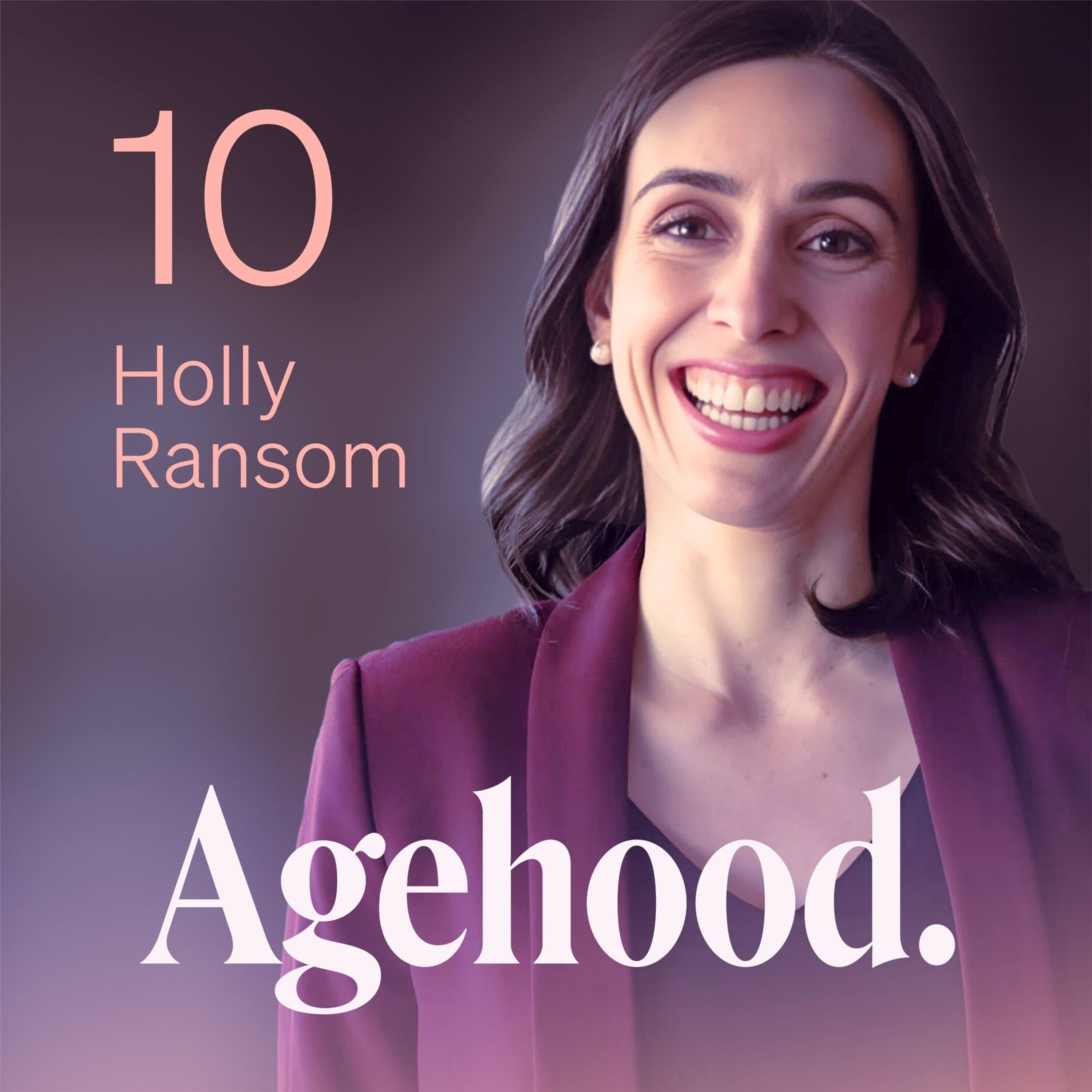
Holly Ransom: On love, loss & leadership
Holly Ransom is best known as a globally recognised speaker, strategist, and CEO of Emergent — the woman who’s interviewed the Obamas, led a G20 Taskforce, and worked with some of the world’s biggest companies. But in this deeply personal conversation, she opens up about the loss of her beloved grandmother Dorothy — and how grief, for the first time in her life, brought her to her knees.
Holly shares the powerful lessons Dorothy taught her — about empathy, leadership, and doing the right thing, even when no one’s watching — and how those lessons are helping her navigate the complexities of midlife, caregiving, and the systemic gaps we face as our population ages. From grief and memory to workplace disruption and policy reform, this episode is a reminder that the most important leadership often starts at home.
FIND OUT MORE
If you’re caring for aging parents, navigating your own next chapter, or just trying to keep all the balls in the air—you’re not alone. At Violet, we offer free tools and support to help families navigate the last stage of life with care and confidence. Visit violet.org.au to start the conversation.
CREDITS
Host: Melissa Reader
Guest: Holly Ransom
Executive Producer: Lize Ratliff
Find out more about Violet at violet.org.au
See omnystudio.com/listener for privacy information.
Transcript
Foreign. Hi, I'm Melissa. Rita. Welcome to Agehood, the podcast for people who are quietly carrying it all. Aging parents, adult kids, work, life and their own next chapter. If it sounds like you, well, you're in your agehood and, and it's time that we talked about it. I've admired my guest today for a really long time. Holly Ransom is one of Australia's most dynamic leaders. She's a sought after speaker globally. She's a strategist CEO of her own company, Emergent, a bestselling author, and she's the youngest person ever appointed to a G20 task force. She's interviewed the Obamas, world leading CEOs and Fortune 500 leaders. But in today's episode, we talk about not just her power, but about something more personal. Grief. After the death of her beloved grandmother, Dorothy, the woman who really helped shape Holly's worldview and taught her the power of empathy, courage, and, you know, knowing what's right, Holly found herself unexpectedly untethered. And it's that experience that led her to the work that we do at Violet. On today's episode, Holly opens up about her first experience with loss, the life lessons Dorothy taught, and why she's still on Holly's speed dial. Today we also discuss what it means to lead with empathy, how to meet people where they are, and why. We urgently need to get better at preparing for and talking about the final chapters of life. This episode of Agehood is brought to you by Wellways Carer Gateway. Being a carer can be rewarding, but it can also be overwhelming and isolating. At Wellways Carer Gateway, the team really understand the highs and the lows of caring because many of them are carers themselves. Whether it's help navigating services, a break when you need it, or just someone to talk to, support is here. It's free, it's local, and it's tailored to you. Call 1-800-422-737 or just search Wellways Carer Gateway to connect with your local team. A will is vital, but it's not designed to keep up with all of the personal, the practical and the financial details of our modern lives. Things like passwords, bank accounts and bills, they often go unrecorded. And while life is complicated, a legacy doesn't have to be. That's where a letter of wishes from today's sponsor, Bill Will, comes in. It's a simple and secure way to reduce stress with for your loved ones to share your values and preserve your voice. And it can save hundreds of hours of Admin down the line. Visit billwhill.com to get started. Holly Ransome, welcome to agehood.
Thank you for having me. I'm excited to be here.
Let's start a little bit by, you know, how we got connected. That was quite an interesting little moment of serendipity.
I guess it was, wasn't it? So grateful for people who are thoughtful enough to make recommendations, particularly when you're in those vulnerable moments. And our wonderful friend Sharon.
Yes.
Who you had supported with everything you do at Violet through the passing of her mum, who was so near and dear to her. She and I were having, I can't remember whether it's coffee or lunch in Sydney shortly after the passing of my beloved grandmother Dorothy, which was really the first time I had lost anyone where I'd say, you know, grief was all of a sudden very present in my life. Like we, you know, very fortunate to be able to say that as someone in their 30s. But this just knocked me for six. And I felt very at sea. And Sharon and I were talking about it and sort of sharing stories of. Of her mother and my grandmother and she sort of said, oh, well, you know, who really helped me, sort of held my hand as I was taking these first few steps through the loss of my mum was, was the team at Violet. Like, you should reach out and connect. And so that's how it. I met you and then had a couple of conversations with Bernadette from the Violet team. Because it's sort of this funny thing, isn't it, when you think about how part of the human experience grief is like none of us get through life without grief.
How totally universal this is.
Absolutely. And yet you can arrive at it feeling so ill equipped. And that was how it happened. Like my, you know, you kind of know when your grandparents are in their 90s, that you're coming towards, you know, saying goodbye. And my grandpa passed away, you know, a year before my grandmother did. And. And so I sort of had always anticipated she would die of a broken heart. In many ways, she lasted a little bit longer than. Than I thought she would. They'd been together nearly just shy of 71 years when he passed, which is remarkable.
Yeah.
Incredible love story. So, you know, it's coming and then still nothing takes away from the. The just devastation and vortex you feel like you fall into when they finally leave.
Yeah. Totally at sea. Yeah.
That's the only way I can describe it. Just feeling at sea and sort of not sure which way to swim or how to survive.
Yeah, yeah.
So true.
And we Just don't have the language or the narrative or the kind of mental models, do we?
That's another thing you noticed. And. And I hope I'm doing better at this for. For people that I'm supporting through grief subsequently. But I could really tell the people in my life who'd experience grief.
So interesting that you should say, because.
You made me think of it when you said language. The messaged like the. The words they use, the. This kind of understanding or this language. In the way that poets can put language around human emotion. You could tell people who'd felt it and experienced it and were reaching out to you from kind of that shared understanding of what you were in. And no, no disrespect to the thoughtfulness of anyone reaching out, irrespective. You're so grateful for every little bit of human connection in those moments. But there was this real way that people who had experienced grief in my life were. Were with me in that moment. That was huge.
That's so true. And I think so often it's about the things that maybe aren't said by those that have been through it as much as the things that are said. Yeah. Can you tell us a little bit about Dorothy? She sounded like a pretty amazing woman.
She was a remarkable woman.
Tell us about her, about your relationship. Yeah. How would we get to know Dorothy a little?
I love that you asked this question because one of the things that I learned through Burnedette and through working with Violet was the importance of still telling her stories and finding ways. And I'm getting better at it. I actually spoke about her on stage for the first time since she passed last week. And so I'm getting to a place emotionally now where I feel I can do it. And it's so important to me because I want my daughter, who's unfortunately never got to meet her great grandmother, to grow up knowing her and to really have a sense of who she was and to be inspired to be like her great grandmother because she was a remarkable human being. I think the thing when I think about my grandmother, well, several things that come to mind. One was she had this incredible, incredible superpower that it did not matter who she was talking to. She would make them feel like the world is so lucky that they are on the planet and they are doing exactly what they've chosen to do, because isn't that the perfect thing for them to be spending their time doing? And there was just this way people left her presence feeling like they're 11 foot tall. And I remember watching that with you. Know, people at the library, people at the shops in. In the country town that they lived in, guys at the surf club. She just had this incredible way of making people feel better than when she met them. And I always thought that was such an incredible gift to give someone and an incredible way to have impact with every interaction. There's nothing about title or rank, money or hierarchy or like that is within anyone's sphere of influence and control. But not many people seized it like my grandmother did and were as deliberate about it. And she had quite an incredible ripple effect in the world by virtue of that. One of the funniest things about my grandparents, I've not shared this too many places, but they co wrote the original sex book, so.
Really?
Yeah. You didn't know that one. I mean I was going to talk.
About what you had had role modeled in terms of your grandmother's ability, but.
This is incredible too.
It's a whole new part.
A whole new part. So they wrote Sexual Joy and Marriage. Go Google it. By Michael and Dorothy Clark.
Wow.
And which we thought was like the coolest as grandkids. Like I remember as a teenager finding the book on the she and I was like grandma and grandpa wrote a book and pulled it down and yeah, my eyes popped out of my head for about a week. But you know, grandpa had been a psychiatrist. He had come to form the opinion that a lot of his patients were presenting with challenges that ultimately stem back to an inability to get into intimacy and to really be able to ask for and get what they needed from their most important partnership. And so I remember, you know, grandma sort of telling the story that he decided to, after many years of practicing, write down sort of some of the things that he'd come to observe as sort of almost the blueprint for. For couples to be able to have thriving relationships. And grandma read the draft, she's like, michael, don't be ridiculous. That's not how women think at all. And so, you know, credit to my grandpa, like I think in many ways ahead of his time in so many regards. They co wrote it together and they went all around the world like they lectured ypo kings queens what year.
But when was this published?
This was. It would have been the 80s, predates me and but yeah, incredible. So they were also really, as you'd imagine with two grandparents that spend their time doing that and, and have these incredible sort of next life after they've raised their kids of sort of these intellectually stimulating conversations and traveling around the world having. Grandpa was very funny. Rantur and and apparently brought this to life in amazing ways on stages. So I think I've got a little bit of him in sort of what I do now to some degree. But incredibly liberal and open minded. And that's another thing I loved about my grandma. Even as late as, you know, in her final 24 months, we would talk a lot about world affairs and politics and she was always very interested when I was interviewing someone, you know, in, in that category of people. And we talk a lot on International Women's Day about how much, you know, she couldn't fathom the choices women of my generation were able to make. You know, she got the choice of you, a nurse, a typist or a teacher when you came out of school, when you had to leave, all of that when you had K. Right. So it's amazing in two generations, sort of some of the things I'm able to do now that her generation paved the way for. But she would still call me and she'd say, you know what, when we were talking yesterday about insert whatever political issue or something, you really made me think differently about that. And I deeply admired her ability to change her opinion and to be open minded. You know, as late in her life as you probably could have said, she could have entirely calcified and had a very fixed worldview, she would still call me and say, you really made me think differently about that. And I hope I can be that open minded, you know, when I get to her stage of life. There's so many things like she was my first teacher about what it meant to be a leader. And what I loved about it is she always led by example, never, never by telling. There are so many stories, many of which are in my book the Leading Edge.
Quite a few of those which have been obviously played a hugely formative role.
Massively for you, massively.
What do you think Dorothy saw in you before you even saw it in yourself? A lot.
Grandma's joke about me was always that I was born in perpetual motion. And so I think she had a. She, she believed I could do anything. And. And I really felt that she was the first person I would call when something exciting would happen. Getting emotional talking about that because I still refuse to take her off my speed dial. She's still next to my wife, the. The sort of second in rank, even though I know that number goes nowhere now. I'd call and Grandpa unfortunately lost his hearing well before he passed away. So he would write great emails. He loved email was a gift to him because he could remain in communication with A world he would have otherwise lost contact with a decade before he passed. And so I've got a folder of his emails, but I've got a phone full of her voicemails. Oh, yeah. And even I go back every now and again and listen to the one she left me on, you know, the. The day I married my wife. And she was. She was unfortunately not of the health to be able to travel to the wedding and, you know, or. Or bir ways or, you know, things like that that are just so lovely to be able to hear her voice still.
There's a whole science behind that around continuing bonds. You know, it's. Yeah. Again, it's not something that we really understand or kind of talk about broadly, but it's so important because I think for so many there's a sense that that person has to be removed.
Yes.
You know, that there, there can be a trace in a. In a cemetery.
Yeah.
But that person is removed. And there is such deep and very real attachments that you need to learn to translate into the next chapter of your relationship with Dorothy. I love the fact that she's still on your speed dial. Yeah.
And I don't know, she probably will forever be. You know what I mean? And mistakenly, actually, the other week, I called the number and it did. It rang out. It didn't go anywhere. But it was just funny how that happened. And with Grandpa like he was, he could look at the night sky and he could tell you every star in the galaxy. You know, didn't need a phone app to do that. He would be able to look up and tell you the stories. And so I often think when I look up the stars, it's him. And many ways that's become part of where both of them are for me. And probably fitting that we called our daughter Aurora, you know, in terms of the. The beautiful skies and something quite extraordinary. But, yeah, I think there's often all of us can think about that person in our life who made us believe before we had it ourself or before we even knew there was much to believe in. And I think for me, she was that time and time again. She saw there as being no bounds to what I could do. An incredible source of support. You'd call her on the days where you felt flat. You'd call on the days where you felt excited. She always had a way of knowing exactly how to meet you, where you are. And I, Yeah, I wouldn't be the person I am if it weren't for her.
What a gift. Do you still want to call her on those days if you, you might have done a huge interview. Do you want to just tell Dorothy that you spoke to the Obamas today?
Oh, so many times. You know, I actually remember thinking last year when I, I was doing an event, I co founded an energy summit in Canada. And on the speaking bill last year we had Jacinda Ardern and Sana Marin, you know, two, two women who had led countries under the age of 40. And I just remember thinking, oh, I'd love to have this conversation with my grandmother. Imagine getting to tell her that we live in a. You know, like I've spoken to two women that led entire nations before they turned 40. Like, what an. What a fascinating intergenerational conversation. So absolutely, there are people that I would love to still be able to, you know, share those stories with her about or get her take on. Yeah. On them and what I should ask and. Absolutely. And that will continue forever in a day, I'm sure.
And it's almost like your career progression and the kind of societal change and the progress that's happening alongside of that are just, they're really, they're quite intertwined, aren't they?
Definitely.
You said, I've heard you say that she never really lectured you or told you what to do, just, you know, lived her values. What's a lesson or a phrase that is kind of a reading from Dorothy's book?
Oh, there's a couple. I mean, one for me that was really formative early was when we were at the shops in. I grew up in Perth in Western Australia, and my grandparents lived at. On the beach in Scarborough, and we were down at the local shopping center getting some supplies for lunch. Grandma was babysitting myself and my older of my two younger brothers that day. And I remember we were in the line to the checkout and this guy that looked like a giant, I would have been four or five years old, had started chewing into this poor young woman on the checkout because she'd evidently given him the wrong change. And for whatever was going on in that guy's life that day, he'd taken real issue with it. And this poor. I remember being very young and I remember her cheeks being absolutely flush crimson, like she looked like she wanted to melt into the floor. She was so mortified and equally probably a little bit terrified. And before I could blink, like, my grandmother's not a tall woman, but she had inserted herself between the giant and this young lady on the checkout, you know, said to this guy, how dare you talk to that young Woman like that, you apologize. And this guy looked like he'd never been told off in his life. And he sort of, you know, took a moment or two to take that in and then grabbed his things and sort of mumbled sorry and walked out of the store. And, you know, Grandma proceeded like nothing had happened but bought bread and milk and whatever else we were getting and. And sort of went to walk out of the shops before she realized, like, I wasn't still standing in lockstep with her. I was stuck back in the queue, sort of having watched all this played out, you know, probably with my jaw on the floor. And she came back to grab my hand, and I said, grandma, that was so brave. And she said to me, honey, if you walk past it, you tell the world it's okay. And I didn't understand what that meant for a long time after she shared that. That with me, but it didn't need to, because she showed me, like my grandma wasn't manager of the store. She wasn't even the same height as this guy. You know, there's a lot of reasons where she would have been forgiven for looking the other way, pretending like it didn't happen, whatever. And here she was inserting herself, you know, with a choice she could make to say, that's not okay, and I'm not prepared to let that slide. And so for me, I think one, that role modeling of the everyday choices that we can make, whether that's putting our hand up and asking the question in the room, whether that's stepping in when someone's not being treated well, you know, she did that time and time again. But see, it in my memory is always that one in particular. And then I think the second thing was really that she'd done that without title, without permission, you know, that. That that power is within any of us. And that, for me, became a decisive sort of guiding phrase in many ways through my life. Like, a lot of my choices have been, you know, whether it was getting involved in certain charitable organizations, whether it was picking what to say yes to or no to, were determined by sort of asking that question. Can I walk past this?
Tell me a little bit about the last couple of years of Dorothy's life. So I've learned from this conversation that her husband died only a year before she died.
Yeah.
Yeah. What was that like for you? What were you starting to think about or notice about Dorothy in those last couple of years?
I think the thing. The difference between Grandpa and Grandma's passing, Grandpa's physical health declined quite rapidly in a Surprising manner because he was a really fit man till. Till he wasn't. Wasn't like it did really happen quite quickly in the sense that my grandmother, Grandpa in his 80s would still be starting the day with 100 full body push ups, an hour of yoga. Like he was a very fit guy, played golf every week. It was really impressive. And yoga, you know, he considered to be one of the great gifts his retirement gave him because he took up yoga when he retired and he really was, he was strong and fit. I remember quite famously. I can't remember how old he would have been. I think I would have been a teenager though. And I had a lot of male cousins who were, you know, surfers and footballers and all this sort of stuff like that. And grandpa pulled out a hand press where he lifted his whole body off the floor and he said 50 bucks to whoever could do it. And not one of the. No, no, nobody could do grandpa. Yeah. For all these people that were fit athletes playing in competitive teams and all this sort of stuff, he was the one that could get that done. So he spent a, a good chunk of his final. Oh, I'm probably guessing now it's amazing how timelines start to disappear on you when you get to this stage of life. So I could be a little off here, but a year, 18 months in sort of hospice care. Beautiful place down the road from where they lived in, in Denmark country. Wa truly like visiting a number of times there and just wonderful nurses. He could look out the window at, you know, his town every day and take in nature. And so grandma's life became shuffling down there however many times a day she could get someone to give her a lift to go and sit at his bedside and, and talk to him to the degree that, that, you know, could, could happen. And I think that's what's interesting when he passed is the loss of that routine, you know, in many ways and. Because while it's not a wonderful routine to have to go and watch your partner decline like that, and it's, it's an anchor. It's an anchor.
The next version of their marriage and relationship and. Yeah, yeah.
And there was something about. I still remember a conversation, you know, and it was one that we had when he moved into hospice and it was one that we had again when he passed of sort of, you know, after 70 years. Probably at that stage he was already in hospice care when they had their 70th, so it must have been just before. But she's like, I rolled over and we've talked about the Day before it started, like, he's always been next to me in bed. Like, to not be able to have that anchor, to use the word you just used, was. Was. Was a real sense of loss. I think that was the first time. And it's funny how those little things, in many ways are the bits we notice, like that, that just grounding routine every morning. Like, that was what we did. And that was the first time I remember her, really. She was stoic. Women of that generation are just something else. They are remarkable, you know, and I think, like, I'm very. For. My wife's got two grandparents, both in their 90s, both still going strong. You know, they're remarkable women of that generation that live through wars and depressions and just get on and get it done and are just so selfless. And she was really stoic. But I do remember vividly having a conversation about that. And the great gift in some ways for my grandmother was she spent very little of her life in any kind of care for her. When it happened, it happened much quicker.
I was going to ask you, was she living independently?
She was living independently till very late. And I say this, my auntie is a saint. It would not have been possible were it not for her incredible commitment to both of them and to keeping them home for as long as they could have. And she lives down in the town. She was there every day. She would do the shopping. She would, you know, shuffle grandma down to see grandpa. She. She did everything. Auntie Sally was remarkable. So that made it possible for as long as it did. And I feel very grateful that she was able to live in their beautiful home for as long as she did. And in many ways, I guess that it happened quicker than. Than it could have otherwise.
Yeah, you know, I think that's a really important point because we know that, you know, 90 of us, actually, we want to be at home as long as we can be. And that makes complete sense. I don't think anybody ever argues that point, but it's thinking about how that's going to be made possible and what kind of a plan is going to, you know, need to be developed and talked about and how you kind of. Kind of put that into action. Yeah, because you look at the. The research in the last 12 months of a person's life, and there's a lot of preventable hospitalization, about 33 days, four episodes. And when you peel back the layers of that, a lot of that comes from a lack of conversation and decision making. So again, it's those crisis moments we're not prepared for totally. We're not, not thinking about and understanding where someone is in their last chapter. And we're not making the decisions that reflect what they want.
And kudos as well to the services that exist to support those choices. Like when I think about Silver Chain.
Oh, Silver Chain. Amazing organization.
And, and those nurses that came, you know, every week, the carers came every week to help shower her and help, you know, do odd jobs and make sure she had a cup of tea in the morning and you know, this and that. Like they also must make, you know.
Absolutely Silver Chain because of their work. A much higher proportion of people die at home in WA than in any other state.
Interesting. I didn't know that much.
Much higher. It's about less than 15% anywhere else.
Wow.
And it's about 60. Higher than 60. I haven't got the exact number, but it's much, much higher because of the work they do and also because of the kind of geographic reality of.
Wait, that makes sense as well. Yeah. Because it really was a. There's only certain options available. I felt very grateful that grandpa could stay in Denmark, for example, not have to go to biggest regional town where the challenge for my grandmother would have been a 45 plus minute drive to get to the hospital every day versus five minutes down the road. And so, yeah, those things do make a difference. The geographical disbursement of WA is definitely a medical challenge for sure. Yeah.
But also, as you've said, you know, calling out the incredible work those services do and investing in them hugely. Because when we look at the ageing population and the quite disparate nature of those services, a lot of that caregiving role is going to fall on the shoulders of your Auntie Sally and those kind of midlife women caring for parents who are aging and in laws.
Definitely. I mean, this is why the conversation you're driving, I think is so important. Because, you know, not only are we not talking enough about death and kind of that final stage of life, but the everything that is needed to support the aging population. You know, we're living longer. We're not necessarily living with vitality for longer. We're starting to get our heads a little bit more around that conversation and funding and everything now. But we've seen an extraordinary expansion in lifespan in where western society.
We've never had to think about this type of longevity before, which is a brilliantly. Bennett Salt calls it the novel dilemma. You know, he's always got a phrase for it. He's got. It's the wordsmith that's right. That it is. It's a very positive thing.
Yes.
But we haven't really thought about it, grappled, reckoned with it.
Yeah.
As a society in terms of conversations and planning and the infrastructure that's required.
And also the economic reality. Like, I mean, I work a lot in the intergenerational space and, and have done for, you know, a decade in, in different policy. And we talk a lot about Millennials now, even more so with Gen Z. Sort of the challenges of, you know, getting into the housing market, the capital available for care should and when that be required. You know, I've had a number of friends navigate having parents with high care needs that have had to go into like relatively high level, like facilities where they need support for MND and Ms. And things like that in recent times with quite a long trajectory potentially still ahead of them. That's a significant financial reality for the family to lean at a time where, you know, you're potentially in your first home with a significant mortgage or, you know, raising your kids and paying off the mortgage and now thinking about how to do this.
So kids, you know, at uni who can't afford to move out of home because of the affordability issues and this.
Is all it, right?
It is all it. So interesting that you raised that because we're releasing a report this Thursday, so that will have already been released by the time this goes to where called the CARE Index. Yeah.
Right.
Which is the Caregiving and aging readiness evaluation.
And how did we come up as a scorecard?
We didn't do well.
Okay.
We didn't do well. We measured it across the preparation, the care contradiction, the kind of paradox between loving deeply but not having a plan in place, the emotional toll, the relationship strain and the competing demands.
Interesting.
So those types of measures have not been analyzed previously. You know, we look at much more technical, often clinical measures around this stage of life. So we did not do well. We scored 23 out of 100. But what I want to bring to that conversation is not all broken. Yep, let's kind of boil the ocean. We've got a really clear two step response framework. There is a way to do this. There are government funding funded programs that are already in place, very underutilised. So it just feels like a point in time to be putting the heat under that because it's like a five fold increase in the next five years. People turning 85. Coming up, Holly opens up about how grief reshaped her not just emotionally, but in how, how she thinks about leadership. Legacy and herself. As a carer, it is not always easy to access support and that's why Wellways Carer Gateway meets you where you are with Walk in Hubs online registration and Wander the mobile support service. Call 1-800-422737 or search Wellways Carer Gateway to find the support that's right for you. Let's go back to Dorothy. Tell me how things were for you because you're in the middle of your career rise I guess as all this is happening, you're a busy lady. What, what was it looking like for you as she started to become less independent, less.
Well, well, I mean we to begin with lived in different parts of the country and you know, Denmark is four and a half hours drive south of Perth so it's not the easiest place to get to. And anyone who lived through Covid in VICT as we did and I was in the US when Covid hit. So I sort of came back meant to be on spring break from my master's program. Got locked down. 48 hours later the hard border went up. Got locked in Victoria for the, the COVID pandemic. So for a good sort of three years of, you know, my grandparents final stages, you actually couldn't get there. And so that was challenging. You're so grateful that we have the assists that we do in the sense of Grandpa had email. Yeah, my grandma had the phone. They weren' quite. Grandpa actually started to dabble in social media in his later days. Not. Well like, you know, you get these things where grandpa had somehow posted a, you know, a blank image to Instagram or something. I don't know what buttons he pressed to do it, but they were very good at sort of tracking things. They understand well enough how to sort of often say oh, I've seen that photo and so, and so, so that was, that was lovely. They weren't quite across how to use facetime and things like that. So those things you sort of needed to have someone there that knew how to use devices to have the chat with you almost as such. But that was, it was hard. I tried to get over when I could. I'm very grateful for the family that played roles in sort of holding the phones up and allowing me to connect and you know, having those moments of like in the pandemic when my, my first ever book came out and something my grandparents were both voracious readers and my grandpa was particularly very proud. His, his father had been an author. He was, he was immensely proud of the idea was going to continue somewhere in the family lineage. He wasn't well enough to be able to read by the time the book came out. But I've got an image of sort of him holding it, opening it in the hospital with grandma and, you know, crying. And I'm grateful for the family that made that moment possible, you know, because I couldn't get to. Into Wa. Let alone down to them at that moment in time. So very grateful for all those moments afforded, you know, the opportunity my auntie gave me to say goodbye to my grandmother at the very end on the phone, you know, in. In the hospital, sort of knowing that that was imminent, to be able to hear her say, I'm so proud of you, you know, that will stick with me forever. Being afforded the opportunity to say goodbye and tell her how much I loved her one last time, you know. So hard. Yes. No harder than anyone else finds, I think whatever way you're interacting with losing someone you love, like whether you're there every day or whether you're half a world away, you know, those things, I think, have their own degrees of challenge and, and difficulty that comes with it. But so grateful at the same time for the fact that technology afforded all these ways to stay connected, even as, you know, know, my life took me to other parts of the world and, and my career made it very challenging to get back to their pocket of the world with the frequency that, you know, would love teleporting to be invented.
Of course, and even just, you know, the difficulty in saying goodbye.
Yeah.
But the possibility that that could happen.
Yeah, exactly. So you, you, you count your blessings for each of those opportunities, for sure.
What was it like after her death, before you, you.
I mean, I think I. Like before I'd met my wife, I would have said grandma was sort of my person, you know, and in the sense of always seem to make the world make sense, you know, was that person that you would call and share news with, always wanted to hear what was going on. Always had, you know, an interesting reflection or something to share. And so I think, think the, the loss of that has a great gravity to it. Hence why things like I just won't remove her from my speed dial and stuff like that, because instinctively I like to think that she's still there. Yeah, I think it was the best way I can describe it. It was. It was a little bit lost at sea. Like, I. I was really emotional. I found it very hard to not cry for a period of time afterwards. Like, anytime I think about it, you just start crying. And then certainly anytime you talk about it or anything like that would sort of, you know, bring that to the fore again. My wife was incredible as, you know, support through that period. Incredibly grateful for, you know, friends that really understood what that was like and were able to be incredible ballast, you know, at that point in time and equally grateful for the Violet team for new strategies and, and techniques. Like I, I needed to hear stuff like the importance of keeping talking about her and the importance of, you know, one of the things my grandma and I did together all the time and I think part of why I love it so much is, is bake. Like my grandma was incredible cook but the thing I always loved doing with her was baking. And you know, Bernadette's advice I remember at the time was like, don't just bake, but when you bake, tell the story of the time you made it with grandma and she, you know, made it for a special occasion or you've mixed the salt and the sugar and it turned out terribly or whatever it is that kind of makes sure she keeps alive alongside the recipes. So I try to be really deliberate about that with my daughter.
Now I was just going to say what a beautiful ritual, you know, to bring in for your daughter. In fact, my, my sister's partner Aaron, we had Christmas in July last week and she made the Christmas pudding and she was telling me a very similar story. Her mom died a couple of years ago and her mom always did the pudding and then she gave it alive to Aaron.
Y.
You know, in those last few months she said this is yours, take it forward. And yeah, it's, it's important, isn't it? Those rituals, those meanings, the things that those people have brought to us and then you can pass on.
Absolutely. And one of the things I'd done on a school, we spent a lot of our school holidays down at the their place when, when we were younger and I think when I was 9 or 10, grandma was a messy cook which I've also inherited. And so the, you know, the Stephanie Alexander and all the different cookbooks were, had a good amount of splattering would sort of stuff all over them. And for whatever reason I decided to make a recipe book for grandma of all her best recipes.
Oh, before she died you did this?
Well, this is as a 10 year old, so this is a long time ago. And so it was in one of those things where, you know, you had the plastic sleeves and I'd put it all together and it was all categorized by, don't know. Very cool. 10 year old. Clearly spending my doing this in secret on the computer and then printing it all out and presenting it to her at the end. And I even wrote a forward like honestly, you should see this.
It was a budding author in that.
Oh my God. But an incredible surprise and I think still the most thoughtful gift I have ever been given. Our one year wedding anniversary was three months after grandma passed. And the first anniversary is paper. And my wife, while I'd been away on a trip had gone. And because grandma had given me the book the last time I saw her before she passed, she'd given me the book I'd made for her all those years ago back because she wanted that to travel with me. But it was in tatters as you might very loved, you know, it had 20 plus years of being used every meal, kitchen mess. Oh, all the kitchen mess. And so my wife, wife had gone and typed it all up and made this most beautifully bound book so that the recipes could continue with our daughter. And so I'm particularly grateful for, yeah. The fact that we really do, we have her, her recipes in this beautiful bound book that I'll get to cook with Aurora forever in a day.
That's pretty precious.
Yeah, it's really special.
If you were, you know, thinking about, I guess listeners to this podcast, probably a lot of people who are either living this experience now caring for loved ones who may be aging or maybe dealing with serious illness, they may be in it or they may know that it's ahead of them. What would you say to those people? A lot of them are going to be women. What, what have you learned or taken away from your experience with Dorothy that you'd want to share? Share.
I think to the degree that don't leave anything unsaid. I certainly feel very grateful that I felt like we had, we always had a very open, very open, caring relationship. But I, I feel so grateful that my grandma knew I loved her. You know, I took every opportunity I could to, to speak with her. I think those moments are so precious. And I've had a number of friends who, who've stepped back from various commitments recently in order to, to more full time care parents and for, for close family who are at that stage of life. And the conversation a number of us have had in recent weeks reflecting on that is you never regret that time spent. And I know it's a privilege to be able to make that choice. Not everyone can. But in whatever way you can seize your moments to make sure you get the time, the memories, the nothing left unsaid. I think that would be My, my biggest reflection. And then I think from a grief standpoint, if and when people find themselves at that stage age, it's really that awareness that everyone grieves differently. And it's to the best of your ability, going easy on yourself and allowing yourself to work out. Your timing will be different to the person next to you. What you need and when you need it will look different to the person next to you. But don't. Don't grieve alone. Like there are resources like Violet, there are friends that are there. It does make a difference to have of support. And I think sometimes when we're grieving, we want to just batten down the hatches and put the doona over our head and, and, and kind of just hope that it gets better tomorrow. And the thing I've learned is you. You do need some strategies. You do need to find ways to talk. You do need to be able to be deliberate about things that you're doing to, you know, put a smile on your face and to be able to look after yourself through what can be a really challenging time. So if, if I have, have, you know, anything to share will be those two things.
And it is okay to feel the emotion.
Oh, yeah.
And I did this terribly in the couple of years after Mara's death, that the kind of the veneer or the facade of I'm okay serves you well sometimes, but can also really get in the way. And so just allowing yourself to feel those feelings when they're there and find those bonds and those ways back to Dorothy's number in your phone. You know, I think that's, that's a really important message for people as well.
Definitely agree. I think you can, yeah, put. We can be very judgy about expressing emotion, like in, in our society. And I think that you're right like that out. I remember someone saying to me in the, the bowels of sort of grief that, you know, grieving is or kind of really feeling that grief is a reflection of how much you love someone. Like, to, to grief, to grieve is to know love and love deeply. And so I think it's something to not be surprised by at all and to not be hard on ourselves for. It's an outpouring of your love for someone that mattered a lot to you and whose life you were intertwined with to some way, you know, some way shape or form for a very long period of time. And then, yeah, I completely agree. That notion of, you know, you need to do for yourself what you need to, to practice some Self care. There's an element of, you know, allowing yourself to feel and then allowing yourself to know that's perfectly okay. And the way that you're working through it is the best way, you know.
How completely today and tomorrow, next week and in 5 years and 10 years. So true. I'm really interested in your thoughts on the rise of the kind of elder care role that is just going to become such a part of the fabric of our society over the next decade and what that is going to look like in a workplace context. It's again, it's linked to some of this research that we've been looking at around very high prevalence of people who are going to be taking on these roles and what that might mean for their career advancement. You know, juggling all those multiple roles and in particular I think about the key worker kind of industries of teachers and healthcare workers and aged care workers and how many of those workers women? You know, I'm not going to spurt all the data back at you. Everyone can read that in the report. But how do you think about that given all the work you do and the kind of context of both workplace culture, the kind of soft side of that, but also the more technical side of it around policy and the way work workplaces can think about and support those people?
Yeah, I think it's a conversation where there is very early days in if at all. It feels very embryonic. Right. Like I know increasingly it's not uncommon to have carers leave and for that to be something that you're aware that people are accessing. But when I think about carers leave and the allocation of carers leave and then some of the caring realities that I've had friends living through at the moment, you know, those two things are not, not aligned. They, they've needed to have generosity above and beyond from their employers to be able to support them through. Because, you know, you know, the number of days that you get from a caring leave perspective doesn't equate to the reality of, you know, what you might find yourself needing to support and needing to be able to be there for. So I think there's a very big conversation. This is the reality of the longevity puzzle that we find ourselves in now.
And the role of informal carers, the family members.
Absolutely. And the fact we know that, you know, even in a heteronormative, you know, household with two partners both working, like the majority of caring respons responsibility is still borne by women. And as, as we have long described it, it is one aspect start of life at end of life all the way through. You know, that invisible care, the component that we don't attribute a value to, that we don't properly understand the burdens of in the way that we need to be thinking through. You know, the policy realities, the working realities, the. The lack of presenteeism at work when.
You'Re contending with that. Precisely. And then the overall kind of downward pressure that is going to a place on our productivity. For me, there's also something interesting in this around permission. So I remember when my kids were very little, it is okay to show up at work and have a big whinge about the fact that your toddler's kept you up all night or, you know, someone's got the next virus that's come home from daycare. I don't think we have that permission to talk about how hard this caregiving role is. Friends, colleagues, you know, in the workplace, I. I don't think that's there. I think a lot of people hold that quite stoically and quite quietly.
Yeah, I think you're probably right. And I think it's probably another example too, of something that we. We need to get better a bit. Like how I think Are youe okay? Day has given us language and a soft start. To your point earlier, around, kind of, we can't go here first. How do we gradually build our way up to it into a conversation around how do you actually talk to people about mental health? And. And also that once you've asked the question and they've given you an answer like, how do you make them there? I think there's a pace around that, certainly for the caring component, where people probably don't know how to have a conversation about it.
That's right.
They don't know how to ask the right questions. They don't know how to be, you know, if you're not living through it. And I think there's also a piece sometimes with this sort of stuff where people sometimes think that that works an outlet. It's an escapism. You know, you may show it differently at work, and being busy allows you to disconnect maybe over here. And I. I want you to feel like you can talk about it, but I don't want to be the person that's bringing it up and making you think like you've got to. If this is. If this is an outlet in some ways.
And so I think discrimination, too, that is very much a part of that. If you're kind of managing, you know, reduced sleep and stress and you know, I think there's some good. The Human Rights Commission did some amazing research discrimination of that interesting in the workplace.
But there's no question with the reality of where the demographics of our country are heading and the realities of what will be required to both support our ageing population, but equally the way we're going to have to think about the very construct of what working looks like because we're going to have to support more creative ways of staying engaged and staying connected both to the fabric of community but also to work itself for life longer. Like their careers are going to have to look different in order for our otherwise much smaller workforce base to support a much larger population. Like the math stops working it. It arguably has. Yeah.
I don't think this is something we're looking at where we're living in.
Yes, I would agree.
Hence the urgency and the.
But with a sort of trajectory that doesn't look better like it.
Goodness.
We're at the.
We're at the beginning of the wave, but we are definitely on the waves. Holly, thank you. What a delight. I love that you threw a few good curly questions back at me.
I didn't realize I was doing it.
I'm sure you don't. I'm sure it's just how you roll through the world. I've really loved the chat. Thank you so much.
Thank you for having me.
If you've been in the same situation as Holly, know that Violet is here to help. We believe that this stage of life deserves the same care, planning and attention as every other life milestone. It's why we offer free support, guidance and tools for families so no one has to face this chapter unprepared or unsupported. If you'd like help making a plan, starting an important conversation, or simply feeling a little less overwhelmed, head to violet.org au to learn more. And if this episode has helped you, please share it with someone who needs to hear it too. We'd love you to follow agehood and leave us a review.