
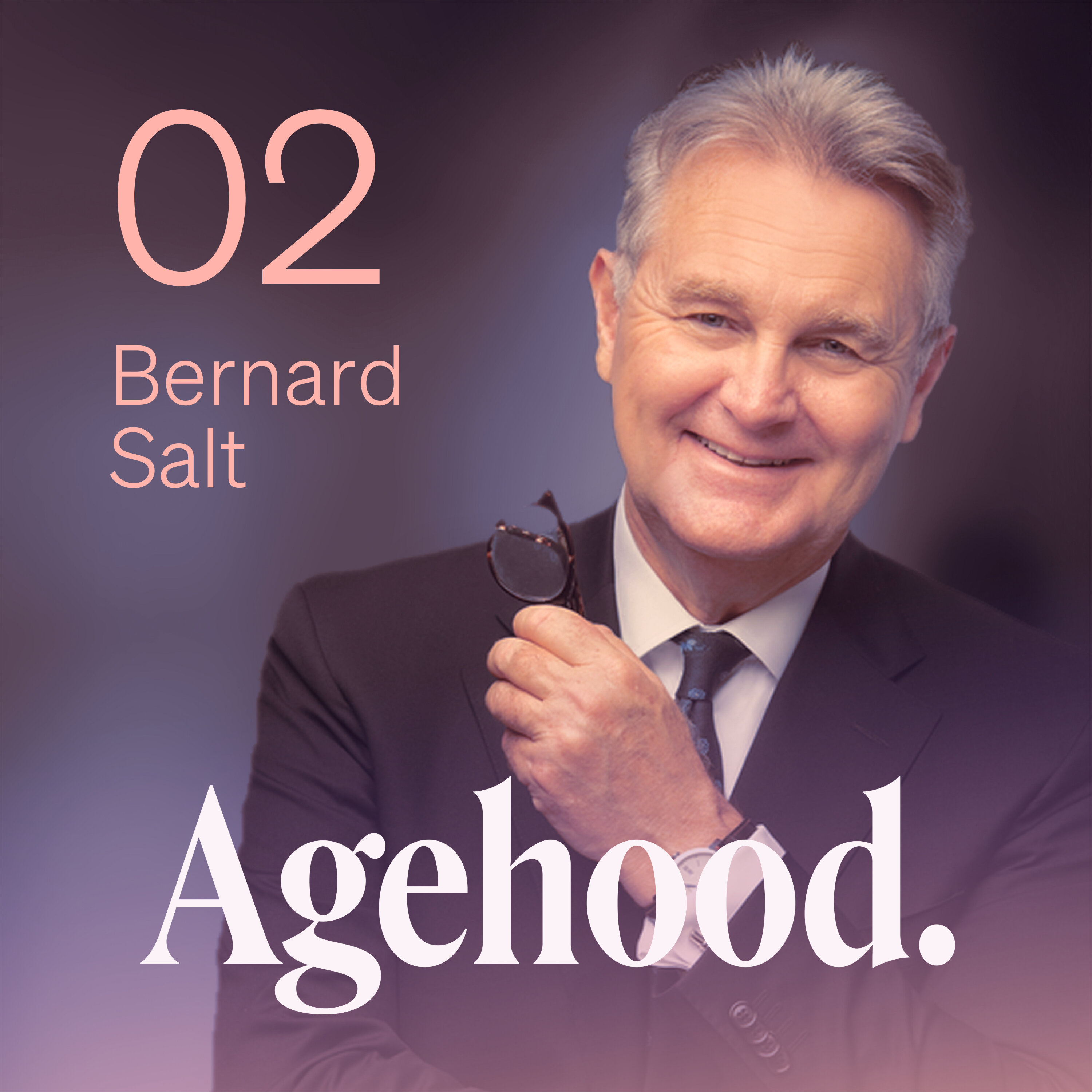
The care cliff is coming: Bernard Salt on the future of family, aging & letting go
Australia is on the edge of a demographic cliff — and according to leading demographer Bernard Salt, we’re nowhere near ready.
In this episode of Agehood, Bernard joins host Melissa Reader to unpack the numbers behind our aging population, the rising pressure on families, and the looming care crisis that will land hardest on women in their 50s and 60s.
With his trademark clarity and insight, Bernard explains why the sandwich generation is growing, what the economic and emotional load of caring will look like over the next decade, and how we can start to prepare now — as individuals, families, and a nation.
It’s a wake-up call wrapped in data, empathy and urgency — and a must-listen for anyone navigating aging, caregiving, or planning for what’s next.
FIND OUT MORE
If you’re caring for aging parents, navigating your own next chapter, or just trying to keep all the balls in the air—you’re not alone. At Violet, we offer free tools and support to help families navigate the last stage of life with care and confidence. Visit violet.org.au to start the conversation.
CREDITS
Host: Melissa Reader
With thanks to Bernard Salt
Executive Producer: Lize Ratliff
Find out more about Violet at violet.org.au
Agehood is the podcast that finally says what we're all thinking but rarely saying out loud. Hosted by Melissa Reader, CEO of Violet, we have the conversations that matter most: watching our parents age, being everyone's go-to person, the mess of love and duty, what it really takes to care for those we love, and yes, death, dying, and loss.
You'll hear Australia's most trusted voices, from beloved broadcasters to respected experts, vulnerably sharing their own stories alongside practical guidance that actually helps. This isn't about having all the answers—it's about asking the right questions and knowing you're not alone.
See omnystudio.com/listener for privacy information.
Transcript
Hi, I'm Melissa Reeder and welcome to.
Agehood, the podcast for people who are quietly carrying it all.
Aging parents, adult kids, your own work.
And your own next chapter.
If that sounds a little like you, well, you are in your age hood and it's time we talked about it. Last week, we unpacked the realities of what it's actually like being in the sandwich generation when journalist Sarah McDonald shared her story with us. And today we're looking at what stories like Sarah's and maybe yours mean for the rest of the country. Bernard Salt is a man known for turning really complex data into compelling human stories. He's a social commentator, he's a columnist for the Australian, and he's also founder of the Demographics Group. And you might remember him best, actually, as the man who questioned why younger generations were spending a lot of money on smashed avocado on toast instead of.
Saving for a house.
Today on Agehood, Bernard joins me to unpack the growing pressure on Generation X, particularly women, as they care for aging parents while still supporting their own children and their own careers. He really helps us to break down the numbers behind Australia's rapidly aging population. This coming spike in people that are reaching 85 in the next five or six years, and what that's going to mean for families, care systems and our economy, but also our own emotional bandwidth. We talk about loneliness, about loss and about grief. Agehood is brought to you by Wellways Carer Gateway, an incredible organisation offering free counselling, care, coaching and peer support to people in the community who are supporting a family member or a friend with a disability, a medical condition, mental illness, or maybe frail and elderly due to age. Just call 1-800-422-737 or visit wellways.org CarerGateway Sad Men is the unexpected burden of endless bureaucracy during times of deep brief. Wills are important, but they don't give critical information like passwords, bank accounts and bills. For that, you need a letter of wishes from today's sponsor, BillWill. Go to BillWill.com for a simple and secure way to reduce stress for your loved ones, share your values and preserve your voice.
Bernard Salt, hello and thank you for coming and having a chat with me on Age Hood today.
My pleasure.
It's really lovely to have you here. I know many listeners will know you as a very insightful columnist from the Australian and also founder of the Demographics Group, where you have provided that very specialist lens on social trends and demographic shifts. But alongside your superpower with numbers, you are an exceptional storyteller. I'M not going to be the first to tell you that you have an incredible, unmatched ability to take what could be quite dry statistical narrative and really paint a vivid picture about who we are as Australians and how we're evolving as a society.
I like the idea of taking simple numbers and looking for the story behind the numbers. And to my surprise, over the years I've discovered that business likes that as well, because I think they're getting advice from advisors saying, well, I think this or I reckon that or whatever. Whereas I say here are some numbers and here is what I think they are saying about Australian values, Australian behaviour. So there's a metric basis to what I say. Whether in fact what I'm saying is right or not is another question, but at least there is some sort of basis to what I'm saying.
Business people are people and people love stories. So it's, you know, there's a circular aspect to that. I'd also say that you are Australia's unofficial wordsmith of social trends. You're brilliant coining of the smashed Avocado Back in 2016, very colourful debate on the housing affordability crisis that followed.
It most certainly did hit a nerve, not just in Australia, but globally as well. So. But you know, I think that's part of the challenge, you know, to raise stories or raise issues and to do it in a way that connects with people, I think. Yeah.
And we've been doing some of that work together over the last couple of months around really bringing some colour and context to concept of the sandwich generation, which we know is a very real experience for about 5 million Australians. So I'm really looking forward to opening that conversation up today and understanding both the numbers and the stories behind it.
A lot of my colour in my analysis involves food. So smashed avocados or sandwich. Sandwich generation. Very early on in my career I talked about the donut effect, which is where people were leaving the inner city and creating this doughnut. It's all filled in, of course, since then, but I think being able to connect a movement or a social observation to something that is every day that people connect with, it's just part of the way of building the, the connection, the story. In fact, the sandwich generation effectively defines people in their 50s who are looking after their 80 something parents and at the same time they have responsibility in many ways for their 20 something kids as well now adults, but forming relationships and getting jobs and whatever and also managing their own work, their own relationships. So they feel as though, and to be fair, that they're at that time in life where they are the meat in the sandwich, the filling in the.
Sandwich, the triple decker sandwich, the triple.
Decker, the club sandwich generation, if we want to be really specific about it. But yes, and that, that is effectively generation X at the moment dealing with, dealing with parents and their aging parents and coming age kids as well, and managing in many respects their own circumstances because they're still at work and relationships and whatever.
Many people are at the peak of their careers. I think there's, there's just so much playing out stories that we're hearing through these submissions of just trying to keep it all together and being stretched incredibly thin. And I would say we're at the.
Beginning of that wave, you know, so.
Let, let's talk a little bit about the aging population that's ahead of us because it's, you know, it's a, it's a term that's again, kind of tossed about. But you've taught me so much about the numbers. So can you, can you take us through it?
Well, I think there's a number of ways that you can measure or reflect the, the aging of the population. The one that I like to use is what I call the, the 85 plus bucket. So the total population in Australia aged 80 plus is increasing over time because of longevity. We're living longer, healthier lives. So there's more people hanging around beyond the age of 85. And the issue is the way in which this is going to escalate in the future. At the moment, the number of people turning 85 and remaining alive right through into their 90s and so forth, that bucket is growing by around about 1012, maybe 15,000 people per year. So that goes to the issue of how many nursing home beds and aged care workers you might need. Now. Not everyone over the age of 85 requires those services. But to be fair, if you're 85 plus, you're in the zone. And we need to be ratcheting up the infrastructure and the spending to maintain quality of life for people aged 85 plus. The issue is that the number of people in that bucket has been growing at 5, 10, up to 15,000 per year for the last 50 years. We've gotten used to that. Over the next six years, the rate of growth is going to go from 10, 15 to in fact it was 62,000 people per year in the early 2000-30s. And the reason for that is that the very first baby boomer ever Invented, born in 1946, tips across the 85 line in 2031, 2032 or so. And so it's the baby boomer generation remaining healthy, living longer, living into later life, living beyond the age of 85 in accelerating numbers literally over the next 10 years and exponentially over the next five or six years, that creates the challenge or the problem.
And that's a five fold increase.
It's a five fold increase. And when you've probably built a career in healthcare, aged care, public administration, Coping with the 85 plus bucket expanding by 5 or 10,000 per year, you can kind of manage it. If it all of a sudden then goes to 60,000, then it explodes. And I think this is the issue with the baby generation. At every stage of the life cycle, they have had an impact as hippies, punks, dinks and yuppies. So they created the hippie movement in Australian major cities. When they went to universities in their teenage, late teenage years, 20 something went to build new universities like Macquarie in Sydney, Flinders in Adelaide, Griffith in Brisbane, Monash in Melbourne. So when they pass through a stage in the life cycle, there is an impact. And while they remain in the workforce, well, that generates wealth and prosperity. They're earning an income, they're paying tax, the tax base rises. It kind of is an issue in the 2020s as they start to come out of the workforce. It is a real issue when they start impacting the 85+ bucket, where the demand for healthcare and care services absolutely skyrockets. And that's the phase that we're going through over the next 10 years.
And arguably this is going to have.
An impact on almost every family, almost every community across the country in one way or another. And I think it's important to remember these are elderly Australians who have contributed to everything this country has achieved for the course of their lives. So how do we think about the kind of care that that group need and how ready are we to provide it?
Well, I always argue that it's not just the 85 plus people themselves, of course, needing services and care and support and so forth. It is the families that reverberate down the next generation, the people caring for them, the people probably administering and managing their care in their 50s. Today's Generation X's and grandchildren, of course, in their teens and early 20s. So what happens to the 85 plus bucket has an echo effect in the 50s and in the 20s as well. There's another, there's another piece of information, demographic information, I think is really important in this story, and that is that there is a, there is a new question that was asked at the last census, we have a census every five years. We ask 62 questions. The Americans have a census every 10 years. They ask 12 questions. It's a big deal to whack another question into the census. We've already got 62, you can't be adding questions willy nilly. The question that got across the line was, have you ever been told by a healthcare professional, doctor or a nurse that you have a long term mental health condition, anxiety or depression? The, the answers to that question were absolutely significant. About 10% of the population said yes that they have been told at some time in their life. When you look at it across the age profile, it the anxiety and depression in the average Australian subsides after the age of 65. The minute you leave work, all your anxiety and depression and you know, you've got grandkids arriving, you've paid off your house, your kids are partnered up, you know, everything seems to be fine. Yeah, they're gone years and you know, you might have a couple of health issues, but they're not dire in your late 60s and 70s generally. But it skyrockets at the age of 78, 79 and 80 and remains elevated right across the 80s and gets even worse into the 90s. And the reason for that, I think is the loss of a life partner. Typically the male grandpa will pass away at about 70, 78, 79, 80, grandma is left alone. And of course that then creates what I think we're going to see with the aging of the baby boomers, a loneliness epidemic. The oldest baby boomer today, born in 1946, is 79. So we've got 5 million baby boomers pushing into their late 70s, early 80s and progressively, literally over the next five years, we are going to see a rise in people living singly and we're going to see a rise in loneliness. Now, loneliness is offset by connectivity, connectivity to the community and to the family. So these are the issues that we will need to be addressing as a nation. In addition to the straight health care age care costs that come with the arrival of that generation.
Yeah, there are the hard costs and the soft costs aren't there that sit with this? One of the really interesting things, and you and I have talked about this a little bit previously, when you think about that statistic is I wonder what the role of grief is in those mental health statistics. Because you think about the prevalence of dementia, you think about what it means to lose your life partner or even have your life partner go into residential care. There's anticipatory grief that happens from a diagnosis, from one of those changes right through to actual bereavement.
Well, grief and bereavement is very real, of course, and especially for, for people who've been married for 50 years or so, their way of life, the whole family, the whole community is interlinked with someone else and then all of a sudden they pass away. And that is not always an easy transition. It often comes more often than not.
Incredibly hard, isn't it? So painful.
Very painful, very difficult, very stressful and requires not just, not just the engagement of a life partner, but also your kids. Losing a parent in your 50s is still a painful experience. Grief and in fact, in many respects there's so much history, so much connectivity, so much emotion, identity. And so yes, it does cause stress. I will also say that there's another stress that comes with this, that not everyone comes from a happy family that is functioning and works together where all the siblings are.
I think most families have a story where that is not the case.
Every time I raise this, everyone puts their hand up and says, oh, that's us, that's us.
Let me tell you about what happens.
But you know, in an ideal world, it's hard enough when everyone is working together, has the same values, the same thinking, same priorities in making these transitions for mum and dad or for mum, because dad's passed away or whatever.
So I find that bit really, really interesting because when we look at really the overwhelming lack of people's ability to talk about or plan for this life stage, you end up with those really complex family dynamics that you're talking about. Everyone's not on the same page. Siblings might be interstate, the eldest brother might fly in at the last moment, mightn't have seen mum for two years, but suddenly wants everything done for mum. And then you look at the data or the correlation between non beneficial treatment and complex family dynamics and it drives up to 30, 35% of low value futile treatment. And that's incredibly confronting.
Well, it is, it's very, very stressful, very difficult. And there is another layer to this around inheritance and wills and assets and money, money and family meaning money here. So yes, it is fraught. It is fraught and it's hardest, it's hard with the best circumstances and it's doubly triply fraught when there are unique family dynamics driving this as well.
And even in your example of the best family dynamics, we look at the case across Australia Today, less than 14% of people have a plan in place for this life stage. And I would argue that even fewer than 14% would be meaningful. And talked about 11% of people have a power of attorney.
Yep. I wonder whether in fact, there's things that we can be doing. Public programs, public awareness programs. Look, we get it that not everyone comes from, you know, the perfect family. What can we do? What are some easy steps in order to facilitate this or make it as easy and as seamless as possible? If you think of some basic healthcare advice, look, you might not be wanting to jog every day or whatever, but here are some basic things you can do. Don't smoke, don't take drugs, have a balanced diet, for example. Well, here are three things that you can do in your 50s to help create that. That preferred transition for your parents in their. In their 80s and your. And for your siblings and the next generation as well.
To think about really what is a chapter of life, you know, for everybody involved. I often use the example of what I imagine to be a very brave individual in a boardroom that might have stood up and proposed that we test people's poo when they turned 50. He probably got laughed, man or woman, probably got laughed out of the room. But here we are now with the national program, which has incredibly high efficacy and we've normalised it, so we've got an incredible track record around. My gosh, you know, spf, smoking cessation, mental health, this is one that we just haven't tackled, we haven't leaned into yet, and it's about time we did.
Well, I agree. And I think these basic healthcare measures, it goes to a core value that I think applies to Australians. My overarching view, you know, my 40 years in demographics and I formed some views about what drives Australians and it is the relentless pursuit of lifestyle, quality of life. It's why housing is so important to Australians as well as travel. We're a colonial people, long way away. We like to travel, we like to invest in our homes and to maintain good quality of life. Now, the whole Daryl Kerrigan thing absolutely hit the button. An aspect of that. Once lifestyle and housing is managed, the next thing I think is wellness and quality of life. In later, more years, lived better at a. At a better quality of life. So I think Australians are interested, very interested in wellness, keeping fit, keeping healthy, not necessarily at. At Olympian levels, but at, you know, what can I do to live a good quality of life, to enjoy my quality of life, remain mobile, remain connected into my 60s, 70s, 80s and beyond? I think it goes to that core Australian value of quality of life.
It's interesting because we tend to think about this last chapter of life with a very medical, clinical lens, whereas it's actually not about medicine, it's about people, it's about what's important to us and our parents and our in laws and where we want to be, the kind of care we want or don't want, and how we get some fundamental conversations and understand that together.
Very interestingly, there's another question in the census that I'm a big fan of. The census?
Yeah, you ought to be in your line of work.
I imagine the question around what a. Your religious affiliation? Now, most Australians these days say they're nothing, you know, that's tick the box, say that they don't have any religious affiliation. But of those that do, and there's a little more than half do, when you look at the age profile, the people least likely to say they have a religious affiliation are age 23. At 23, you're young, you're fit, you're healthy, your parents are alive, you don't have kids, so you don't have to think about that. And even your grandparents are probably still around, so don't kind of think of it, I suppose. But then it steadily rises the proportion of people who say they have some form of religious belief system. And the people most likely to believe in a God are aged in their late 80s. The closer you get to the end of life, the more you do think about these sorts of things. Now, is it because you're thinking about the end of life or is it because if you're in your 80s, almost 90 now, you've gone, you probably remember, maybe even remember the Depression, the Second World War, all of the privations thereof. And you might come from an era where religious belief systems were stronger, perhaps, or you become more reflective, more concerned about the meaning of life. It's very interesting. My own mother died at the age of 95. She was very devout right throughout her life and so. But she, she would say is very philosophical, had wonderful discussions with her. She would say, you know, later in life, even with her belief system, she would say her question was, what is the purpose? What is the, what is the. It's that question, what is the meaning of life? And so I think that you do grapple with those issues in your 80s and 90s. In fact, it's a different perspective on life when you're 23, 33, 43, young, you fit, you're healthy, you're pursuing a career, you're building a home, all that sort of thing. There's not the Space to actually focus on, well, religion.
Religion brings comfort, it brings anchor, it brings identity. And, you know, if you correlate that conversation with what we were talking about earlier around mental health issues, loneliness, grief, you can understand why people. I mean, the strangest thing happened to me after my husband died. I did go to Catholic schools, but I certainly didn't kind of stay religious in my view. But I found myself back in church for the first few months after he died. And I can't even explain that today. I just needed somewhere that maybe felt comforting and familiar in the. In the strangest of ways.
There's no doubt that there is a tremendous role that, that is fulfilled by religious belief systems for those in what they would say is their hour of need, their time of need. And I think it's a human condition or need that is not just relevant today. It's been for thousands of years.
Has changed so much, hasn't it? I think people would have turned to the doctor or the priest to make sense of someone aging or approaching the end of their life or dying. And that relationship is so different now in modern society that there something else needs to emerge to help us make sense of this and be able to talk about it together.
Well, that's true. I'm not quite sure what that. That is. Maybe there's a. There's a role for influences to say, look, here is how to discuss the pathway forward, to normalize it. Exactly. And that's right.
Coming up, we hear about how Bernard was interviewing his mum two weeks before she died and what she had to say in the last weeks of her life. Season 1 of Age Hood is brought to you by Wellways Carer Gateway. Dad's fallen again. The kids won't listen. Your boss is really losing patience. And that voice in your head is saying, you're failing it.
Everyone.
Hey, you're not. You're human. And you don't have to do this alone. Wellways Carer Gateway. Know that caring for someone that you love, it can be really tough, whether they have a disability, a mental illness, or being elderly and frail. And Wellways are offering free counseling, coaching and peer support because you just shouldn't have to do this alone. Call 1-800-422-737 or visit wellways.orgcarergateway and find. Find the support that's really right for you. If you're out there caring for someone that you love and you need more help with this chapter of life, you can also access Violet's support programs. They are fully funded through the wellways Carer, Gateway.
You talked a little bit about your mum there, Bernard. I know you've written about your mum in some of your columns over the years. Tell us a little bit about how you found the experience of her aging her in her 90s, I guess. Were you able to talk to her about that chapter of life in terms of what was important to her?
Yes, very, very much so. In fact, I interviewed her, rang her. I live in Melbourne, she lives in a. Lived in a Victorian country town. So I rang her and said, would you mind if I interviewed you for my column in the Australian? And she was delighted, of course. And so I had the chance to ask her at the ages. She was 94, coming up for a 95th birthday and she died two weeks after her 95th birthday. And so it was an excuse for me to ask questions. Sometimes you need that. You can't just bowl up after 50 years and start asking questions. It kind of looks odd.
Very unnerving for people.
Yeah, that's right. But I had the. And one of the questions I asked was. And I wrote about this mum, now that you're, you know, you're approaching 95, you know, you must see that this is. You're coming towards the close of life and so forth. Are you concerned about dying? That's the question I wanted to ask. I couched it as politely as I possibly could. She scoffed and said, no, no, I'm ready, I'm ready. And she was, she was incredibly devout Catholic, of course, and she prayed the rosary twice a day since she was 8 years old. So was that 88 years? Twice? I don't know what the mathematics are of that.
Well, if you don't know, then I definitely don't know.
And I mean, I'm not a church going Catholic myself, but a rosary is 50 prayers, 55 prayers or whatever it is. And she and her sister would say, I could knock it off in 10 minutes without knocking off the rosary.
My nana was like that, very efficient with prayers, very efficient.
But if you think about it, saying the same words twice a day, 50 words, 50 prayers twice a day for 88 years, it is akin to meditation in a modern sense. We'd say this is pure mindfulness. And when I look at the person, I wasn't aware. I knew she was devout, but I didn't know until that moment, it was effectively a month before she died, that this was twice a day in fact. And you think, well, that explains the strength of character, her surety, the anchor. The anchor, in fact. So it's so Interesting. And it also has been very. It was very reassuring for me in the sense that, well, 95, it's pretty good innings, as they say. And she was not concerned. Oh, she died in her sleep, in fact. So it was perfect from that point of view. And I think I will mum. She died on her terms, in her way, and she was ready. And to me that was. I could not have asked for and she would not have asked for anything, anything better. I think so. But I'm deeply aware that this is not everyone's experience. I feel incredibly lucky to have had that, that experience also, just the way.
You'Ve told me that story. There is a gentleness but a reassurance in the way that you're thinking about that chapter of your mum's life. And in all of the conversations I have, more often than not, people have a very palpable element of regret as they tell those stories. So I think you're right. It's. You're probably far more the exception than the rule in the way that that happened for you and your mum.
I think, I think she knew the end was near and I think she was reassuring me in her words. If I look back and I've analyzed the words, of course. And so I think it was her making it easy for me. And I thought, you know, if I'm in that situation years, decades into the future. Yes, I think that's probably what I would want.
You've got a role model to.
I have. I have indeed. Yes, that's right.
I think the research is telling us that about 90% of us want to be at home. We want to age in place for as long as we possibly can. A lot of people would like to die at home, if that's at all possible. The reality or the misalignment of what's happening in the system today is almost the extreme opposite of that. And I'm interested on your thoughts around a post pandemic society. You spoke so eloquently for us in Parliament House earlier this year around the fact that we work from home, shop from home, Netflix from home, telehealth from home. How do we think about caring for aging loved ones at home, where they want to be, in the way that our home has changed so much?
Well, I think this is very much the way of the future. In fact, I've done quite a bit of work in ageing, demographics of ageing with the hospital sector around Australia and there's a movement called hospital in the home. So you're quite right. Work from home Shop from home, telehealth from home, care is provided in home and hospital in the home. And I think ultimately working towards a situation where if this is your choice, to be able to pass away, to die at home, not necessarily surrounded by your family, but in, but in circumstances that you are comfortable with. And there's also a practical element to this. There are so many baby boomers that are pushing into their 80s who will pass away over the next five, 10, 20 years or so. It simply is. Makes good economic sense for. To open up this option for those who feel that this is a pathway that, that I would prefer as opposed to the, the alternative pathway, which is to go into care and, and to possibly be separated from family or whatever at the time when it happens, or.
To not talk about it or plan for it and end up just kind of in the muddle. And the mix of a fall or an infection or a series of events that takes you into those very stressed hospital corridors where so many families are faced with those decisions today.
Well, this, this goes to my issue of how do we make this pathway easier for people and for families into the future? And you use the phrase some people have not had the discussions or need to have. We need systems to enable these discussions to take place Now. I was very lucky because I had the excuse. Can I write a column on you? I'm turning 95. I'm sure I would have inspired a.
Lot of people today.
Well, I would like to, I would like to think I would have found another pathway, but I didn't know the end was only a month away at that, at that stage. So is there a way in which you can build in a way of normalizing those discussions? Can it be on their birthday? Can it be on their wedding anniversary? Or can it be at Christmas time where seemingly or hitherto difficult discussions can be broached, in fact, and to secure a conversation with the older person as to what they would want. I know it's very confronting, it's very, very delicate. I was very fortunate being able to navigate it. But it has been such. I think it was also help to my mother and it was been incredibly helpful to me as well to say, well, yes, you know, it's what she wanted, she was happy. And of course it has to happen to all of us at some point. If it must happen, then here is the best way for it to occur.
Those conversations are really, they're really transformative. They take us into places that we never thought we could go to talk about with each other, but they're not often single conversations. What we find is that there's often little moments in time where you can sow a seed of an intention to have a conversation. I talk a lot about just gently opening the door a little bit, a little bit wider. You might get a sense that there's a willingness or there might be a situation where you can put a question forward that makes that more possible. But you're so right to say that you sensed your mum got relief from that conversation because we hear that all the time. So it's about the normalising a little bit of courage, a little bit of grace and humility and stepping into those conversations and bringing them back to the kitchen table so we're not in those rushed.
There was another point of that discussion that I thought was very, very interesting. My mother didn't swear, of course. Of course. And, you know, not even, not even in the slightest way, you know, not even a. I did her refer once. She said, you know, this, this kid said the B word. I don't even. She probably does know there are other, other letter words or whatever, but she would never say oh my God. Even, even oh my God. Which is OMG these days. And it had never occurred to me until I was in that discussion. Mum, I've never heard you even say something like oh, my God, have you ever? She said no. And I said, that's a choice, isn't it? She said, yes. And again, it comes back to this incredible self discipline. She never told us not to. That is what worked for her. I did not discover that until a month before she, before she died.
Do you know if any of you. I know you have brothers and sisters. I don't remember how many. Did they have any conversations with your mum or were you the one that kind of instigated that and did you share it with them?
My. My sister, I think, had discussions, but not, not in the forensic way that. Interview your mum, I think she interviewed her. But, you know, none of this, none of these sorts of observations really, really surprised them at all. So anyway, look, it was. When I look back, it was. It was a positive experience in many respects and a releasing experience in that. In that. That conversation enabled me to move on in a very positive, happy, relieving sort of. Sort of way.
I'm so pleased that that's how that played out for you and your. Your family. We are sitting here in the week after the election and I'm not going to get too political. Don't worry, I'm not going to take us down. That Path, but I'm thinking about those 5 million Australians. And again, through your analysis, you know, you've helped paint a picture of typically a 58 year old woman. That's what the numbers tell us, isn't it? And I just didn't get any sense from any of the major parties that the reality of the aging population was part of, of the political conversation. And that surprises me. It worries me. What's your view on that given this is five or six years away?
Well, yes, I think it is something that we can not talk about, but it's going to come up and bite us on the backside at some point. And yes, I do, I do make the point that it is 58 year old women who do most of the care. And that goes to the census question of do you provide unpaid care to anyone? And the people that say yes, they do the most are 58 year old women. And then it drops away because at 59 and 60, mum or dad has died off. There is a sense of relief. In fact, that's typically the way it works. But I suppose I wonder whether in fact aging and the baby boomer needs and so forth, healthcare needs and you know, the transition to passing on this is all five, ten plus years out beyond the electoral cycle perhaps. But I'm hopeful that as these trends gather momentum and escalate over 20, 25, 26, 27, 28, towards 2032, that will develop an appetite. We can see what's coming and we do need to take action in order to deliver the services and the systems to manage this.
And there's some incredibly great work happening to expand home care services nationally. We know that, you know, there's a lot of reform through aged care and home care very, very broadly. But I think the idea as a society to be able to start to talk about and plan for this, that needs to happen now. That can't wait another three, four or five years. There's going to be a lot of pain and a lot of cost for a lot of people if we leave that too much longer.
Well, you can, you can see it gathering momentum. It's like you can tell after a long dry summer. You can smell rain from beyond the horizon, you can see the clouds, you can, you know, there's temperature change, you can actually see that there's, there's something coming. A good example of seeing what's coming is the, the Australian Bureau of Statistics estimates of the number of people in a single occupation. That occupation being aged and disabled carer is the time that the job, it's about 400,000 of them at the moment. And they are growing. That category of worker is growing at about two and a half thousand per month. And it's been doing that per month. And my expectation is that by 2030. By 20, by 2032, it'll be the largest single occupation in Australia, replacing shop assistant, which is about half a million at the moment. And so the whole issue there is one of. So there's two and a half thousand extra aged care workers finding employment every month. How many people do you need to interview to get two and a half thousand net extra? It'd be three and a half thousand. Who is training? What is the accreditation system? What is the process by which these workers? And the oldest baby boomer is barely 79. They're not even in the real zone yet. So this is gathering momentum at a rate of knots and the peak is still in the early2030s. In fact, you can feel the storm clouds gathering or see the storm clouds gathering for what lies not in this electoral cycle, but in the next electoral.
Cycle, which is not that far away. And just on that kind of theme of, I guess, productivity, you know, so many of our women and men in this sandwich generation, you know, there's going to be a huge downward pressure on productivity as a result of this caregiver role. What is required of those people and their families as they care for, for aging parents and in laws. And I think that's a real blind spot as well.
Well, yes, you could argue that it is a drag on productivity. However, in a civil society, this is what is required when you have this number of people at that stage in the life cycle. There's also the argument that technology can play a role here and not necessarily technology in aged care worker. There might be little bits and pieces, but managing a care is a very human tactile thing. You need to be able to to be there. However, a good example of this is the number of waiters on the Australian continent peaked five years ago 2019. Number of people taking orders at a cafe, bar, restaurant, whatever it is, we still have not recovered to the number of waiters we had in 2019. And I'm thinking, okay, so people who were waiters have gone off during the pandemic and found something else to do. Do they move into aged care worker? Because waiters these days have been partially offset with technology by QR codes.
Absolutely.
Sit down to cafe that was born.
In Covid, that was born in those times. Types of solutions.
So technology QR codes has released labor from one area to enable it to go to another area. So there are ways in which I think technology can deliver productivity gains. But the fact of the matter is we are a civil society with a sense of civic responsibility to caring for those who need care. And for the first time in human history, we're going to have vast proportions of our population over the age of 80, over the age of 85. We need to come up with a system that delivers the care that that cohort will require.
And we need to start that very quickly. I hope that the work that we're doing will be part of that solution at scale, part of that normalising, part of helping people have those conversations and have a meaningful plan. But I think, you know, we are just part of a very big and complex jigsaw. And the headline here is, it is a life stage. It is a chapter of life. It is not a week or a day or an hour in time. It's not something many of us are going to escape either.
So, you know, we've got to get better at it.
Most certainly we do. And I think this is one of the great challenges for our generation. How long have Homo sapiens been on the planet? I think it's like we can go back millions of years, but certainly Homo sapiens 3, 4, 500,000 years. We are the first generation to actually have a vast number of people beyond the working stage of the life cycle. Well beyond the working stage of the life cycle, requiring care from the entire community. We need a political system, we need an economic system to actually deliver that care. So we need to develop the protocols, the systems that actually will deliver that. At its peak, its peak will come in the2030s. You can actually project it and you.
Have, based on the 20, 30.
And we need to have those discussions now. Now, this is not something we need to be panicking about, but quietly, purposefully planning and responding to those challenges is the great challenge of the next decade.
That's a fabulous place for us to land. Thank you for the conversation. Thanks for the work we've been doing together. And let's hope that we do see some of those shifting tides, shift, shifting sands around, normalising this life chapter over the next three, five and ten years.
Thanks, Melissa. It's been a pleasure.
Thanks, Bernard.
You can find more about Bernard's work by reading his weekly column in the Australian. It's always a good read. At Violet, we really believe that the last stages of life, they deserve the same care and planning and attention as every other milestone. And that that's why we're offering support and guidance and tools for families just like yours so that no one has to face this unprepared or unsupported. If you'd like help making a meaningful plan, starting an important conversation, or you.
Just need to feel a little less.
Overwhelmed, head to violet.org au and if this episode helped you, please share it with someone who needs it.
We'd love you to follow Agehood.
Leave us a review and join us again next week when we sit down to talk to Nikki Gemmell, one of Australia's most well known and loved authors, to talk about her experiences and two very different stories of death. If any of today's topics brought up difficult feelings for you or you need some help with this chapter of life, Violet is here to help you with free phone chats to connect you with the right support. One on one support programs from trained Violet guides help with care, emotions and having those important conversations as well as online tools for healthcare wishes and decisions. And remember, you don't have to figure this out alone. Startwithviolet.org au Today's episode of Agehood was brought to you by Wellways Carer Gateway. They're offering free counselling, carer coaching and peer group sessions to people out in the community who are supporting a family member or a friend with a disability, a medical condition, a mental illness, or who is maybe frail due to age. And this is all provided by an incredibly caring team who understand what you're going through. You don't have to do this alone, just call 1-800-422737 or visit Wellways. This episode of Agehood was brought to you by Bill Will. Sadmen is an unpleasant, often unexpected burden during times of deep grief and lightening that burden for those closest to you with a letter of wishes from Bill Will is really an act of love. Help navigate the tangle of passwords, the bank accounts, the bills and more, all while expressing your your personal preferences. Reduce stress for your loved ones, share your values and preserve your voice@billwill.com au.