
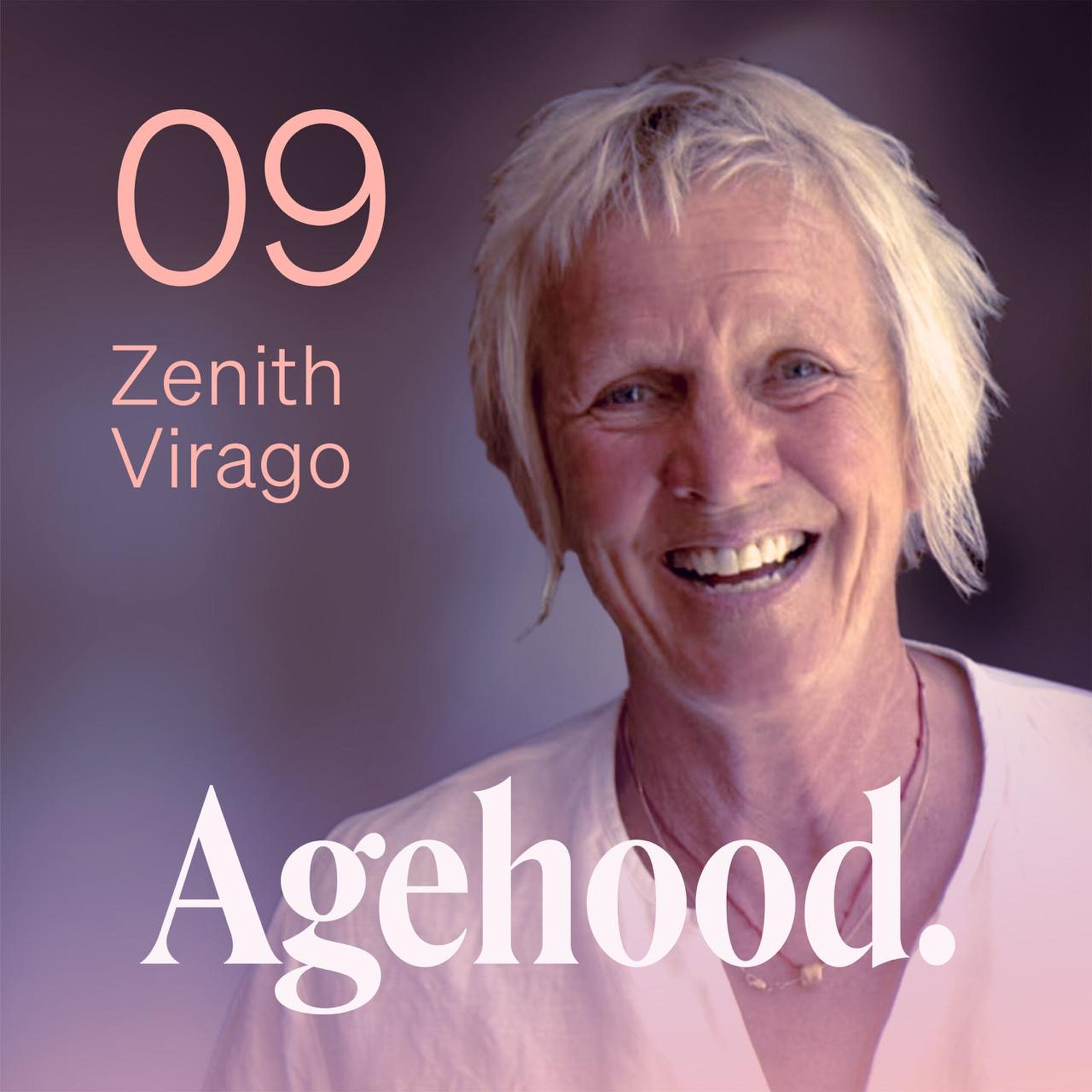
Inside the life of a death walker - with Zenith Virago
Zenith Virago is a death walker — someone who walks alongside people as they approach the end of life. For more than three decades, she’s supported individuals and families through death, grief, and everything in between — from the bedside to the burial, from the paperwork to the heartbreak. In this powerful and moving conversation, Zenith invites us to see death not as a medical event, but as a human one — something to be approached with presence, love, and participation.
Together, we explore the practical and emotional realities of end-of-life care, what it means to reclaim dying as a natural part of life, and how the “sandwich generation” can begin preparing — for our parents, for our children, and for ourselves. If you’ve ever felt unsure about what to do or say when someone is dying, or how to honour them when they’re gone, this episode is full of clarity, comfort, and unexpected strength.
FIND OUT MORE
If you’re caring for aging parents, navigating your own next chapter, or just trying to keep all the balls in the air—you’re not alone. At Violet, we offer free tools and support to help families navigate the last stage of life with care and confidence. Visit violet.org.au to start the conversation.
CREDITS
Host: Melissa Reader
Guest: Zenith Virago
Executive Producer: Lize Ratliff
Find out more about Violet at violet.org.au
Agehood is the podcast that finally says what we're all thinking but rarely saying out loud. Hosted by Melissa Reader, CEO of Violet, we have the conversations that matter most: watching our parents age, being everyone's go-to person, the mess of love and duty, what it really takes to care for those we love, and yes, death, dying, and loss.
You'll hear Australia's most trusted voices, from beloved broadcasters to respected experts, vulnerably sharing their own stories alongside practical guidance that actually helps. This isn't about having all the answers—it's about asking the right questions and knowing you're not alone.
See omnystudio.com/listener for privacy information.
Transcript
Foreign.
Hi, I'm Melissa Reeder, and welcome to Agehood, the podcast for us midlifers who are quietly carrying it all. Aging parents, adult kids, careers, and our own next chapter. And if it's sounding like you, you're in your agehood, it's time we talked about it. My guest today has described herself as a death walker, someone who walks alongside people in their final chapter of life, offering presence, guidance and care as they die. It's a role that sounds ancient, and it is. But in our modern world, it's also quite deeply radical. For more than three decades, Zenith Virago has supported three thousands of individuals and families through death. From the bedside to the burial, from the paperwork to the heartbreak. She's helped people die with agency and she's helped families grieve with love, all while challenging the cultural silence and fear that so often surrounds the end of life. In this conversation, we explore what it means to to face death your own or a loved one's, with eyes and hearts wide open. We talk about participating in death care, about trauma and truth telling, and about the gentle strength that it takes to stay present when everything else is falling away. This is a conversation about death, but it's also about life and how to meet both with as much grace as we can. Today's episode of Agehood has been brought to you by Wellways Carer Gateway. Wellways deliver free Carer Gateway services across Queensland and also across parts of New South Wales. They're designed by carers for carers, and the services really focus on building skills, easing stress, and helping you to stay strong in your caring role. Because when you look after yourself, you're in a better place to care. Care for the people who need you. Call 1-800-422-737 or search Wellways Carer Gateway to connect with your local team. A will is vital, but it's not designed to keep up with all of the personal, the practical and the financial details of our modern lives. Things like passwords, bank accounts and bills. They often go unrecorded. And while life is complicated, a legacy doesn't have to be. That's where a letter of wishes from today's sponsor, Billwill, comes in. It's a simple and secure way to reduce stress for your loved ones, to share your values and preserve your voice. And it can save hundreds of hours of admin down the line. Visit billwill.comau to get started.
Zenith. Hi, welcome to Age Hood, the podcast. It's really great to have you in a conversation today. I've known about your work for so long and you describe yourself as a death walker.
I do for many years, probably 15 years, I was working with people who were dying or were bereaved or with the bodies of the dead. And I didn't have a name for what I did. And then after about 15 years I thought, what am I doing? What am I actually doing? And I just thought I am walking with those people, I am accompanying them in their journey, but I'm not actually doing anything for them. I'm encouraging them, inviting them to do what they need to do as the dying person or as family and friends.
It's quite different, isn't it, from a kind of palliative care nurse or a funeral director. How do you describe the difference to people?
It's a non medical role. So I don't often I don't even ask people what they're dying from when I go to meet them because I sort of have nothing to contribute to that side of their situation. And that's for the medical people or other health professionals. And the funeral director is generally only dealing with the collection and conveyance and processing of the person once they've died, towards the burial or cremation. So that after death care. Whereas people like me are working with people when they're. Well, when they're dying, when they have died. And we might be working with the family and not the dying person because they don't want to talk to anybody. So it's a very across the board. You're responding to whatever is in front of you, whatever the request for assistance or help is. So normally I just say to people, what do you want from me? Because I have an incredible wealth of experience now. I have a big toolkit and I have a lot of resources. And so I need them to work sort of begin that conversation themselves. So they have to work out what it is they need so that I can assist them with that generally or refer them on.
I understand certainly in kind of getting to know a little bit more about you and the work that you do, that you're very good at uncovering new rituals, the things that are perhaps less traditional but are really deeply important to that person or to their family.
And I think that aspect is so.
Interesting because historically people have turned to their doctor or their priest, you know, to make sense of this life stage. And it's starting to look so different now, isn't it?
Well, I think actually you need to rethink that because really tell me more because originally, before religion, before the medical system, before Health practitioners, family and people died. People just died. But those people were generally looked after at home because there was nowhere else to be. And usually by their family or by their village or by their community. And then when hospitals came into being, I mean, you're not old enough, but people who are my age, in their 60s or older, will remember that when we were children, old people said, oh, I'm not going to hospital. That's the place you go to die. Whereas we have a concept that you go to hospital to heal or to cure whatever's wrong. But in the past, that was there because generally they would die at home. And religion, you know, people, every religion, every philosophy, every sort of spirituality generally has a concept or a dictate about death. But before they came into being or before anybody signed up to that religion or was born into it, there was just life and death. And so in a way, it was much more simple. And what has happened is that hospitals and health practitioners taken over the medical physical care and religions have taken over the sort of spiritual care because people want to believe something leaves the body, that something lives on, and they want to believe that they're going to somewhere. They're going to somewhere. A lot of people are not good in the not knowing and they're not good in the mystery. So those institutions are very supportive of for people to live in a way knowing they're going to die. And it's sort of an investment in their afterlife. But no one actually knows what happens after we die. We know that the body dies, but we don't know if we have a spirit, if we have a soul, consciousness, being, whatever, where that goes and what happens. And that's sort of exciting. I find, having been with many people in those situations. And there's something about the mystery that we don't know what it is, that when we're trying to find the answers to everything, to just be with what is. And so, you know, religion and medicine are relatively recent. It is the traditional way. It's not an alternative.
No, I think that's so true. I mean, this is about people far more than it's about medicine. But I think what we've seen is just the rise of technology and the kind of medicalization of this life stage, and the idea that we go to hospital to be fixed and cured and returned to health and actually, you know, in the last stage of life, that's just not always the case, is it?
No. And. And young people die, middle aged people die. It's not a guarantee that we're all Going to live a long life. But generally, if we have lived a long life at some stage without medical intervention, we may have died. And so it's a. You know, it's a great thing. But really dying is an inside job. Aging is an inside job. It's about how you feel on the inside, how you accept or deny that process.
That's really interesting to me, Zenith, because my hunch is that some of these new rituals and these new ways of making sense and making meaning actually help people come to terms with this in a really different way and maybe in a much better way. And I was listening to your story of your best friend back in your 30s, and the way that you said you'd honored her. And actually in a way that helped you live on without physically in your lives. And that really touched me. Can you tell us a little bit about that moment? Because I understand that's when you really started to get much closer to this kind of work.
Yeah, I had nothing to do with death at all until my friend Sylvia died. And she died suddenly in the garden in Clunes. And her body was taken away by the ambulance. And later that day I went with her husband. He had to go to identify her body. And I'd never seen a dead body before. I saw her in the hospital. And with that I was fortunate to have an experience with her body where I thought felt her physical energy leave her body. And what I know about my life is that I learned something once. So I've become very present because I'm often only going to have that experience once. And I don't want to miss that. And that's how I'm going to be with death. I'm going to be very present to that moment. So I don't miss that moment of what happens. Because I haven't spent 30 years on that coal face to miss that moment. And if there's nothing fine, but if there is something fine, it will all become clear in the moment. But what that did for me was we then took care of her body, we did the paperwork. We didn't use a funeral director to do the work. He just accompanied us and supported us to do it ourselves. And then we had a ceremony for her which was very simple but very real. And probably in that moment I realized that it's what the people do that makes the difference in how they live on. So if you feel that you've honored that person fully, but it's really about participating, it's about having hands on with the body of the person that you love, for your brain, for your nervous system, for your heart to accept that that person is dead and what that actually means. But most people who are involved with the care of the body realize quite quickly that the body is empty. That the part of the person that we know and love that isn't the body is the energy, the life force, whatever, is gone. And children realize that really quickly. They'll come and look at a dead body and they'll say, well, that's not Nana, she's not there. And they, they get it really quickly because it's so obvious to them. And so we as adults have got much more attachment to some, to the physical form of someone because we've embraced it often, we've made love to it, it's birthed us, it's fathered us, whatever. So we have a deeper connection to that. Whereas children have a very simple day to day connection. And so for them it's very easy.
And we're so removed from all of that, aren't we? Like, we don't get those opportunities. 99% of people would be so removed from that experience of someone dying, being with a body and being involved in that aftercare. But it's just, it's so fascinating what that might help with in terms of that acceptance and that making sense and actually managing grief and managing loss.
Yeah, and I'm really understanding a deeper level of living, a deeper level of our emotions about what death teaches us. And we all know about post traumatic stress or disorder, but there's also post traumatic growth. And so some people will grow exponentially from something that is traumatic, which in the moment may seem catastrophic or terrible, but it sometimes grows us in a way we can't imagine. And it can be anything, doesn't necessarily need to be a death. It can be our own experience of a health crisis or falling in love and falling out of love, whatever. Having children, I mean, you know, it's a very pain, it can be a very painful experience to have a child, but it's exponential growth to become a parent. And so life is all about richness and depth. And the funeral ceremony is a lot about life and about living on from that moment and taking the gift or the lessons from that death on into our lives. A bit like when kids have a pet that dies. So some parents will say, oh, the dog ran away. But they're really sad because they know the dog died. And that's a very mixed message for a kid because they can see that something is not quite right in that picture. Whereas parents who allow the children to feel the depth of their emotions and bury the dog in the garden. You know, those kids are growing a capacity for loss. They're growing a capacity to feel deeper, richer emotions which are love and they're okay at the end of that and they will go and sit in the garden at that dog's grave for a while and then they'll get a new dog or they'll get new activities in their life and that pain will lessen.
Coming up, Zenith talks about the emotional and spiritual value of preparing a body, sitting in vigil or hosting a home based funeral. And her reflections on how Western cultures have lost the traditions of death care. As a carer, it is not always easy to access support and that's why Wellways Carer Gateway meets you where you are with Walk in Hubs online registration and Wander, the mobile support service. Call 1-800-422-72 or search Wellways Carer Gateway to find the support that's right for you.
You have this concept of every death having an equation. Can you talk to me a little bit more about that?
Sure. Well, every death is its own entity, full stop. But our response to that death is different every time because it depends on who the person is, how they have lived and the circumstances of their death. That's sort of about the person. Then it's about us, who we are, our experience of life and death so far. But our relationship to that person will give us a different response every time. So for example, if it's just the neighbour and their elderly, we'll just say, oh, I'm sorry to hear that, I'm going to miss them walking up and down the street and saying hello. But if it's a family member, if it's a very close friend, if it's a partner, if it's a child, then that relationship is different. And the subplot to that relationship is our love feelings for that person. Because sometimes people are also glad when someone dies, even if that's someone close to them, because if that person has been abusive or cruel, then they're glad that that person's dead. And also now, like what you mentioned before we began, which is about that sandwich generation where people are caring for their children or their grandchildren and, and they're having to care for elderly parents who have lived a long time. Then you know, when those parents die, they might be, they're full of lots of different emotions. Some of them are relief that they don't have to spread their time anymore or it's not going to take up all of that energy. And so you have to be able to break it down into sections where you can say, well, I'm glad they're dead, but because my life becomes my own, but I love them and I'm going to miss them as my parent or as my friend, whatever. So it's really good to just break it down into sections where you can have a different response or a different emotional response to each part of that loss so you don't have to feel bad that you feel good and we.
Can be real about the full range of those emotions. Like relief is not an uncommon emotion, particularly if someone that you love is managing a really tough illness. Now we know the toll that takes on a person and on a person's body and on their physical and their mental health. Also a really elderly, frail person, you.
Know that it can be a really.
Challenging period and often those people are no, no longer the full version of who they were. So I think that that's a really tough part of a society that is living much longer than we did 30 years ago. Life expectancy was like 68 in the 50s and here we are now with the life expectancy of. Yeah, well, exactly right. And now life expectancy is 84 and many people will live beyond that. So we're just trying to catch up with this, I guess, as a society and figure out how we live our fullest lives in the very best way. But it's not easy and it's not.
All.
Rose tinted glasses. So I love the equation which breaks it down into different ways, different ways of feeling, different ways of experience.
But it's also our attitude that quantity is better than quality. So for me, as a marriage celebrant for 30 years, I don't think the measure of a relationship or a marriage is longevity. It's about quality. Because a lot of people stay together because they're terrified of being alone or they're insecure. And so some people have a great relationship. As a long term relationship, great. If that's you, well done. But the measure of a life is not the longevity of it, it's the quality of it. And so we need to see, because you've got people who are living with dementia and Alzheimer's for 20 years where that is very challenging for them because they're gone, but also their family and friends where they're relating to the body of someone but not to the mind of someone or the personality of someone. So there are lots and lots of challenges now that are extenuating because of medication.
Tell me a little bit about what you're seeing in the work that you do. So I'm really fascinated to get a sense of what. What your work looks like. Tell us about some of the things that you do with people and with their families. What are some of the most memorable experiences that you've had as a death walker?
I think some of them are the conversations at the kitchen table and the bedside, and then some of them are watching the family take care of the body, especially in sudden death. So if you've got an expected death, where someone is dying from a disease, weeks, months, years, then people have time to adjust. That's its own particular journey. But often when someone dies suddenly. And so one of those that I'm thinking about right now is when a young woman I know died from an ectopic pregnancy where she had. She was at home, she knew she was pregnant, they'd announced it to close family, and then she started to feel unwell and she googled the symptoms that she had, and she was a reasonably intelligent person, and she thought it was an ectopic pregnancy, which is where the fetus starts to develop in the fallopian tube, which of course is a deadly condition. And so she went to the hospital, they misdiagnosed it here, Mullumbimbi, and sent her home. And there were a couple of other steps, but basically she died overnight on the kitchen floor in pain. A helicopter took her to Lismore. Her parent, her mother, was informed in Germany that she was on life support. And so one of the things that people don't understand is that sometimes life support is actually death support. The person is dead, but they are just oxygenating the body. But in some circumstances it is life support and people will return. But sometimes, and that's very confusing for people, unless you've had that experience. So it would have been so much better if someone had told that woman when she got on the plane that her daughter had died. So she could have used the journey to come to terms and process that for 24 hours on the flight, but instead she spent that 24 hours in hope that when she got there, her daughter would be alive and a miracle might happen or whatever. And so when she got there, they told her that they'd switched the life support off, but she'd actually died on the kitchen floor at home. The mother was able to participate in that fully. And I watched her in that experience. And I just thought, what do other parents do when their child dies? How can they process that loss without a physical connection to that body and being Able to do whatever they need to do. And what I see. And she put her head into her daughter's tummy, she held her feet, she washed her body along with some friends. But such a lot of processing of emotional adaption to that situation and to releasing shock can happen when you are doing something. And so taking care of the body of someone you love is a great way to move some of that, especially when it's shock because someone's died suddenly. And so some people are afraid because it's a new experience. And so if you've got someone like me or a nurse in your family, family who is familiar with that and can guide and assist you to do that, the outcome is always better. And I see one of my biggest learnings from 30 years of working with people is that most people are incredibly capable. They are incredibly courageous if they are accompanied and assisted and rather than closed down or will take care of that. But if they're encouraged and supported and invited in and that is incremental, it's gentle and it's explained, then people really go beyond. And without fail, they will say, thank you for helping me to get to that moment. Thank you for explaining that. Thank you for allowing me to do what I needed to do with my person.
And there's no more powerful example of that than a parent with a child who's died, the child that they've grown and birthed and cared for. And as a parent, I'm just sitting, holding that story like that scene heavily. Do you have, have you had experiences with less sudden deaths, deaths that are much more predictable in nature where people want to be at home? You know, we know, we know most people want to at least stay at home for as long as they can with the right support and the friends and family and the familiarity of home around them. What are you seeing in your work? Is there a. A greater shift towards people wanting to die at home? Is it, is it more possible? I'd love to get your thoughts on that.
Well, it's always been possible, but then it starts to depend generally on the amount of people you have as a team, but also on the medical condition of that person. So no one should be dying in pain. So palliative care, you know, they are great pain managers as well as wonderful people. And that whole palliative care model is a real. If I was dying, I'd be going to palliative care. I would not be looking to oncology or anything. Because palliative care don't see death as a failure. What they do is make that end of life the very best it can be. They're not prolonging life at any cost. And so people. From the very beginning, I've worked with people who are dying at home, and I'm sure people have always done that. And that's great for lots of reasons. But the downside of that is that family members. And when I say family, of course I mean anybody not family, family by blood, but family by choice. Family of choice. Yeah, yeah. Anybody who considers themselves family, they have to be the family person and the carer. And sometimes when the physical demands of that person become so great, sometimes that can be a stretch for the people. And so sometimes people will go into palliative care, hospice care, hospital care, and so that the family people can come back to being the son, the daughter, the husband, the wife, and then just have that last dying period without having to attend and being worried about the pain and the medical treatment. So it's a very much an individual decision for. For the dying person in consideration with the people they're expecting to care for them and their decisions about what's the best for that situation. Because dying at home is great, there's no doubt about that. But sometimes it's very hard for people to watch that person suffer in that way and feel they should have done more.
So much dependent on that, isn't there? In terms of. Yeah, there's a lot of relationships and dynamics and whatever the condition is of that person who is dying, their location, services, all that stuff comes into the mix. So you can't standardize it in any way. But I'm kind of sitting with. I'm sitting with the connection that you've drawn around the aftercare of a loved one's body and being very present and helping make sense of that. And whether there's any similarity in terms of being able to care for someone in those last weeks and days and the processing and the acceptance and of course, a lot of the work. But is there a bit of a connection that you can see?
Yeah, I think people just need to feel that they were well informed, they knew what their options were, they considered them, and they were able to make the right decisions or the best decision decisions for them. And so, as I said, dying is an inside job. So it doesn't really matter in a way where you are, because it's what's happening on the inside that is important, as well as the pain relief if you have a disease that is painful. But generally people will say, we cared for our person and we're really Glad we did that. But sometimes, oh, God, we cared for our person. It just took forever. And the end was difficult or challenging, but we wouldn't change it. So it's very much an individual thing. So my work is really about offering people their options, explaining them so that they can make a decision and consider it, so that that is the right thing for them. And the byline to that is so that they don't have regrets and they are able to move forward.
Yeah, we're on the same song sheet. Absolutely. This podcast is really designed to talk about, you know, the last stages of someone's life. And we're in a situation where we've got a huge demographic shift with an aging population, like the biggest demographic shift we've ever seen. What would be some words of wisdom from you to the sandwich generation of caregivers who are absolutely going to be managing this life stage with all of its love and compassion and its complexity in the next five to 10 years with their elderly parents?
Well, I'm not sure if I have words of wisdom for that particular situation, but what I would say, and I think that it's a valid statement from that coal face, is that the dying person only has one job to really do, which is to die. And they are moving towards that goal, towards that outcome, either willingly or reluctantly or somewhere in between or the very best they can. But the carers have lots of other demands on their time. They often have children, or they want to be with their grandchildren, or they are in a partnership. They may have a job that they're managing a business. There's so many other demands from life. And I think the thing that I would say is to be as kind to yourself as you are to others and to put the oxygen on yourself before you take care of others. So we all know that expression when we're on the plane. You know, it's put the oxygen mask on yourself before you look after the children. And in a way, if you don't sustain yourself and. And you might have to have a family meeting, you might have to do things that you don't want to do. The person might not want to go into care, but that may be the only option when you look at all the practicality of it. So I think whatever decision you make, be that to care for someone or to make other arrangements for them is to have considered that fully, but taking your own needs into consideration, because you have to live on. And sometimes that is a much longer period of time than people are expecting, because often when people get good care and they are loved, they live longer. And so, you know, that's a pretty tricky situation for people who are expecting something to wrap itself in a reasonable amount of time, but the more care and attention because some people are lonely, some people are desperate for loving and there's so many scenarios in that situation. But absolutely look after yourself, value yourself in that equation, not just the person who is is demanding that time. And, and don't feel bad if it doesn't look like the storybook outcome, you know, because sometimes life isn't a storybook. You know, we, it's full of different than not.
I would say more often than not the, the mess. The mess is, is more the kind of narrative hey Zena, thank you so much for having me A chat if.
My conversation with Zenith has made you realise that you need to start thinking about planning for the last stages of life, Violet is here to help. We believe that this stage of life deserves the same care, planning and attention as every other life milestone. It's why we offer free support, guidance and tools for families so no one one has to face this chapter unprepared or unsupported. If you'd like help making a plan, starting an important conversation, or simply feeling a little less overwhelmed, head to violet.org au to learn more. And if this episode has helped you, please share it with someone who needs to hear it too. We'd love you to follow Agehood, leave us a review and join us again next week when we sit down with Holly Ransom, someone who spends her days chatting to the likes of the Obamas and Richard Branson, all while running a global business. But in one of her darkest hours, Holly reached out to Violet, and on the next episode, she's going to share that story. This episode of Agehood was brought to you by Wellways Carer Gateway. As a carer, prioritising yourself and your own wellbeing can be hard. That's why Wellways Carer Gateway is making it easier with Walk in Carer Hubs, simple online registration and Wander, a mobile service bringing support to carers in their own communities, help is now more accessible than ever. Whether you're looking for practical advice, emotional support or some help navigating other support support systems, Wellways Carer Gateway can help. Call 1-800-427-37 or search Wellways Carer Gateway. Wellways Carer Gateway is providing support for everyone who supports someone else. Today's episode of Agehood was brought to you by Bill Will's aren't designed to cover the full picture, especially when it comes to personal, practical and financial details. A letter of wishes from Bill Will really helps to fill that gap. From passwords and accounts to everyday instructions, it can save hundreds of hours of admin for the people that you care about most. Reduce stress, share your values and preserve your voice@billwill.com au.