
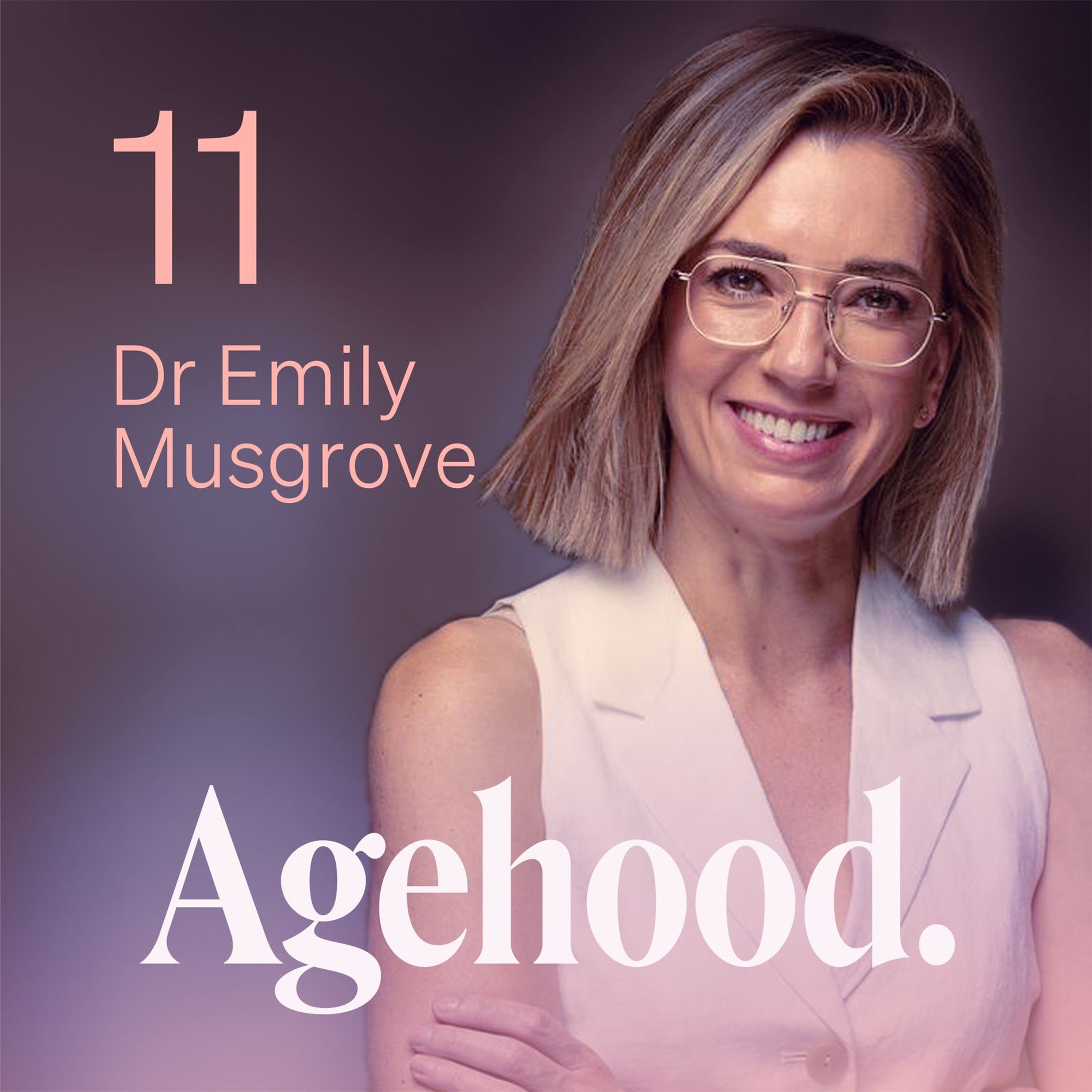
Dr Emily Musgrave believes we don’t need to fix grief
When someone we love dies, our world shifts in ways we can’t always name. Too often we’re left to navigate grief without a guide, unsure of what to say, how to feel, or even what’s expected of us. Dr Emily Musgrave is a clinical psychologist who specialises in grief, loss and trauma — and while her expertise is invaluable, what makes her work so powerful is her deep understanding of our need to connect, to make meaning, and to be witnessed in our hardest moments. You may know Emily from The Imperfects podcast or her book Unstuck: A Guide to Finding Your Way Forward to the Life You Want to Live, where she brings warmth, clarity and compassion to a subject so many of us struggle to face.
In this conversation, Emily explains why grief isn’t something to be “fixed,” how ritual can help us honour what we’ve lost, and why there is no such thing as a hierarchy of grief. She shares insights on parenting through loss, holding space for others, and the quiet power of simply showing up. Whether you are grieving, supporting someone who is, or trying to understand this part of life a little better, this episode offers comfort and perspective — and above all, a reminder that none of us are truly alone in our grief.
FIND OUT MORE
If you’re caring for aging parents, navigating your own next chapter, or just trying to keep all the balls in the air—you’re not alone. At Violet, we offer free tools and support to help families navigate the last stage of life with care and confidence. Visit violet.org.au to start the conversation.
CREDITS
Host: Melissa Reader
Guest: Dr. Emily Musgrave
Executive Producer: Lize Ratliff
Find out more about Violet at violet.org.au
See omnystudio.com/listener for privacy information.
Transcript
Foreign.
Hi, I'm Melissa Reeder. Welcome to Age Hood, the podcast for people who are quietly carrying it all. Aging parents, adult kids, work, life and their own next chapter. And if this is sounding like you, well, you're in your agehood and it's time that we talk to about it. When someone we love dies, our world changes. But all too often we're left to navigate that change without a map, really unsure how to grieve, what to say or even what we're supposed to feel. Dr. Emily Musgrove is a clinical psychologist who specialises in grief, loss and trauma. But more than that, she's someone who deeply understands really human need to connect, to make meaning and to be witnessed in our hardest moments. You might know Emily from her appearances on the Imperfects podcast, where she joins the boys every month or so, or her brilliant book Unstuck. It's a guide to finding your way forward to the life that you want to lead. In this episode, Emily and I talk about why grief is isn't something to be fixed, how ritual can help us honour what we've lost and why there's no such thing as a hierarchy of grief. Emily also shares her insights on parenting through grief, holding a space for others and the quiet power of simply showing up. Whether you're grieving, supporting someone who is, or it's trying to understand this part of life a little bit better. I hope this conversation is gives you some comfort, some clarity and a reminder that you're not alone. Today's episode of Agehood has been brought to you by Wellways Carer Gateway. Wellways deliver free Carer Gateway services across Queensland and also across parts of New South Wales. They're designed by carers throughout for carers, and the services really focus on building skills, easing stress and helping you to stay strong in your caring role. Because when you look after yourself, you're in a better place to care for the people who need you. Call 1-800-422-737 or search Wellways Carer Gateway to connect with your local team. A will is vital, but it's not designed to keep up with with all of the personal, the practical and the financial details of our modern lives. Things like passwords, bank accounts and bills, they often go unrecorded. And while life is complicated, a legacy doesn't have to be. That's where a letter of wishes from today's sponsor, Bill Will, comes in. It's a simple and secure way to reduce stress, for your loved ones, to share your values and preserve your voice. And it can save hundreds of hours of admin down the line. Visit billwheel.comau to get started. Doctor Emily Musgrave, welcome to agehood. So great to have you here today.
It's so great to be here.
Melissa, you're a clinical psychologist, therapist, and now you're the author of Unstuck, a book that offers people a way forward when they're feeling lost in grief or burnout or life transitions. And you're working with people who are navigating some of the most painful and tender parts of being human, including loss, illness, infertility, and trauma. So, gosh, it feels like such a great fit to have your voice in this conversation series.
Oh, thank you for having me. Yeah, it's an, you know, all of those things that you've mentioned feel so both meaningful and important areas that we're. That we kind of keep in conversation, I think.
Yeah. And as you and I were just saying, it's just surprising that we don't have this in much more frequent conversation. It's so universal. It's affecting all of us. I think some of the research I looked at recently says about 85% of people have had someone that they know or love within a couple of degrees of separation who's died within the last 12 or 18 months. It's a very real part of being human.
Yeah, it is. And yet we work so hard to avoid it. And, you know, look, it makes, it makes sense that we do because we know that as humans, we are so driven to avoid pain. And, you know, if we step into grief, it can be the most profound experience of pain. So to approach the conversations and to approach the discussions means turning towards this prospect of pain, which is a real, a real challenge and takes, I think, some kind of really skillful action.
How do we begin to understand actually what grief is? How could you help us start from that very broad place?
Yeah. So I think I really want to give reference here to Dr. Mary Frances O', Connor, who is this? I'm sure you've heard about her before and I've spoken about her before. She's this incredible neuroscientist and researcher based in the States, and she has a beautiful book called the Grieving Brain and a more recent one, I believe, the Grieving Body. And she brings like this great scientific and neuroscientific perspective to the experience of grief, because grief is not actually just a feeling. It's a whole body and mind experience. And what she does is she differentiates the experience of grief from the notion of grieving and so she describes grief as the emotional experience that arises in response to a loss. So the grief is that intense, almost like wave of feeling that we get of sorrow and heartache. It might be anger, it could be rage. It could be a whole host of feelings. So that's our emotion in the moment. Yeah. And so that's where we would speak about, like, a wave of grief. It's like these emotions are rising to the surface, and they may be very intense and they could hang around for some time. But the. But grieving is how the grief changes over time. So grieving is the process. And the example that she would give is like, if you were to, I don't know, follow the stock market, and you were to track the stock market over a year, you would see, like, the ups and downs of the stock market, and that would be the grieving. That's how your grief is changing and experienced over time. But grief is the intense emotional experience that arises and that will be presenting itself in different ways at different points in time, of course. So in the early stages of grief, we might say that this is extremely intense and extremely. It has a longer duration. But we could also expect that over time that that changes. And so we may not get hit by as many waves of grief. We may go for a period of time where perhaps there's calm water and then here is a wave or here is even a tsunami of grief, and we're hit by it again.
And those things, those moments can be so unexpected, can't they? Even myself, you know, thinking about my husband's death over 10 years ago, and I talk about this a lot. And some days I can talk about it with calmness and with a kind of resolution almost to the story. Other days it will just knock me for six. Yeah, it's very unexpected.
Yeah. And I really. I think what feels so important in that is emphasizing how incredibly normal all of those experiences are. And so, you know, it might be 10 years, it could be 30 years. And you may find that on a particular day, in a particular moment, you absolutely knocked off your feet by this intense feeling. And that. That does not tell us that you haven't grieved. It tells us that that relationship is deeply important to you and that. That when this feeling is here, it's a reminder of the loss of this.
Person to you, the love that you had for them.
Yes, yes. And that's the part of it. Yeah.
I've got questions spinning left, right and center. I am quite familiar with, with the work that you're talking about from the us. And it is. It's really, really helpful. And what I was in was this idea of why grief literally hurts.
Yeah, yeah.
Physically hurts.
Yes, it. Can you tell us a little bit about does? So I don't want to step on the toes of the neuroscientists out there. And so just, I guess, being transparent around what I know about how the brain works. But what we. What we do understand is that there is a very. Basically, when in the brain, when we experience pain, a certain area of the brain gets activated. And if we were to look at the studies around the experience of emotional pain, of grief, that those same areas in the brain are being activated as well. So it is felt physically in the same way that an actual physical pain is felt. And we don't. I don't think we give that enough attention. Yeah, yeah, yeah.
I think we have this narrative of trying to contain grief or, you know, turn the volume down on some of those feelings. But when you connect it to a physical sensation.
Yes.
Gosh.
Yeah.
Helps me make sense of it in a really different way.
Yeah. And I think it gives a gateway, too, to understanding how we would heal a physical illness. For example. So if, for example, you had. Let's just say you had a wound on your leg and you covered it up with a bandage and you expected it to heal, and then you open up the bandage and here it is, it's not healing, it's getting infected, it's getting worse. And yet that's what we will so often do with. With our emotional pain, is that we will cover it up, push it down, try hard to avoid it with. Under the guise that it will go away. And I think it really bears such an honoring that this pain is here and it's calling for your attention. And if you don't pay attention to it, there will be much greater suffering, I think.
And as that cut on your leg may well leave a scar, it might be the smallest of scars or it might be quite a significant scar. Grief stays with you, doesn't it? And it does have that kind of enduring mark.
Yeah, I mean, that's so. That's so true. I was having a conversation with a friend yesterday, actually, about how, you know, how we understand things like diagnoses, medical diagnoses, to impact upon the subsequent experience of someone's life in terms of their identity. And I think, you know, what stood out to me and that is that all of our experiences are constantly shaping who we are as people. And if we deny grief, for example, it's like we also Deny the gifts that it can offer us as well, in terms of how it shapes how we want to show up to this life we have now. And I just always think that in and amongst all of the suffering and the pain, there are. There are spaces where we can find a greater meaning and purpose. But if we work so hard to push away from that, then I think we deny that opportunity too.
There's such a strange gift that is part of grief. It can really reshape who you are, how you see the world, how you make decisions, how you maybe become more intentional or purposeful like that. There's a whole range of reactions, isn't there? But it's that really. That really sits very truly. Yeah, yeah.
I mean, it's the most unwanted gift you ever want. Exactly.
Yes.
Really. But. But it is. There is. And I think there has to be. There has to be. Because what then keeps us moving forward it. And I. And I do emphasize that there will be times when it is really important to dip out of the painful work that we do need to be able to simultaneously dip into the grief and also be able to come out of it, to resource ourselves as well. So it's not that we need to be constantly pushing ourselves to feel the pain and to be with the pain, because that's actually not helpful either.
That's quite disabling, I think, and may suggest other stuff is going on that might be some attention.
Yeah, yeah.
If you were talking to someone who had never really experienced loss before, that does happen, doesn't it? People reach their 40s or maybe even their 50s, and they. They may not have had a grandparent die or anybody close to them. How would you describe it, the process of grief and loss? Like, how would you put language around that?
That's. That is such a great question. Because I think for many people who have never experienced it, it's so hard to grasp somatically in the body. So, you know, really hard to grasp what that feels like and what will happen when you get exposed to it. But I do think that even if they haven't lost a person, there will have been experiences of grief in there. So it might be the grieving of a relationship that ended. It might be the grieving, the loss of a pet, it could be the loss of a life that you imagined for yourself. And that whilst it may not have. I mean, for some people it may have the same emotional intensity, but if it doesn't have that same emotional intensity, we can even kind of allow this imagining here. And I mean, there's many different processes and ways in which we can do this. And there are some interesting insights from Stoic philosophy and Marcus Aurelius, for example, would. I'm sure you're probably familiar with this, Melissa, this idea of premeditating death and that every night, in order to, in some ways promote a sense of resilience, would actively imagine the death of his. Of his family and friends. And that may seem so. Oh, it may seem just so unnecessary, but there's something very useful even in that. Now when we think about our loved ones and you can step into imagining not having them, that gives you an insight. I think it gives you an insight into what this might feel like. But, you know, for many people, they will say that until you've lost someone, you won't really fully understand. And I do get that.
I've been really intrigued when I've heard you talk about attachment alongside grief. And that's where my mind's going to. In terms of what you're talking about. How can we think about that in a really useful way to kind of understand grief, but also maybe just to be a bit more intentional and take a few things less for granted in our everyday life?
Yeah, absolutely. I mean, really at its heart, grief and love are two sides of the same coin. So where we love, we will grieve, and where we grieve, we have loved. And so like. That, to me, is the very foundation of why it is that we pursue relationships. So we pursue relationships as adults, for example, because we're built for connection, wired for connection, and we yearn for an intimacy and a closeness. And what we also yearn for is to feel. And what is so important about that is that with this yearning to feel, we get exposed here to joyfulness and awe and love and excitement. But with that willingness to have those emotions also opens us up to a willingness or to a vulnerability even to experience the other spectrum or the full spectrum of emotion. And yet if we. If we work again, work so hard to shut off the unpleasant emotions, we also shut off our accessibility to all the. The other end of the spectrum there.
We do see that so often, right? People just having this concept or even kind of default behavior pattern to push this feeling down and not address it. And, you know, I think probably I remember reading about Lisa Marie Presley, and she talked about sitting with her father's body and sitting with her son for days, actually allowing herself to sit in that place of pain, place of grief. And that's not for everybody, of course, but we don't really have that connection anymore, do we? We don't allow ourselves that space to physically sit with that pain and maybe make sense of it in a different way. We do. We do tend to push it down or turn it down at least.
Yeah, yeah. And I think culturally we're not accepting of it so well, at least in the Western. In a Western culture, maybe in some pockets of Western culture, are we able to give. Give a greater space for grieving and acknowledging this loss. But I think so often there can be an expectation from other people that we should be over this by now.
My dad has this fabulous saying which is, keep your chin up and keep punching. And he's very much a man of the 50s. And I get it, comes from a good place. But like that, that sentiment, you know, sometimes you've just got to be able to keep that chin down and. And sit with that. Sit with that sadness.
Yes, yeah. Yes. And then simultaneously to keep moving forward. So it's a. It's such a tricky thing.
Maybe he is right.
Deny and avoid. Keep on going. It is like, it brings to mind for me, you know, again, obviously, this avoidance of pain sits at the heart of that, but the fact that we don't talk about death even with, like, in education. So there's another incredible researcher and trauma grief therapist, Megan Reardon Jarvis, and she is such an advocate for bringing in education of grief into, like, childhood learning. In the way that they learn about puberty, we also can learn about grief and that when we start to normalize and bring education into grief. So what is actually going to happen, for example, in your body in those first stages of. First early experiences of grief, so that, you know, you're armed with a toolkit to know that. Aha. Okay, so this brain fog that's here, this is not just me struggling to do stuff. This is actually a very normal, functional response to the grief that's here or I'm not sleeping. Yes, this is a normal response to this grief that's here. So, you know, if we were able to have these conversations and to normalize talking about grief from childhood, then I think that this prepares us to be able to have those bigger conversations in adulthood around. Okay, preparing for death.
Coming up, Emily shares how grief doesn't just break our hearts, it really actually disrupts our identity. We talk about the role of ritual, why meeting matters, and how to support someone in pain without trying to fix it. As a carer, it is not always easy to access support. And that's why Wellways Carer Gateway meets you where you are with walk In Hubs online registration and Wanda, the mobile support service. Call 1-800-427-37 or search Wellways Carer Gateway to find the support that's right for you. I want to talk a little bit about the idea of anticipatory grief, which is a bit of a label, but I'm very, very curious around how this kind of reveals itself over time. And again, I'm going to put it in the context of aging and frailty because most of our listeners for this conversation series are in the sandwich generation. They are managing their families and their kids of a range of ages and their work and their relationships and increasing care needs for parents and in laws. And you know, grief just doesn't appear as a thing one day that you are faced with and feeling.
Right.
It can be very, very incremental and it can actually arise from sometimes very, very small incidents.
Yeah, like you said, the fall, for example. Yeah. And so anticipatory grief is a real thing. It is as though we're grieving in real time the anticipated loss of this person or this attachment. And there is something deeply important about that process if we're willing to again to turn towards it. But to begin with, it is actually mimicking the experience of grief at the loss of someone at their actual death. So we will notice that we'll experience things like, you know, this great sense of despair or an emptiness or a heartache, you know, these same. And even a rage and anger shows up, irritability. So this whole range and spectrum of emotion, intense emotional experiences that arise when we recognize that this person is going to die. And it may not be in the next week, it may be in five years. But when we know that there is a terminal diagnosis or like life limiting experience in elderly, for example, we know that this is going to happen. And these little markers here tell me that this is true. And with that truthfulness, we then get exposed to these feelings. So I think that that can feel very confusing often for people that this person is still alive. And yet I'm feeling all these things.
And I sense, and I certainly see in my work that that anticipatory grief arises when maybe that person can't go on that long walk with you anymore or can't really debate the news with you anymore that there has been a physical change or a cognitive change that means part of your relationship or your way of being together is no longer. Yeah, that's incredibly hard for people.
It is, it's, it's. And if we look at again the, the work of the brain and how the brain is making sense of this when someone is declining in their functioning. And so we're no longer able to do those sorts of things that the. The brain becomes disoriented because this is not its normal prediction tool. So the brain is. Is in essence, a prediction machine. And it's constantly predicting and making expectations, attachment, relationship, or this relationship with this person based upon a history of experiences. And so if we think about it like a map, our map typically has in the past been very reliable. So I might, for example, go and have. Go for a walk with my mum every week. And that has been a reliable prediction that happens every time. And now when there is this recognition that, or this awareness that actually we can't do this anymore, that is extremely destabilizing to the brain. The brain is disoriented. And what comes with that disorientation, again, is some very, very uncomfortable feelings. And with that disorientation is this feeling of loss and sorrow and aching and yearning for what's no longer there.
You're giving something up. You're losing something in that moment. Yes, yes, your mum's still here. She's still your mum, you're still her daughter, but the relationship is different. And there are things you'll never be able to return to.
Yes, yeah. And this is complex work because if we look at, you know, if we look at what happens when someone actually dies is that their body is no longer there with us. But our attachment never dies. So our attachment to them never, never dies. But when there's an experience of anticipatory grief and we see someone deteriorating, it's like an incremental exposure to this, to the loss of the body. And so this challenge that we have is like, how do I stay here with this attachment? Because that attachment, like I said, never does. But it's very complex and very difficult work. And what often shows up in like, particularly even in mentioning the sandwich generation, is absolute exhaustion. So when the brain is trying to reimagine this new map, okay, so now mum is not able to walk, or now mum's in a home, or now we're getting this care that the brain is constantly now re updating. Constantly re updating, re updating. And if you think about the amount of energy that is required to re update information, it makes an immense amount of sense that we will feel absolutely exhausted because it's a state really of threat. And so that re updating is in essence, eliciting this stress response. So in a prolonged experience of anticipatory grief, for example, we are constantly in and quite potentially exposed to a chronic activation of the stress response. And so that is extremely hard to maintain. It's like juggling a million balls in the air.
Absolutely.
Particularly if you're caring for younger children or children at the same time as well.
It's really interesting to think about all of those concepts in relation to dementia and in increasing cognitive decline of a loved one, given how prevalent dementia is. And I think a lot about, you know, how those roles change over time, where you have been parented by your parent and suddenly you are the one now making more of the decisions, you know, setting more of the boundaries, taking on that more authoritative role in some respects, with all the right compassion. And there's grief in that, isn't there? There's conf. That. There's a reckoning.
You're absolutely right. I think it can very much be a place of reckoning. And it will also bring up, in my experience, it will also bring up reflections, consciously or not, about how I was parented.
Oh, that's interesting.
Yeah. And tell me more about this. So this is not. This is not always going to be the case, but this is. This is some people's experience that perhaps they have held some feelings of being let down by their primary caregiver, that there may have been some really difficult experiences as a child. And what shows up often for me in this space in particular is that perhaps that parent, when they were a child, wasn't providing them with the needs that they had at the time. And so that might have looked like not maybe not caring for them in the way that they really needed to. And then as they move into adulthood and their parent now becomes the one that needs the care, that brings up these big questions, like, I'm now here caring for you at the end of your life, and you were not caring for me when I was a child. And that, I think, is very complex work because it brings up a whole host of feelings. It brings up a feeling of resentment and anger. But often what sits alongside that is guilt. Like, if I don't do this, if I don't show up every day, if I don't do this, I will feel too guilty. And so it's. Gosh, it's hard.
It's really complex. And I'm thinking about circumstances where there may have even been trauma in those relationships, how that is reckoned with.
Yes, yes.
Those roles change. That's really cool. Complex.
It's. It's very complex. And again, something that we don't we don't talk about very often about the complicated process of losing our parents because our parents were human too. And they will have made many mistakes, no doubt, and in many circumstances there may be significant trauma which makes that work so much more difficult. You know, even in the space of having had estranged relationships and then kind of coming back into the fold in this end of life period. It's like I said before, probably many times, it's really complex and can be very confusing for the person that's caring. Absolutely.
You think about that as a sandwich, Jenna. I'm just sitting with my own experience around kids in their late teens, kids in their early 20s. You are again, reckoning with a lot of identity changes because these people who needed you so much need you less. And that's very good and healthy. But you've got to give something up in that transaction. And at the same time, you're then negotiating this change relationship with your parents where you have to step in in a different way. No wonder it's tough, right in this chapter of our lives.
Well, I mean, I think particularly what you're saying in there, Melissa, too, is the sense of loss as my role as a mother in the way that I had always known it to be, because they now no longer need you in that regard, like in that particular way. So there is a loss there. It gives way to a new relationship and a new understanding of this role of motherhood. But that's occurring so often simultaneously with this changing role as daughter or as friend or as sister, for example.
That's right.
Yeah.
And at the same time, we've got all of the mess of periwarm menopause.
Yes.
And menopause and all. My goodness, midlife also.
It's a lot. Yes, it is. And I think what gets missed in there are what are your own needs.
Yeah, well, that's in the sandwich somewhere. Exactly.
Where are they? They've disappeared. Yeah.
In the context of the sandwich generation, how do you think about workplaces? So I'm really fascinated by this because I just don't think it's on the radar. Yeah, the, the impact of people, but predominantly women between 40 and 60 that are going to be taking on these caring roles and what that's going to mean for their own well being and their own productivity and how they show up in their workplace and how they're going to need their workplaces to respond to them. Feels to me like we're only just catching up on the parenting end of that and we haven't even begun. Begun to Think about this kind of parenting space.
Yes. Oh, gosh. I think that that is so important. And I absolutely agree. I don't think that we're having the conversations we need to be having around that. And you know, as, as a bit of a kind of adjunct to what you're saying there. In the same way that, you know, I was mentioning before about this kind of notion of education of children around grief, I think it's also so important that there's grief education in workplaces so that, for example, our workplaces can really understand that in those, particularly in those early stages that I'm not going to be able to show up, I'm not going to be able to attend to this in the same way that I was before, but in terms of anticipatory grief and this kind of real chronic stress that we experience. So there's the demand from maybe the people that we're caring for, maybe our parents, and there's the demand from our children, and then there's this demand from the workplace. You know, to me, what, what so often happens is that a woman will step out of the workplace because that's actually not sustainable. And then we know that we have significant costs to that financial independence and financial future. So, yes, it, it bears a significant cost, not only to the workplace, but, but most significantly to the woman if she's the. If she's the primary caregiver.
Exactly.
Yeah.
And even if she's not the primary caregiver or, you know, there's so much obviously dialogue around the gender pay gap and the long term implications of reduced superannuation that is all going to play out.
Yes.
In this, in this issue, you think about the permission we had and have to go into work and maybe have a bit of a whinge because we've had a toddler that's kept us up all night or, you know, something's happened in those early parenting years. Would I really have that permission to go in and talk about, you know, mum might be really sick and might have been in hospital. I'm trying to figure out how to get her respite care and aged care. And. Yeah, we don't have that same.
Yes.
Space, do we?
Yeah, no, absolutely. And I think again, it brings with it, you know, it's just so associated with this avoidance here, obviously of death. But also, and this is just a hunch I have, that in some way that people minimize the, the experience of grief when it is of someone who has lived a long life, that in some way we, we will minimize the Fact. Like, for example, if you've lost a parent and let's just say they're, I don't know, over 80, that we somehow don't give it the same validation that we would give the loss of someone who's younger than that. And so in our workplaces, when, you know, when we're saying something like, I have to go and attend to finding a. A. Oh, gosh, I'm losing my words. I have to go and find a new hospice, for example, or we have to find more care for my parents, is that it's not held in the same way. We would say my child is sick. And I think that what. In all the work that I do, there is no comparison of grief because the grief is so unique to your individual attachment with that person. And so whether they're 90 or whether they're 30, the grief is dependent upon what that relationship means to you. But I don't think we give it the same attention. Yes, exactly. Exactly. Yeah.
I've heard quite a. Quite a few people relay this sentiment to me that they might have been caring for a parent who might actually have been ill for quite a long time. And so in many ways, there's a predictable element to that person's death, but when they do actually die, it is truly shocking for that person and for their family.
Yes, yes.
It's interesting, isn't it, because they're kind of in a state of hiatus. Not necessarily hope, but hiatus. And yet when that person does die, it is still every bit as painful.
Yes, absolutely. And again, if we come back to this idea of that prediction machine, that if someone has been unwell for quite some time, the brain may have updated the map to say that I will go and visit Mum in the hospital. And so now here's my new map, and that becomes a reliable experience. And so then when they do leave, and now that part of my life is not there, me going to the hospital is not there, that will then bring about again an immense amount of intense emotion. There's a really, I think, very useful model of grief called the dual processing model. I'm not sure if you're familiar with that one.
No, I'd love to hear more.
And it really differentiates itself, I guess, from the Kubler Ross original seven stages of grief model. And I think I find it most resonant for me in this kind of grief work. And it has resonance as to whether it's anticipatory grief or whether it's like actual. Well, here is grief, and it proposes that there are Basically that we have to oscillate in the space of grief between two primary functions. The first is what's called the loss orientation. And so that is that we're coming into this feeling, this obviously deep, intense feeling of loss, of sadness, of sorrow, of aching and yearning. Yearning in particular being a very key part in there. And that is inherently, as we know, extremely stressful and distressing. And then what will happen is that we simultaneously, or in moving in between, oscillating between, we come to what's called the restoration orientation. And the restoration orientation is how we restore and become, make meaning in the life now that they're not here. And functionally what that can look like is, for example, now I'm not going to the hospital every day, so what do I do with my time? Now this person isn't here and maybe that person was in charge of the finances. Now I have to be doing this, and I don't know how to do this from, you know, in other circumstances it might be that that person's role was to do the school lunches or to do the drop offs or to. So all of the roles that that person carried and the way they live their life is now having to be rest by me. And that's also inherently stressful. So now not only am I working with the loss, I'm also trying to restore my life now that they're not here and to try and make meaning of that. And so, as I said, both are inherently stressful and both are very needed. Gosh.
I'm particularly sitting with that, thinking about the loss of a partner.
Yeah, yeah, yeah.
That's a framework that would have been very helpful to me about 10 years ago.
Yeah, yeah.
Thank you for sharing it with me now.
Oh, Melissa, it's my pleasure. Because I'm sure it makes. I mean, it's so much sense.
It does, it does. But again, it's very. It's very hard to access these frameworks and ways of making sense.
Yes.
Of this emotion.
Yeah, absolutely.
I. I loved in your book Unstuck, where you said so many of us walk around believing we're broken in one way or another, but actually often we're just stuck.
Yeah.
And being able to reframe this idea of I'm broken to I'm stuck is. Is a really big shift. And, you know, one opens the door to change, the other one closes it. How do we think about that in the context of this conversation?
Yeah.
And grief.
Oh, I think it sits. It just sits so powerfully in it. I think because you know, from. From what I know, both personally and, you know, in my practice is so often this sense that, you know, people will come in experiencing overwhelming grief. And there is this phrase, I'm so broken. I'm so broken by this, and I will never be the same. And in some ways, first of all, yes, you will never be the same. So we can acknowledge that and that and at the same time. So rather than an either or, I will never be the same, and I will be okay. So that's one part of that. But the brokenness inherent in broken is that I need fixing, and that someone. It's almost as it implies, as though someone else has to do that because I can't do it anymore or I can't do it now. In that place of brokenness, we have no sense of agency and no sense of choice. It's just is. It is. I am broken. And yet the pull in the work that I do is actually, there is nothing about you that is broken. This pain that is here tells us that you're alive and that you're human. This pain of this grief says that you've cared so deeply and that you love this person so much, but you're stuck in this pain. You're stuck in this struggle with pain. And the beauty, I think, in stuckness is that it can be temporary if we're willing to really turn towards it. So it is, I think, particularly relevant in grief.
I think it's a concept that is so resonant with so many parts of life. But I agree, it is. It is so relevant to this experience of grief and loss. I hope everybody out there listening gets their hands or their headphones on a copy of Dr. Emily's book Unstuck. Can I ask you one last question? What has this idea of grief, both personally and professionally, taught you about what it means to live well?
Oh, I love that question. You know what. What you may be aware in reading the book is that I was. I had a diagnosis of breast cancer three or four years ago, and I'm. I'm well at the moment and hope to be well for a very long time. But this grief work feels so important to me because it teaches us about living. You know, it teaches us about why I want to be here, who I want to spend my time with, what I want to do with my time, and that I think what it does is it can really, if we're willing, I think, tear down all the stories that we tell ourselves about the achievements that we should be striving for, the identities that we should be cultivating, but instead actually what truly matters deep in our heart and that may be, that will be different for different people. I know for myself in doing this grief work and you know, in my own experience that, that I, I really deeply want to make an impact, to know that, that in some way I've been impactful in a, hopefully in a positive way. But for people to know, the people that I love, to know that I loved them and that I think, you know, if, if we leave this, this planet with people knowing that, then I think I would feel very, very happy.
I often say to my kids, this is not a dress rehearsal. You know, if you have a big decision to make, a big conversation, to have a big feeling to feel, feel it, do it, say it.
Yes. I love that analogy so much.
It is an address rehearsal. I don't know that I would have said that before going through the experience of Mara's death. I think that really helped me to arrive at that realization. Gosh, I'm working hard to embed it in the minds of the people that I'm loving and raising. Emily, what an amazing conversation. I'm so grateful. I'm all goosebumpy after that. That was very, very special. I look forward to having more conversations with you and thank you for the work that you're doing to normalize some of these really complex concepts. Just bring them into the zeitgeist and getting them into people's hearts and minds. Thank you.
Thank you so much for having me.
You can find Emily's book unstuck via the link in our show notes. And if you've got a question for Dr. Emily, good news as she will be joining us again on future episodes. So send your questions to podcastiolet.org au here at Violet, we believe that the last stage of life deserves the same care, planning and attention as every other life milestone. It's why we offer free support, guidance and tools for families so that no one has to face this chapter of life unprepared or unsupported.
Supported.
If you'd like some help making a plan, starting an important conversation, or simply feeling less overwhelmed, head to violet.org au to learn more. And if this episode helped you, please share it with someone who needs to hear it too. We'd love you to follow Age Foot and leave us a review. Foreign. This episode of Agehood was brought to you by Wellways Carer Gateway. As a carer, prioritising yourself and your own well being can be hard. That's why Wellways Carer Gateway is making it easier. With Walk In Carer Hubs, simple online registration and Wanda, a mobile service bringing support to carers in their own own communities, help is now more accessible than ever. Whether you're looking for practical advice, emotional support, or some help navigating other support systems, Wellways Carer Gateway can help. Call 1-800-422-737 or search Wellways Carer Gateway. Wellways Carer Gateway is providing support for everyone who supports someone else. Today's episode of agehood was brought to you by Bill Will. Wills aren't designed to cover the full picture, especially when it comes to personal, practical and financial details. A letter of wishes from Bill Will really helps to fill that gap. From passwords and accounts to everyday instructions, it can save hundreds of hours hours of admin for the people that you care about most, reduce stress, share your values, and preserve your voice at billwill.com au.