
Fear and Love: What Medicine Can’t Teach with Steve Robson
What does it take to face fear, to lead with love, and to truly care for others at their most vulnerable?
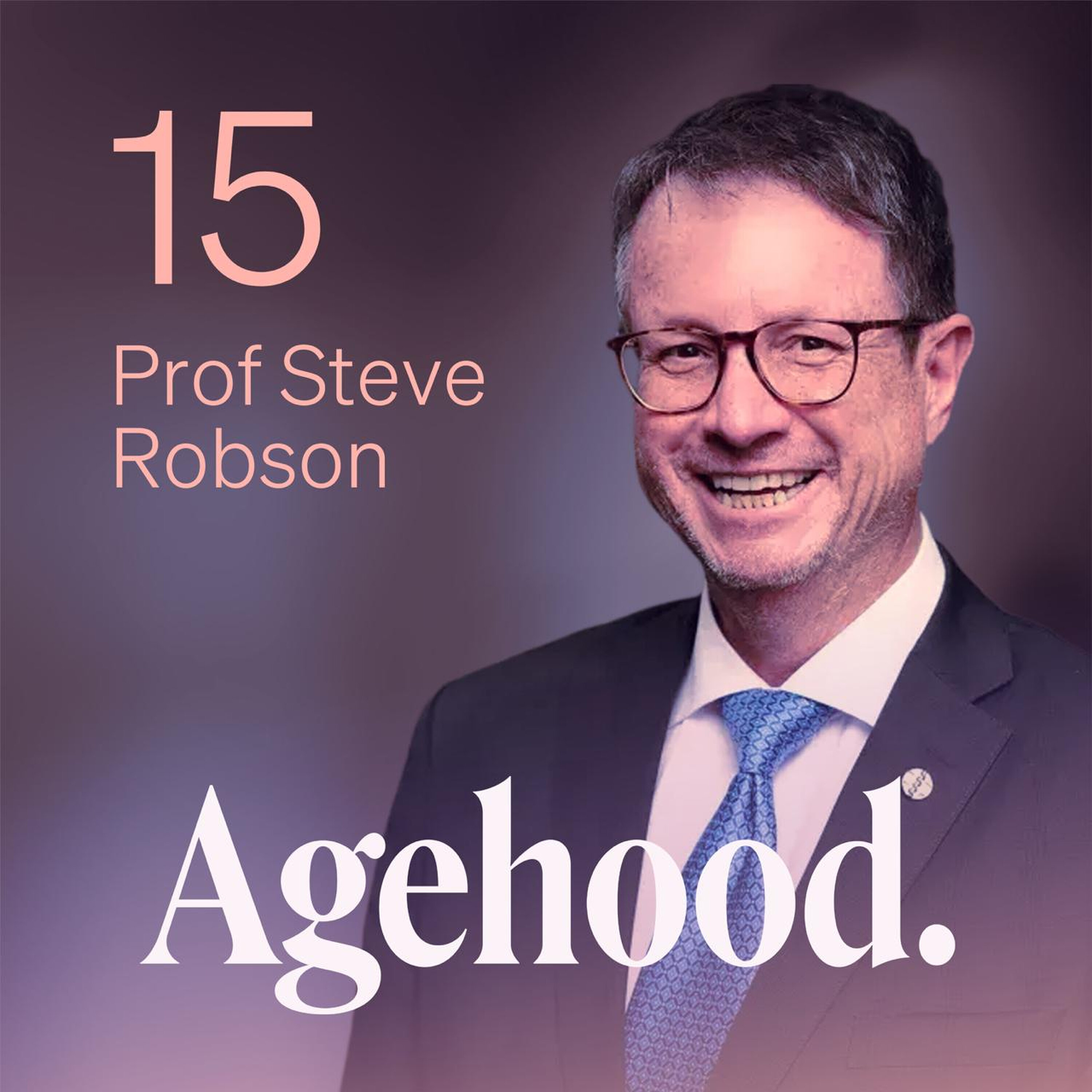
In this episode of Agehood, Melissa speaks with Professor Steve Robson - former President of the AMA, doctor, and son - about the lessons he’s carried from rural Queensland to the frontlines of Australian medicine. Steve shares what jumping out of planes taught him about fear, the Christmas conversation with his mum he’ll never forget, and why love should sit at the heart of every medical decision.
FIND OUT MORE
If you’re caring for aging parents, navigating your own next chapter, or just trying to keep all the balls in the air - you’re not alone. At Violet, we offer free tools and support to help families navigate the last stage of life with care and confidence. Visit violet.org.au to start the conversation.
CREDITS
Host: Melissa Reader
Guest: Steve Robson
Executive & Audio Producer: Madeline Joannou - Mylk Media
Find out more about Violet at violet.org.au
See omnystudio.com/listener for privacy information.
Transcript
Foreign. Hi, I'm Melissa Reeder. Welcome to Agehood. It's the podcast for people who are quietly carrying it all. Aging parents, adult kids, work, life and their own next chapter. If this sounds like you, well, you are in your agehood and it's time that we talked about it. Today I am joined by Professor Steve Robson. You may know Steve as the former president of the Australian Medical association, but his story begins in rural Queensland in the 1960s, where he was the first in his family to go to university. Steve's journey from a struggling medical student to becoming one of Australia's most trusted medical voices is a story about fear, love, and what it really takes to care well for others. Over more than three decades, Steve has worked at the bedside with families in their most vulnerable, vulnerable moments. And at very top of the health system, he has learned that fear doesn't have to be the enemy. And that love, you know, it's rarely discussed in medical training, but it might actually be the most powerful force in healing. In this conversation today, we explore what Steve has witnessed about aging, resilience and the final chapters of life. What families need to know that doctors often can't say how better planning could transform both family experiences and medical care. And why the human side of medicine, the love, the fear, the legacy we leave matters more than we might think. Sadmin is the unexpected burden of endless bureaucracy. During times of deep grief, wills are important, but they don't give critical information like passwords, bank accounts and bills. For that, you need a letter of wishes from today's sponsor. Bill will go to billwill.com for a simple and secure way to reduce stress for your loved ones, share your values, and preserve your voice. Before we get started today, I wanted to share a story that has stayed with me. Katherine reached out recently to share a story about her husband, Tom, who was in his late 80s. Catherine knew that Tom wanted to die in his aged care home, but when he became frail, he had a fall, he developed pneumonia, he was taken to hospital, and he went through a whole lot of really painful procedures and he actually died under intubation. And she knew that wasn't the experience he wanted. Catherine said, you know, she's living with that regret that the last few weeks and months could have been so much better if we'd known how to communicate Jim's wishes. So stories like this are exactly why Violet has created the Care Compass. Families need a safe place to start these conversations. We know they're really hard to begin. The Care Compass makes it simple. It's just 15 minutes. You can capture what matters most and you can keep it close, accessible in your digital wallet, ready to share with family members and other healthcare professionals when it's needed most. So please don't wait for a crisis in a hospital corridor. Start gently at your kitchen table with Violet's Care Compass. We'll launching this in Carers Week 12th to 18th of October. It is free. It is available for everyone to use. You'll find it@violetcares.com. Steve, thank you for being here today on the age hood couch. It's really nice to talk with you.
It's a real pleasure. I've been looking forward to it, Melissa.
Yes, have I. Your story began in rural Queensland, as I understand it, with your dad as a carpenter and your mum as a ballerina.
Yeah.
Which I thought were two beautiful and quite different ways of making beauty in many respects. And I wondered what that childhood, you know, those roles that your parents had, how did that influence you in terms of taking up a role, caring for people?
It's a really good question. I guess on the side of my dad, he was an immensely practical man and he would turn his hand to building, fixing, etc. So he really was someone who encouraged a lot of hard work and industry and so on. My mum, who I've lost, was very, very interested in the performing arts As a young woman. She'd been a ballerina and in fact cut her teeth. It was the end of the Second World War when a lot of servicemen were in Brisbane from the US and they would dance to entertain the troops. They had a lot of things to keep the troops entertained. So she'd had a really, really interesting early life as well. And they found themselves in rural Queensland, which is probably as discombobulating for them as it was for me.
Yeah.
At the time. But there's a great sense of community in rural Queensland and so I think they worked together really well over their lives and won wanted the other. They were very, very different people. But like a lot of couples, it really worked.
Yeah. Was there anyone else who took up medicine in your family?
Yeah, my brother is a doctor. He's a general practitioner on the Sunshine Coast. He and I, there's a bit of an age gap between us, but he took up medicine and is really interested in sports medicine and on the Sunshine coast there's a lot of sport. He was involved in surf life saving and would be the doctor at various beach events and things. So I think he's sort of had a more glamorous career being at the beach with all of this stuff going on than me. I think you've had a fairly salivary.
We'll get to that. We'll get to that.
No worries.
I was reading about some of your adventures, jumping out of planes despite paralyzing fear. I'm feeling that as I'm saying those words out loud and how that experience began to make you think differently about fear, that it can completely change our physiology and the way we make decisions. Tell us a bit about that.
Yeah. So I was flat broke at medical school and took the last couple of years of my medical studies. I was on a scholarship with the Royal Australian Navy. I'd had family members in the navy and after some time in public hospitals joined up full time as a doctor in the, in the navy. My very first posting was at the naval air station at Nara where the parachute training school is. So you spend a lot of time at drop zones dealing with people who've jumped out of planes. And of course I was asked immediately to do the training as a parachuter. So I'd grown up in the, in the country that was very flat, you know, hadn't been on anything high my entire life and was not very good with heights at all. Luckily I'm short sighted so I didn't, couldn't see where I was a lot of the time. That made it easier.
Did you close your eyes as you were?
I have to admit at times I certainly totally appreciate that. I guess the military philosophy is it's not joy flighting or anything like that. It's getting soldiers out the back of a plane as quickly as possible. So as the officer I was at the head of the queue and the back of the plane would open and I remember the first time I thought, gee, I hope I've got the nerve to jump. But I needn't have worried because there were 12 soldiers behind me and the minute the door opened they pushed me out the back of the plane.
There's no room for kind of second thoughts there. You just get a shove, I imagine.
And you just get shoved out. I found that it was a real recipe for fear with me as someone with a fear of heights. And I think one of the things it really did across my subsequent medical career was gave me a great sense of what it's like to be really, really frightened and to also be able to pick that because I, you know, I spent the entire time trying to disguise the fact I was terrified of jumping out of planes. But it gave me a bit of a sixth sense and I in a lot of the work I've done, people are afraid and they don't necessarily want people caring for them to know that they're afraid.
They don't want their families to know.
They'Re afraid, they want their families to know. And I think being able to sense it and connect with people and say, look, I understand what it's like, let's talk about this. I think one of the things that also it gave me a very strong sense of is if there is some emergency playing out or something is going wrong, the worst thing you can do is arrive and panic. And I put a huge amount of effort over my career because often as the sort of senior specialist, you're called into something going very wrong to deal with it, to help to solve the problem, to provide whatever treatment. And it's so important to not show that you're afraid or anxious or anything, to appear calm because fear is infectious and it infects contagious. It's contagious, absolutely. So people come in and you look like you're panicking. It is a recipe for everything going to pieces. So coming in and saying, all right, this is happening, I'm here, we're all going to work together, we'll try to sort this out for you, we'll try to do this for you or solve this problem for you, I think gives people confidence, it settles the whole environment down and it's much better for patients and for their families, mothers.
I imagine there's a fine line in some cases between bringing that sense of calm and not being read as detached. You know, you've got to really lean in on the reality of how frightened people are and hold space for them, but bring that reassurance, bring that kind of direction and protection.
I think you're absolutely right. And one of the things that I'm sure everybody who works in a public hospital, whether you are a doctor, a nurse, whoever you are working in that care team, is you see a lot of people, you see a lot of patients and families and you don't necessarily have a pre existing connection with them. So being able to encounter people for the first time at often what is one of the worst days of their lives. But do your best to connect with them, to assure them that you are there to help them to provide care is really important. And that's a skill that just takes time to develop.
But people don't forget doctors and healthcare teams that meet them in that way. I mean it from my own experience and we've talked about that, it's really profound when someone sees you in that big system when you are completely overwhelmed and just feeling the crisis.
Yeah, I agree. And it's often disorienting. You have this feeling of overwhelming dread and just meeting people who genuinely care for you, building that connection and saying, I am here to look after you and I will do that to the best of my ability. It just gives people confidence. And I think it's a really important thing. And it's so easy to miss that because everything's so busy and resources are stretched and things like that.
And it's your everyday in that healthcare system. But it's their extreme family crisis moment in many respects. And I know you've done a lot of work in obstetrics over your career. How many babies would you have delivered? Steve?
It's a good question. I tried to add this up at the start of the year and I probably a little over 5,000 babies over a career. I don't remember them all.
I think you'd be forgiven for not remembering them all, but that's a lot of babies being brought into the world. That's beautiful. And we've talked a lot, haven't we, around later stages of life, end stages of life, what that experience is like for families in the healthcare system. And I'm interested in how do you help them move from that place of fear and overwhelm to one where love and empathy can start to really guide their choices.
Look, I think a key word that you brought up is love. And I actually started doing some research into love in medical decision making a couple of years ago, and it got sidetracked, but it's rarely spoken about. A colleague and I went through the medical literature and we found that love rarely comes up, but it's fundamental to decision making in families. And I look at it right from the start. You know, having a baby is often something that love dictates. A couple will meet and love will dictate, you know, when they start their family, how big their family is. There's no doubt that when a child is born into a family, there is so much love. And if a child is ill, if a child has a disability, for example, love overwhelmingly affects decision making. But we almost never see it discussed in medical literature as though people are embarrassed about it.
It's really interesting. I mean, it actually feels obvious. It's an obvious omission when you say it out loud. But it doesn't play enough of a role.
It does not play enough role. And I think there are two key areas where love is so fundamental to the provision of medical care, and that's at the start of life and at the end of life. And I have seen many situations, both as a doctor, but also personally, where decision making at the end of life is so intimately tied up with love that you cannot disentangle the two. But I rarely read medical literature that explicitly says this. It might phrase it in other terms, but I think we should be completely open about this and so call it for what it is. You know, we do things for love that are inexplicable, important, and I think also for so many people, love underpins their satisfaction with life. And I think as a caring profession, one of the most important things we want to do is make people's lives better, and love is a big part of that.
Melissa Love is incredibly motivating to Stephen in a stage of life which we know is quite frightening for people. It has its own stigma and taboo and it's difficult to talk about. Bringing that framing of love in is a really lovely door. Yes, I think it's a really nice way to think about it. Can you tell us about maybe an experience, either personally or professionally, where you saw love overcome fear in a healthcare context?
Yeah, absolutely. And I think it's a really personal experience. My own mum, who passed away about over 15 years ago now, had a terrible end of life experience. And I think it was also isolating for her because they lived in a part of Queensland, it was a little bit inaccessible for other relatives. And my mum was diagnosed with a really terrible complication of her cancer on Christmas Eve. And it was a shock and I think it completely disoriented her. And I visited her and my dad on Christmas Eve when, of course, she was already sick. But she put a lot of stock in Christmas and the importance of Christmas as a family occasion.
And.
And I get a little bit emotional talking about this, but we talked about what had just been diagnosed and she said, I'm really sorry this is going to muck up Christmas for you. I just was really taken aback and I gave her a hug. And of course, by that stage she felt a little skeletal. So you worried about breaking her when you give her a hug? I said, mum, all I want is for you to know that we all love you at Christmas. And I think that kind of broke the spell that she still had this mum sense that she wanted to manage Christmas for the family.
Coming from a deep place of love.
Yeah, absolutely. And I just said, look, all we want is for you to know we don't care. The main thing about Christmas is that you know, we all love each other. In fact, that was the moment that I realized that, you know, we often don't articulate love as an emotion, as a feeling, but it so profoundly affects how people feel, how they act, why and when they do things that it's really important.
How many Christmases ago was that, that your mum had that more complex diagnosis?
Well, that was 17 Christmases ago. Coming up, this will be the. The 17th Christmas. It's one of those moments in life that we never forget. You know, there are some moments that are just imprinted.
They shape you.
They shape you, absolutely. And the two things from that that, again, were how fragile my mum was at the end, how it felt like by just hugging her, you could break her. And how despite all of this, despite her own travails and everything she'd been through in treatment, how it was still important to her that she sort of oversaw a Christmas for the family. And it puts a lot of things in your life in perspective.
Yeah. She wanted to be your loving mother.
Yeah.
In that Christmas gathering.
Absolutely, yeah.
What followed for your mum after that Christmas?
My mum got worse very, very quickly after that, and within a few months she had passed. And luckily, I think I say this in the sense of her not suffering. The end was quite quick, but she had this real sense that she didn't want to be a burden for the family.
It's very common, that language, isn't it, of not wanting to ask too much or be too much or need too much and be a burden.
It's so difficult to get past that and say, we don't care. We are your family, we love you and we want the best for you. We want you to be comfortable and as settled as you can be, and you are not being a burden and just put this out of your mind. But your mum can't get that out of her mind. And it's a constant dialogue about, oh, I don't want to be a burden or put you out, but at the same time recognizing that the end is near. I guess you would know this as much as anybody else. Everybody tiptoes around this fact, and it's a very difficult thing to admit. And I think another thing that came out for me would be that perhaps we need to think about how we can have conversations like this that are affirming, fulfilling, but still truthful. And it's not easy, but I think it's actually important for everybody in a family when they're dealing with the end.
Of life and having those conversations in a way that is Anchored in love, in trust, in familiarity, rather than in legal language or technical language or even clinical language, because you feel so detached from the reality. If you're framing it in that way, you know, ticking a box on a piece of paper that says DNR does not really help you understand what's most important to that person in the later stages of life.
I agree with you. And I think, speaking as someone who provides health care, it's often very easy for someone like me to retreat into that language to make what you are doing easier. It's hard. Sometimes it feels like you're going against your training to talk frankly and in language that everybody understands. It's easier for you to retreat a little bit into technical language when having difficult discussions. And I think if there's something that would be very, very useful for a lot of people in healthcare, and I know some people do it well, but not everybody does, is being able to help people think about how to have conversations near the end that are not crowded in jargon or as you say, you know, an exercise in getting technical legal documents right and things like they're people conversations.
We've had lots of wisdom in the Age hood series from Dr. Catherine Mannix, and she just continually reminds us these are not conversations about medicine at their core. They're conversations about people and relationships and trust and what's most important.
I agree 100%. I think that's absolutely on the money.
You have seen, no doubt, many, many examples of what happens when families haven't had those conversations before. They reach those really stressful moments in a hospital corridor. What's the conversation that you wish families would have? What would help you as a doctor receiving that dynamic and that kind of circumstance in the hospital? And, you know, how does it make it better?
So I think there are two aspects to this. I think there are anticipated deaths. There are definitely situations where a family anticipates that somebody will be lost. And you see this in older people. I've certainly seen it quite a lot dealing with people in a younger age group with cancer.
Yeah.
In my own area, ovarian cancer is something that takes the life of women, often in the prime of life.
And that's one of those horribly silent cancers.
It is one of those absolutely silent.
Cancers really late and can often be really advanced.
Yeah.
It's devastating.
Yeah. So sometimes you will see an anticipated loss at somebody, and there is an overwhelming sense this person is too young to die. We get this. You know, they feel like they are gone too soon. The other is the unanticipated loss, the accident, the thing that comes out of the blue. And the wishes of the deceased often are not clear to family members. And I had this brought home to me a few years ago where a lot of the work I do is in fertility work. And of course that's about people starting a family, extending a family. It's about the start of life. But one of the things that not uncommonly we're asked to do is to take reproductive tissue from someone who's recently deceased because their family or their partner says, our family was not complete. And I don't want to lose that chance to have one more child with my, my partner. Now I've been involved where an accident has taken a life and family members are already overwhelmed with grief, with shock, huge trauma, horror in losing a young family member unexpectedly. Not only reproductive tissue, but often organ donation is a thing that is so important for the community, but often the conversation, conversations and never had. And it causes this conflict in family members. And some people will, will say, that's not what we want. Well, it's, you know, perhaps what your loved one would have wanted. And I think so. I, I think a lot of things don't occur to younger people to talk to family members about their wishes. Even, even things like, and I've seen this recently in people I knew very well about cremation versus burial. And it an issue that seems to me, I know it's really important to some people and it's culturally important, but the conflict it seems to cause in families at times, because the discussion was never had, blows my mind at times. So I think at a time of grief, people latch onto to some things. And at a time when everyone should be united in grief, you know, being divided by conflict is sad.
These family systems get really activated, don't they, in those pressure cooker moments? They do, they do. We all know what that feeling is like when you kind of, you get that chord struck within you for different relationships and the way they played out in the past. But when you look at some of the research, 40% of people have a permanent fallout in their family, in their closest relationships because of the experiences through the last stage of life and grief and loss. And that's because of care decisions in, because of legal and financial fallout, whole myriad of issues, but that's a big.
Number that has happened in my own family. I'm choosing my words carefully here, but there were situations where there was disagreement in my own family when my mother was very ill toward the end. And those issues have not been resolved 15 years later. And it is to everybody's cost. It is to everybody in the family's cost. And that statistic you quoted does not surprise me. And I don't think we should underestimate it, because at a time where a family can be united in grief and love, to see them divided and, you know, have permanent fallout is a real tragedy. And I suspect a lot of it is because conversations were never had when they should have been, and things lingered and were never resolved. And it can be a real blight on families.
Really painful. I'm really sorry to hear that has happened in your family.
I'm not the only one.
You're not. But I think connecting these ideas of conversations and love and what matters most to the person facing the end of their life, if we can have those conversations from their perspective, what matters most to them and at the very least be aligned around that, understand what it is, I do feel that would make an enormous difference in terms of making decisions as a family. Whether you're a very cohesive family or you're not. If we're talking about your mum or my dad, and we have a really good sense of what they thought, what their important things were, we are importantly being directed by what matters to them.
I couldn't agree more. And I would hate the thought that when my time comes, my family members and loved ones are divided in some way about some decision about me. I want it to be a time when everyone comes together and just, you know, connects. And I think the nature of families at the moment is a lot of family connection is lost these days. A lot of people, you know, on Facebook or social media and have a sense of connection, but they're not intimately, relationally connected. They're not relationally connected. And death grieving is the first time in a long time a lot of family members will come together as one. And it can unmask unresolved things. It can unmask things that people just didn't recognize because their connection was virtual or digital or whatever and not human. And I think that's a thing for society to think about.
And it's just the nature of Australia in terms of, you know, we've all come to this country from a range of different places. So many people live interstate. Yes, that's such a common thing in an Australian family. And then you have that quite often told story that there might be a sibling who lives interstate, who may not have seen mum for a couple of years, and she might have sounded okay on the phone, or she might have Put a best self Forward on the WhatsApp video call or however. And then when that person arrives, you know they're not in the same place as the rest of the family. They haven't watched that decline and they haven't done the emotional work to recognize or reckon with mum's changing health. And that's often the person in what I've learned that says do everything for mum. Have you seen that a lot?
Yeah, absolutely. It's often the person with the least direct recent connection who is demanding, you know, that everything is done. I have actually seen it in start of life care as well.
Have you?
Yeah. So I have definitely seen it where in fact, not that long ago, where families are going through the trauma of harm to a young baby, often a preterm baby, and you will have a fairly peripheral but influential family member demand or expect things or be difficult with staff, even though it's clear they haven't had a lot of direct connection. And I'm sure that plays out as well at the end of life. I suppose it's human nature, but it just makes the dynamic difficult. It makes it difficult to provide care. And again, I suspect it's one of the things that contributes to these family fractures, fractures that you talked about earlier on, that coalesce around difficult times.
Yeah. And they also, again, just drawing on the research, that level of disagreement, misalignment, conflict can Drive up to 10 times low value care, preventable hospitalization, the kind of futile treatment that you would know, and certainly anybody that's been through this would know. It's just not what that person wanted or needed in those last months, weeks or days of their lives. I mean, 10 times is a big number.
Oh no, I agree completely. And you know, there is a sense that people want to be seen to be doing everything possible, even though you know in your heart this will achieve nothing. And in fact, in, in many cases, a lot of end of life care actually makes things worse for people. It prolongs things, it improves, involves discomfort or adds to suffering for what is, you know, minimal, if any, quality gain. Look, I would never presume to tell anybody else how to think or how to act, but for myself, I think I would like the end to be about love, about connection and about comfort. And a lot of things that people like me do as doctors are the opposite of all of those things. So I think we need to be really mindful and I can only speak for myself and I totally respect if somebody has a different view, but I think in the end we need to Be aware that exactly as you said, it drives an enormous amount of low or no value care.
It really does. And it, it is so out of alignment with the experience that most of us would want. Exploring this a little bit further, tell me a little bit about what you have seen in terms of. Good is a difficult word to use in this context, but end of life experiences in the healthcare setting that feel right for the people that don't leave, you know, a lot of regret in that family or even in the healthcare team. Tell me a little bit about maybe an experience or your views on that.
So I think it's an incredibly rich area to talk about. I think as a system, and like health systems around the world, doctors and healthcare workers tend to view their job as making people better rather than making people comfortable. And we all wrestle with this impulse that, you know, we need to, as we said before, do everything we can to try to prolong life by a day or, you know, whatever. And I think the really great people involved in palliative care or other end of life care get the fact that to be, for example, like my profession, a doctor, you don't have to treat actively or offer, you know, some sort of therapy to do the right thing by somebody for whom you're providing care. And I certainly see it all of the time. People are afraid of criticism or they're afraid that if they don't do something, one agree family member will put in a complaint that, you know, something wasn't done. And it's very, very hard to. And particularly in a system where we may not know the patients that well, the people we newly encounter, people just want to say, look, we, we did this, you know, you can't criticise us. And I think getting the paradigm where your responsibility as someone who provides health care is to actually make people's lives better. And I think we have enormous opportunity to make what is left of a life better.
We have enormous, the best it can.
Be, the best it can be. And in fact, I don't think we should say, well, look, you don't have a lot of time left, so we're going to give up, say, actually this is an opportunity where we really can find, fulfill our role and make what is left of your life better, as good as we possibly can. And focusing on that, I think would be good for as, you know, thousands and thousands of people.
Would it be helpful if more families arrived in healthcare settings with at least some of those conversations, with at least some sense of what was important kind of directionally for the person that's in care.
I think as a society we do our level best to avoid talking anything about end of life. A lot of the time, even healthcare workers uncomfortable talking about it. So families will often arrive in these situations, have had few coherent conversations, haven't been guided to thread their thoughts together on this. And I think it's actually a huge responsibility because it's not rare, you know.
People, it's the opposite.
I mean, it's the opposite. I mean we're all going to hit this, this, hit this point. So it's inevitable for every one of us. And I think this huge opportunity community wide, have really important conversations early to mainstream these sort of conversations and for people to understand just how important they are because there's a sense, oh, it's a bit, you know, a bit out there or whatever, but it's not, it's really important and we should focus them on mind, on these things. So I think that's a really admirable pursuit.
Melissa and framing the need or the motivation for those conversations in love, coming from a place of love, as you've brought to this so beautifully. So Steve, can we talk a little bit about your professional work and maybe your legacy in all the work that you've done over many areas of medicine, but also policy and having a really important voice for advocacy in the community, both as a doctor and as a person. What would you like to be remembered for?
Look, I think we go through stages in a career and early on you are absolutely obsessed with being, you know, the most knowledgeable, the most skilled surgeon, the most thoughtful and considered in my profession, doctor that you can be. You go through a phase of consolidation where I always remember one of my early surgical teachers said there are three ages of a surgeon. The first age, you take out every appendix you can see. The second age, do you get excited.
About it in those early years?
Yeah, you want to take out every appendix you can find. The second age you realize, oh, I think I can pick the ones I need to take out and the ones I don't. Then you realize you're wrong. And the third age, you go back to taking them all out again because you realize you can't actually pick them. I think in the middle of your career you often are consolidating. You're finding that one of the hardest things is understanding when not to do an operation or not to offer a treatment or something like that. And I feel I'm in a lucky sort of situation now where I don't feel I've got to be prove Anything in terms of my skill or ability or whatever anymore. In fact, you know, I recognize all my limitations. I think you reach a phase where you want to pass on the most difficult thing of all, which is judgment, and trying to pass judgment on to the people with whom you're working, the younger people with whom you're training. But one of the things I've really recognized is that we need to be great stewards of the resources of the health system. That they are limited, that we can't just have everything all the time. And a way that you can make sure you squeeze the most benefit for the most people out of the resources, the money, the resources available is great policy. So I've put a lot of, I guess, thought over the last decade or so into less about treating the individual patient. Not that I don't think about it, but I mean less about thinking about things as the individual person in front of you and more about the system as a whole. And how do we get a great system? How do we make sure that every, every Australian, no matter who you are, where you are, where you came from, has the best, the best access to healthcare possible, that we, we do really great healthcare in this country. So a lot of what I've done's really been around that for the last few years and it's, that is an endless, endless thing. There's no easy answers.
But judgment is earned and learned, isn't it? It's not something you're kind of just, you know, badged with, fresh out of, out of med school. It's really interesting when I hear you talk about that and I think about junior doctors who would be looking to doctors like you for that wisdom, for that judgment, for that modeling and putting that in the context of everything we've talked about around the right decisions that reflect people's wishes as they near the end of their life. So we're not just doing what we can do because technology makes that possible. We're actually thinking what is right for that 96 year old man, who is he, what was most important to him and how do we help him and his family in the right way?
Yeah. Look, I hate to say this, but judgment often comes from getting things wrong.
That's actually very true. It's really, it's a hard learning.
I know, absolutely. And you spend a lot of time at medical school and in your specialist training with textbooks and papers and learning. But some of the most valuable things that we learn are when things just didn't go right.
Yeah. Where things failed or you made the Wrong call.
When you made the wrong call, you learn an enormous amount. And. And I say, look, we need to see failure in. In many aspects as the opportunity to learn how to do things better. Now, the stakes are high. You know, if you get something wrong, it can harm patients or not make them better. So I'm not talking down the stakes, but I think a lot of the real experience I've gained is as much from getting things wrong, making the wrong call, not interpreting something correctly, as it is about having the knowledge. And there's another saying that, you know, 80% of making a diagnosis is just listening to a patient. Most of the time, people will tell you what's wrong with them if you listen carefully enough. And I think, as I said, a little bit around the sort of slightly frivolous thing about taking out appendices, you know, we learn how to treat things and we are proud of our ability to do an operation or manage a treatment. And it can be the hardest thing to say, actually, this is not right for that person. The best thing I can possibly do is not do this operation, not offer this treatment. And that can be a hard thing to shake, particularly for people at the start of their career who are so proud of what they can do and have mastered skills, tools. Saying, actually, the right thing is not to do it takes a bit of a mindset shift, and I think that's something that only comes with time.
One of a very wise mentor of mine said to me, you know, it's really important to know when to slow down in order to speed up.
Absolutely.
And that's actually, I think, a great example of what you're describing is very linked to diagnosis.
Yeah, I agree with that. And I think one of the other things, and this is probably slightly off piste a little bit, but I can.
See you can go off piece.
But I say to my trainees, sometimes the really great surgeons, for example, don't look like they're doing much. It just seems to be just flowing along and something wonderful is done. And other people, there's a lot going on and it's not going right. And talk about off piste, like skiing. Some people just make a skiing look effortless, so graceful. I know you just see them and.
You wish I was one of those.
Wow. I wish I was like that. They just look great.
They're usually European.
Yeah. And they don't look like they're putting any effort into this. You know, they're incredibly skilled.
I'm sitting with a whole lot of questions around, you know, where we are at this moment in time where we've never had people living as long.
Yes.
Never had longevity like this. We've also never had volume. So the baby boomers, as they came through, changed pretty much everything.
Yes.
You know, we had to build a ton more universities. Everything has been reshaped. And I'm also thinking about all of those very eager, very skilled and less experienced doctors who are going to be responsible for the care of hundreds of thousands of people in this country in the very near future. How do we think about that? Where does the responsibility sit for obviously not badging them with that wisdom, but at least opening conversations around judgment, as you've said.
Yeah. I think one of the really important things is the demographic change we see globally. We certainly see it in Australia, where we're going to have an increasing proportion of the population is older people like me, and we'll have a smaller and smaller proportion of young people not only providing care. We know that the caring professions, whether it's aged care, health care, disability care, will be the growth area. There'll be increasing demand, fewer people to do it. And we face that dilemma of should a high income, highly developed country like Australia take healthcare workers from countries that have fragile health systems anyway, to accept the fact that we train those countries train people, we take their best and brightest. Such an important point to Australia. We leave countries with the most need, often with the most fragile health system. We need to think really carefully about that. There's a lot of talk about artificial intelligence, for example, virtual care, picking up the slack. I'm skeptical about that. And I also think that when we are at our most vulnerable, when we are sick, when we are near the end of life, we want human connection and we want touch. And people say to me so often, oh, I was so sick, it was so wonderful to have the nurse come in and just spend time with me. It felt so good. You know, he or she cared so much about me. And I think when we are at our most vulnerable, the thing we want most is human connection. And AI will never provide that. I mean, it's fine, get an AI chatbot or something.
Yeah, AI should be doing the, you know, the administrative stuff, the kind of, the non human, non care component. That's where we've got the big AI opportunity. But I couldn't agree with you more. You're so right to point out how we are currently staffing our workforce in these critical industries which are, they're at capacity today. What will this look like in three, five, eight years time? And where are we Drawing the people from. And is that, is that morally okay?
Is it morally okay? It's a complex question. I would imagine every single Australian who's had healthcare has had encounters with people who did their training overseas, often in lower income countries and abort here. And we are, you know, in, I've heard it said, we're really stripping the resources from countries who need them the most. So I think we have a lot of really important questions to ask ourselves in this country.
Not a lot of time either, Steve, to ask ourselves those questions and maybe try some other solutions. You know, this is happening really quickly on that theme. If you could change one thing for this stage of life and kind of aging for Australians and their families, what would it be?
I recognize that many of the things that affect the health of Australians do not occur out of the blue at the end of life. They are the end of a lifelong process. And I think if there's one thing I'd really love all of us to learn is to say things that affected us at the end of life, whether they are conditions, diseases, cancers. Could we have perhaps done things earlier in life that might have ameliorated or prevented this? And I think it's an opportunity for families to understand the critical importance of prevention. I was at the Public Health association conference and this came up that so much of the burden of disease in Australia is potentially preventable. And we know that exercise, great dietary choices, moving, staying out of the sun, all of these things set you up for much better end of life. Even if they don't necessarily prevent you getting something, they can make the progress of a condition slower or less impactful. So I think the end of life, we shouldn't forget that it's an opportunity for us to learn about prevention and for the next generation to understand choices. You know, I've had plenty of relatives who drank too much, smoked too much, ate the wrong things and suffered for that. And in some ways, I think that's that circle of life that the young can learn a little bit from the older generation. And I think the other big thing is the critical importance of compassion in everything we do and the art of putting yourself in somebody else's shoes. And I have seen some absolutely abominable online discourse. And it's very easy to be a keyboard warrior and judge people or make terrible comments. And it's very easy not to put yourself in somebody else's shoes. And I think the opportunity for young people to understand the critical importance of compassion, of taking a journey in somebody else's shoes or Seeing things from another perspective is really important, and I think it gives us yet another opportunity to do something great for the next generation.
I often ask guests on the podcast, Steve, you know, for a word of advice out there to people who might be caring for loved ones. But I'm wondering if I can ask you, what would your word of advice be for your clinical colleagues in the context of the discussion we've had today and the very influential role that you hold and have held for a long time in the system in Australia, what would you want to share? What are those words of wisdom?
I think I would say take the opportunity to not treat the person you're caring for as a patient, but to put yourself in their position and say, what would I want in this person's situation? Now, it's not always possible and each of us have different things, but I think sometimes just putting yourself in that person's position would temper the way that you manage things, and it would make you look afresh. I mean, I said before, look, as I see it would rather be comfortable, you know, affirm, love, and reconnect with people at the end of my life than be having all of these treatments that I know in my heart won't work. So I think my advice would be take the opportunity, if you can, to just do what you can to place yourself in that person's position and ask yourself, would I really want this myself? And to be honest with yourself and with the. With the person you're caring for.
That is such an eloquent way to type. So many of the themes in this conversation around acceptance of the end of a person's life, making decisions that come from a place of space and reflection and empathy and compassion and love. But also your point around the finite resources that we do have in the healthcare system, where they really should be directed, and how to address that misalignment that we know is just so common in people's experiences today.
Very common.
Steve, thank you. I have thoroughly enjoyed that conversation. Thank you for everything you do in the medical profession and in the community at large. I think many people listening to this will have been in awe of your career and want to share the same. Thanks with you, Melissa.
It's been a pleasure. And similarly, thank you for everything you do.
Thank you to Steve for sharing not just his medical expertise, but his deeply personal insights about fear, love, and what it means to care well for others. In their final chapters, Steve's journey reminds us that even our most accomplished healthcare leaders, they start, started somewhere often struggling, often afraid, having those big moments, but choosing to move forward with compassion and courage. His message is really clear. Fear doesn't have to be the enemy. Love is a powerful force in healing, and the conversations that we have before crisis hits can transform how families experience loss and grief. If today's conversation resonated with you, remember you don't have to carry this alone. You can find support, resources and guidance@violet.org au@violet, we believe the final chapters of life deserve the same care and attention as every other life milestone. If you'd like to share your story or even send us a question, you can reach us anytime@podcastiolet.org au and if you found today's episode helpful, please follow us at Agehood Leave us a review and share agehood with someone who might need to hear it too. We'll be back soon with another conversation. Until then, take care and thank you for listening. This episode of Agehood was brought to you by Bill Will. Sadmen is an unpleasant, often unexpected burden during times of deep grief and lightening that burden for those closest to you with a letter of wishes from Bill Will is really an act of love. Help navigate the tangle of passwords, the bank accounts, the bills, and more, all while expressing your personal preferences. Reduce stress for your loved ones, share your values and preserve your voice@billwill.com au.