
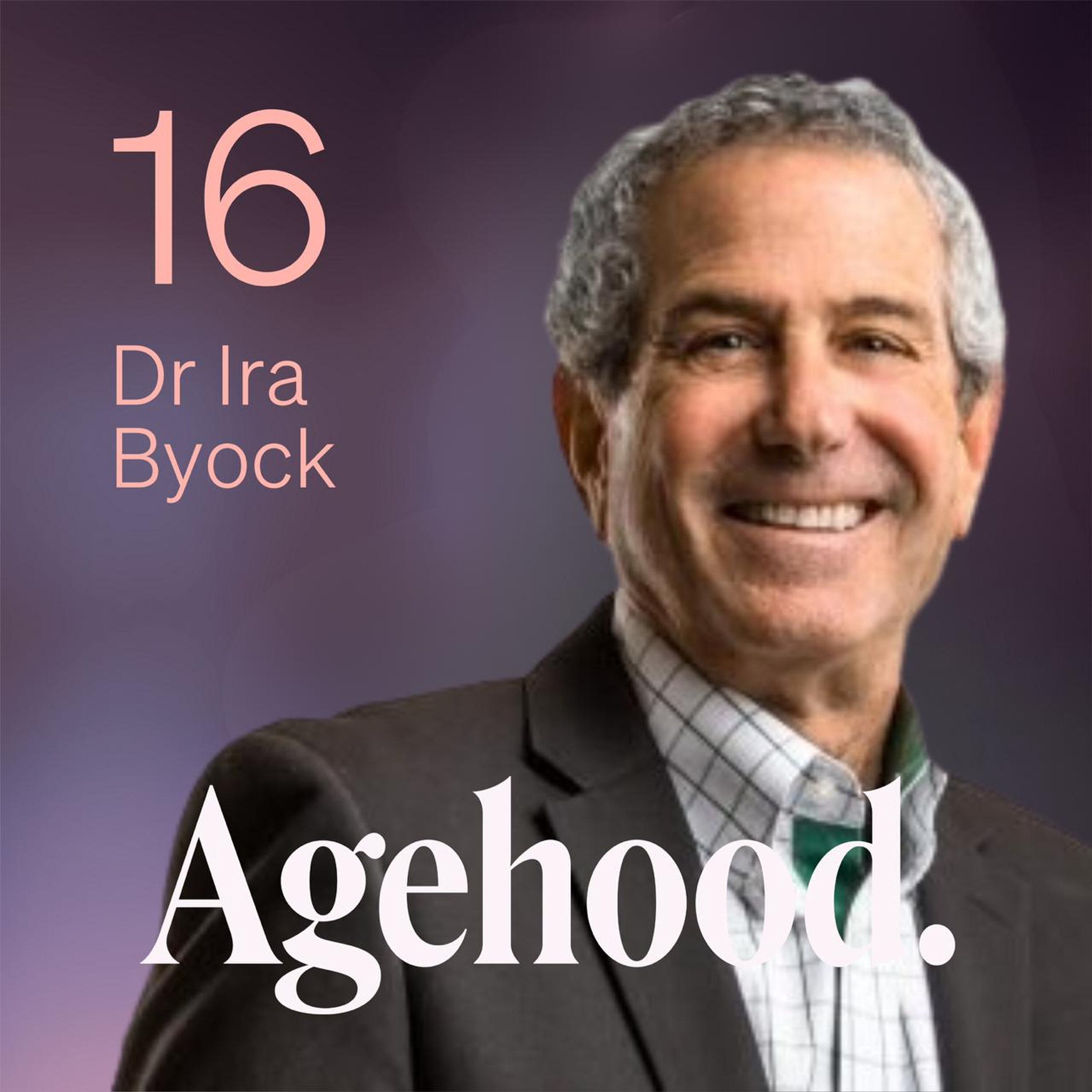
Dr Ira Byock: On The Four Things That Matter Most
Most of us know we should talk about the end of life - but almost none of us know where to start.
In this episode, Melissa Reader is joined by Dr Ira Byock, one of the world’s leading voices in palliative care, to explore how we can live and love more fully by facing what we often avoid. A physician, author, and global advocate, Ira has spent decades reminding us that illness and dying are not just medical experiences, they’re deeply personal ones.
Together, they unpack the four simple phrases that can transform our relationships - “Please forgive me. I forgive you. Thank you. I love you.” - and discuss why planning for life’s later chapters should come from trust and love, not fear.
This conversation also marks the launch of Violet’s Care Compass, a simple values-based tool designed to help families start these conversations early - around the kitchen table, not in the hospital corridor. Because it’s never too early to talk about the end.
FIND OUT MORE
If you’re caring for aging parents, navigating your own next chapter, or just trying to keep all the balls in the air - you’re not alone. At Violet, we offer free tools and support to help families navigate the last stage of life with care and confidence. Visit violet.org.au to start the conversation.
CREDITS
Host: Melissa Reader
Guest: Dr Ira Byock
Executive & Audio Producer: Madeline Joannou - Mylk Media
Find out more about Violet at violet.org.au
For more information about Dr Byock's books, visit his website here.
See omnystudio.com/listener for privacy information.
Transcript
Foreign.
Hello, I'm Melissa Reeder. Welcome to Agehood. It's the podcast for people who are quietly carrying it all. Aging parents, adult kids, work, life and their own next chapter. If this is sounding like you, you are in your agehood and it's time that we talked about it. Today I'm joined by Dr. Ira Byock. You may know Ira, he's one of the world's leading voices in palliative care. He's a physician, an author and a global advocate. And he has spent decades reminding us that illness and the later stages of life, they're not just medical, they're deep, deeply personal. Aira's landmark book, the four Things that Matter Most, has helped countless families navigate some of the hardest conversations with love and clarity. But Aira has also been part of something new. He's been helping us to shape Violet's Care Compass. This is a new tool that we're launching this week in Carers Week 12th to 18th of October, because we know that most of us care so deeply, but we, we plan poorly. Eight out of 10 people are telling us they don't know where to start, so they're leaving things too late. They're having conversations in hospital corridors where everyone is feeling very, very stressed. The care campus is really designed to try and help and change that. It's a simple, values based tool helping families to talk about what matters most and to make sure the voices of their loved ones are heard so everybody knows what decisions should be made when it matters most. In this conversation, Ira shares what led him into this work in the first place, why those four simple phrases still matter and how Violet's Care Compass could change the way that all of us approach this stage of life. So many families tell me the same thing. We just don't know where to start as we care for elderly loved ones. And that's exactly why we've created the Care Compass. It's really simple. It's a 15 minute way to capture what matters most to the person you're caring for so you have the information you need to share with family members and other healthcare professionals. You can start today. Have a look at the care compass@violetcares.com Ira, thank you so much for being here today.
Good morning, it's nice to see you.
It's so nice to have you joining agehood, particularly this week as we launch the Care Compass, which is one of the things that I've really want to explore with you today because you've been such a part of the development of that product. But before we jump into that, tell us a little bit about yourself because there will be a lot of age hood listeners out here in Australia who may not know you as well. Tell us a little bit about who you are, what drew you into this field of medicine, into caring for people in the later stages of life.
Well, it's a delight to be here. I imagine that there are very, very few people in Australia who know who I am, which is totally fine. I'm a 74 year old American physician who started my medical training and career quite certain that I was going to be a small town, rural family doctor. And I trained, I went to a very kind of intensive postgraduate residency training program to learn family medicine, kind of cradle to grave family medicine. Did a lot of pediatrics, obstetrics, gynecology, neonatal care, but also elder care and everything in between. And life had other plans for me. And I ended up getting drawn on the one hand into emergency medicine, which I practiced for about 14 years or so, and on the other hand into caring for people who were seriously ill and likely to die of their medical conditions, which it seems utterly dichotomous, but frankly in my experience was not. I saw emergency medicine and caring for people through sort of hospice care as kind of an extension of the same thing. Just trying to give people the best care I possibly could during this situation in their lives, this age or stage of their lives anyway. So that's who I am. And because of my advanced seniority or something, I have been able to contribute to the, really the development of this still young field of hospice and palliative care in the United States really since the late 1970s and early 1980s. So name recognition is not high for me, which is fine. But in the small community of American hospice and palliative care, I'm known.
Well, you certainly are, and we'll talk about that. One of the things that I've really loved in the work we've been doing together over the last year or so is just your clarity, your ability to say, well, we've tried that and it didn't work. You know, we've tried that framing. We need to think of a different framing. And also you just, you bring a lot of courage. You bring a lot of courage and a readiness to approach things in different ways and experiment how to make this easier for people. So I've really enjoyed that part of our working relationship. Do you have a particular patient experience or story that you've come across that really confirmed for you that this was the work for you in your life?
It was an evolution. I have a couple of kind of origin stories, but back in my residency in a place called Fresno, California, which is the Central Valley of California, it's a big agricultural region, lot of migrant workers, many Spanish speaking only people. I trained at a large county hospital there, and training was intensive and quite excellent. But as a young physician in training, I recognized that while we really did a lot of things superbly well in our hospital and health system, when somebody was acknowledged to be dying, there was sort of just this lapse and sort of a blind spot. And in the hospital where I did a lot of my training was working with patients who had been admitted to hospitals. I'm not kidding. People who were acknowledged to be dying were literally sort of put down the hall, ostensibly for their privacy, but really it was because those of us physicians particularly who were doing our daily rounds and stuff, it was awkward. We were sort of uncomfortable around people who were dying. We didn't know what we were supposed to do. And so we left it to the nurses. And the whole thing was just sort of. It struck me as like, when did they stop mattering? Like, what's going on here? And as a sort of a lapse in our commitment to excellence, but also as frankly sort of a social injustice culturally. It was an odd thing for me. The story that I often related, because it really ended up being, I think, what changed my career, though it took a long time, is a story of a fellow. I remember his name as Mr. Rodriguez. He was a middle aged man in his probably late 40s with advanced colon cancer. It had filled up his liver. He was. Had jaundiced from liver failure and he was a migrant worker and impoverished and he was in the hospital and he was dying. And he knew he was dying because I had the conversation with him myself. And one morning I came in to see him on rounds and I knelt by his bed to kind of get to his eye level. I said, Mr. Rodriguez, how are you doing today? And he looked me straight in the face, Melissa. And he looked into my eyes and he said, he smiled, he said, I'm well, doctor, how are you? And I have to say, it seems so simple, but it kind of knocked me back. I just sort of sat back on my heels like, I'm well, doctor. And I thought to myself, well, that's odd, you know, it must be the morphine or drugs, you know, it's the drugs, you know, it's the steroids we're giving him because of his bulky liver disease. It's a little. He's euphoric. But I later came to realize that, no, he chose his words carefully. And he wasn't the only person, though it was rare. But I heard things like that. Occasionally a family would come back to see me and say, you know, when you told us mom was dying, it was the worst thing we'd ever heard. I mean, she's the center of our large family. But, you know, this last month has been the best month we've ever had together. In my Western culture. I had no place to put that. Remember I said I was learning cradle to grave medicine. I was steeped in childhood development and human development. Abe Maslow and Eric Erickson in Neonatal Piaget and, and they talked about well being and growth and development in childhood and early adolescence. But I was finding that, as they all said, by the way, that actually human development is a lifelong process. It became clear to me that well being was actually possible even when you acknowledged that you were dying. And with all of this sadness and the physical discomfort and it's, you know, dying is not pretty and it's, it's just a lousy thing to go through. Right. But people can be well within themselves. So that Mr. Rodriguez's experience and a few others fascinated me. It got under my skin. I really became obsessed with how is that possible? What makes that happen? How could I help make it happen more often? And how do you talk about it? What's the language that you use to talk about? Not just suffering or its alleviation, but a sense of well being. Wow.
A sense of well being, even at the end of life, the later stages of life. And, you know, you've given me such an education on that around this reframing, as has Catherine Mannix, who we both know and has also been on the podcast you and I have talked about the fundamental nature of this stage of life is not necessarily medical. It's personal. And Catherine often says this is not just about medicine, it's about people. And I think that's very interesting. I think it's very helpful to people to make it a little less scary.
And a little more human.
How do we shift language and culture from talking about this stage of life in a way that currently it can be terrifying for people? How do we talk about living well until the end? How do we open that up?
So I just want to affirm what you just said. I give a lot of public talks or, and interviews and I try to emphasize that illness and dying are fundamentally personal and only partly medical. And while that sounds like, you know, obviously oh, duh. Sure. In mainstream American culture, and certainly in healthcare culture, that's not obvious. People actually kind of assume that when they get a cancer diagnosis or a heart failure diagnosis that their experience is fundamentally medical. But frankly, it's only fundamentally or mostly medical if you're suffering, if your pain isn't being well treated, or you're constipated constantly, or you're itching, or that you haven't gotten good care so that you have attention to what matters most to you during the times of illness. But illness and caregiving and dying and grieving are fundamentally personal, which means that it need not end in failure, that it's possible to live fully through these inherently difficult and unwanted but entirely normal experiences of human life. These stages of human life.
That's the headline.
I don't want to get overly philosophical, but I think I'm aware that we're all going to be a dead a long time and a. There's no reason to rush it. You know, we should be getting exercise and eating well and sleeping well and doing all of that. Right. Because we're all going to be dead a long time. But also we should be living as fully as possible, you know, as vigorously as possible, as joyfully as possible during each age and stage of life.
So true.
That's the healthy response to the force majeure.
And when we think about that in the context of aging populations in your country, in our country and so many nations worldwide, where we're seeing huge numbers of people naturally reach the end of well lived lives, you know, we've never seen people living as long as they do today. A life expectancy has grown by nearly 20 years over the last four years. And we've never seen the same volume of people reaching this stage of life demographically. And I do think there's a big space for us to occupy around how do we live well right until the end and how do we start to think about this in a much more normal and human way that is a little less frightening for people?
Absolutely. As a culture, Western culture, we need to grow the rest of the way up. You know, we need to acknowledge that this is a part of life and then talk about what it means to live fully and to live well and die well. You know, I've written three books for the general public and my first one was called Dying well and the title is actually a play on words or a double entendre, because when you hear it first, there's a sense that dying well is a phrase about the best way to Die. But it's actually the word well is even more provocatively heard as an adjective defining or describing the person who is dying to be well. Can one die with a sense of well being? Can you die well? And my resounding response to that is yes. So that first book, all my books but are story driven books. Stories of real people dying well opens with my dad's story. And the book kind of explores and illustrates the various ways that people can experience and have expressed to me a sense of well being in these very difficult circumstances and unwanted situations of, of being ill and not likely to survive.
And we'll put the details of each of your books in the show notes so that listeners can find those and dive in. I want to talk a little bit more about your book. The four things that matter most, which really anchors in the idea of these four quite simple phrases. Please forgive me. I forgive you. Thank you, I love you. I know through following your work, the impact those phrases and that work has provided for so many families. Can you talk to us a little bit about why you chose those particular phrases and what you've seen happen when people actually use them?
I learned those phrases when I was an intern and family practice resident. They were not quite as crisply packaged, but I heard things that people should say to one another before they die from a couple of nurses and one social worker I remember well, with whom I was working at that county hospital. And it kind of just caught with me. And I started to think about it and ruminate about these things which I tend to do. And I, I wordsmithed them as well as I could. And I began, I was giving lots of little talks. When you're in medical training, you know, you teach as well as learn. And as a young doctor, I gave a lot of lectures and was trying to stand up a little fledgling hospice program. And this notion of saying five things before you die was a routine part of basically every talk I gave to residents or, or fellow physicians in practice. Please forgive me. I forgive you. Thank you, I love you, and goodbye. Goodbye being the fifth. And it resonated. And probably it was the most common. It was definitely the most common response I got back and questions or people stopping me afterwards and saying, well, that was really good and, you know, all of that. And after a number of years, enough people approached me after lectures or during the Q and A section of a public talk and said that, that I finally, and it took a while, realized that, you know, maybe this is what I, I can put into the culture to kind of Help the culture grow the rest of the way up. Right? And I also realized that all these people who were coming up to me, they likely had a story or two. So I started either stopping them and giving my card and saying, I'll bet you have a story. Would you talk later and could you give me a call or let's communicate by email. And I started then by intention, collecting stories. I realized because some, occasionally somebody would say it to me is, you know, Dr. Bayock, you don't have to be forced to say goodbye before those other four things. You don't have to be dying to say, please forgive me. I forgive you. Thank you. I love you. You just have to be mortal, right? And even if you think you're immortal, if you love somebody who's mortal, well, that still puts you at risk on any given day of losing opportunities to say these things before that relationship.
You're making me a bit emotional here. I mean, they are just the most simple, beautiful, deeply profound. They're the things we should say to each other every day. Right? I'm feeling really emotional as we're talking about this. I think it should remind us of the things that we do need to hear and say to the people we love. But the fact that you've brought this together at that really important moment where so much can be resolved and released and forgiven, that's really, really important.
We matter to each other. If you ask somebody who's being wheeled into bypass surgery, heart bypass surgery, or facing cancer chemotherapy for the third or fourth time, what matters most now to you, I promise you the answer will always include the names of people they love. I don't care what color their skin is, what language you're having this conversation is, what their age is, what their diagnosis is. This one is a constant. We matter to one another. And so I think the four things are really not about dying. They're about completing relationships. And I don't even mean completing is different than ending. I mean completing relationships in the manner that a circle is. When a circle is complete, it's unbroken. It can roll on. Right. It's not fractured. So I like to keep my relationships complete and in that regard so that there's nothing critically important left unsaid. If I should die suddenly or, God forbid, one of my daughters or my wife or sister or somebody I love were to die suddenly. You know, I've started now for decades, trying to make sure there's nothing critically important left unsaid. And I think those four things, while I learned them from people who are Facing the end of life. I think they are a tool of well being and relational well being that can be applied at any time in life.
That's exactly what I am sitting with. Those four things featured pretty recently in a medical drama. And I have not been a fan of many medical dramas, but I watched the Pit over the course of a weekend. I loved it and I was completely struck by episode four. And in talking to you, this work that you had developed over many decades really shaped the narrative in episode four. And Philistnus who haven't watched the Pit, first of all, go and watch it. It's a brilliant piece of television. And they are currently working on season two. Episode four tells actually a very common story in an uncommon way. It tells the story of a gentleman who I think would be in his early 90s who is coming to the end of a well lived life and his adult children are in the hospital with him and they are obviously completely unprepared for the fact that their dad was dying. Do you want to tell us a little bit about how that came to be, how you worked with the writers and how it felt for you to see your work embodied in Hollywood in that way?
It's remarkable and strange and in a delightful way, my contribution to the Pit, which is a great show, it really is. And I, and I usually avoid medical shows too, but this one's really exceptional. And I was asked to spend an hour with the writers room. So my contribution is literally an hour with the writers room over zoom about, I don't know, a year or more before the show began to air. And because of my background in both emergency medicine and hospice and palliative care, they were interested in talking with me. I was delighted to do so. And what ended up being a very animated conversation, I pitched them a couple of ideas and I responded to some of the ideas that they wanted me to respond to. But I pitched them a couple of stories and the one that they really resonated with them and that they took and ends up in episode four was a four things story that is a real story that it actually, I was a physician in the emergency department and the medical situation was different, but a gentleman came in and had what's called leaking abdominal aortic aneurysm. And I got a call in the ER from the ambulance, described the situation. He had basically classic findings of this. So I was prepared. I actually called the OR before the guy got to the emergency department saying, it looks like we got a guy coming in with a ruptured aortic aneurysm. We better get the OR scrambled. And. And he hits the ed. And I evaluate him and talk with him and say, I think this is what's going on and this is life threatening. And he says, yeah, no, doctor, I actually am aware that I've had this condition and I've talked to my internist about it, and, and because of my other medical problems, I'm not going to go to surgery. I've known that if and when this happens, that this will be the way I, I die. And so we, I sat down, of course, and we're talking about this. And, and so that was the plan. He had thought it out, understood. I knew his internist, so I made him comfortable. We did the usual clinical protocols to buy some time and ease his pain because it's causes severe back pain, had the OR stand down, and then got him admitted to the hospital. During the time before he left the emergency department and went to his hospital bed, his family had come into the emergency department. I remember he had two adult daughters and his wife. And now he's quite comfortable. And I made the time to sit with him and say, you know, hopefully you have several hours, maybe overnight to be together upstairs. I don't know if it'd be a value, but it's been of value for many of my patients to have said at least four things to one another before they're forced to say goodbye. And I went through it. Please forgive me. I forgive you. Thank you, and I love you. They thought that would be great. Thank you very much. They went up to the room and I didn't hear anything else about the case. I was busy in the emergency department before I left for my shift that evening. One of his daughters stopped back by the emergency department and asked to talk with me. And she said, you know, dad died just about a half hour ago, and he was comfortable and he just sort of drifted off. And she said, you know, this afternoon was just remarkable. And we can't thank you enough for suggesting that we, during our visit, say those things to one another. And, you know, that's what I pitched them. And, boy, I didn't even interact with Noah Wiley. We know some people in common, it turns out, but I was working with another physician writer named Joe Stein. But Noah was in the room. He was in physically in that meeting, but he wasn't the one I was speaking with. I know they took the story because it's in the episode, but also, Noah Wiley's been very generous in interviews about the pit and that episode to Mention me and. And the Four Things that Matter Most. The book.
I just thought that it would be different.
I thought that we'd have more time.
Is your family religious?
Oh, God, no.
I had a teacher, mentor who told me about a Hawaiian ritual called hooponopono, or the Four Things that Matter Most. It's basically just a few key things that we can say when we're saying goodbye to a loved one that can really help at the early stages of loss.
What are they?
They're gonna sound really simple, but I swear I've seen them work.
Okay.
I love you. Thank you. I forgive you. Please forgive me.
That's it? Yep.
I told you it was simple.
It's an absolute credit to the work that you've done, but it's also, just, for me, a really moving and uncommon way to see death on television because it is so commonly glorified or glorified. You know, it becomes this high drama cpr. Bam. The person's heartbeat is restored, or it's all blood and guts and gall. But that episode did two things. It brought your narrative in, and it reconnected that family. And there was a whole lot of resolve and forgiveness that was very, very palpable in that episode. But it also just showed what normal dying can look like.
Yes, and this connects back a bit to why I'm so invested in Violet and Violet succeeding in its mission. The episode on the Pit, and the Pit in general, is part of speaking into the culture. It is part of cultural maturation, of helping the culture grow the rest of the way up. What that episode and that storyline illustrated was something that happens not very often in emergency departments, though it's a real story. It happened in mine, but it happens every day in hospice and palliative care practice. This is a normal part of what we do. Not only preventing or alleviating suffering, but helping people feel that things are more complete, that there's nothing critically important left unsaid. It's a part of celebrating life and relationship in the midst of. Of the very waning stages of life and relationship. What's exciting to me about participating in something as broad and successful as the Pit is working at scale to foster cultural growth. And frankly, that's what I think Violet has the potential of doing. What you're doing really has an opportunity to be a cultural moment here where we look at one another and say, given that we're all mortal, that no one gets out of this one alive, we should make sure that we're communicating clearly, honestly, lovingly with one another. And Living as fully as we can, making sure that our own values and priorities are reflected in how we're cared for.
Coming up next, Dr. Ira Byock talks about why Planning for Life's final chapters needs to shift from fear to trust. And how Violet's Care Compass can help make some of those conversations simpler and a little more human. And also what's giving him hope for.
The future of care. You have given me a beautiful segue into the Care Compass, which is a tool that we've been working on together. And I want to explore that a little bit. And we are launching it in Carers Weekly. What we've tried to do here is build something that is actually very simple and very values based because we know how hard it is for people to have these conversations. And what I have heard over and over and over again is I don't know where to start. You know, I kind of know I should do this, but I don't know how to do it. I don't know where to start. The Care Compass is really trying to give people a place to start, to sit at the kitchen table with a cup of tea or whatever your preferred beverage might be and have a conversation about what matters most to the people that you love and care for. Particularly at this point in time, talking to your parents and your in laws. And you've brought so much wisdom, as well as really key parts of that tool, Ira, and into the work you've developed in the U.S. why do you think it's so important that we have something that feels very different to traditional advance care plans and directives? What gap are we trying to fill?
I do think that it tracks back to illness and caregiving and dying and grieving being personal, not just medical advance directives. I remember when they came about in the United States. I was right about the late 1980s and early 1990s. There was a famous law here, the Patient Self Determination act, which made them important. But they were developed largely by attorneys, very well meaning. And I was engaged with this process and they were kind of designed on the chassis of contracts. And when you step back and think about it, contracts are based basically in fear. You develop a contract, you sign a contract to protect yourself from either bad actors or bad actions or some risk that you think this relationship will put you at. Right? And I didn't realize this for a long time. A colleague of mine named Dr. Joseph Finn brought this out that most people don't want their medical decisions made out of fear. They want them made out of love. And so it became clear to me and changed a lot of my teaching and behaviors, clinical practice behaviors, when I realized that he's right, we can develop these things not so much as contracts, but more as kind of covenantally. Covenants are correlational acknowledgments and they're based in love. I want decisions that affect me if I have a stroke or have a head injury or in cardiogenic shock and my wife and daughters are left to make decisions on my behalf because I can't speak for myself. I want those decisions made out of love for me. And I have trust. Covenants are based in trust. I have trust that they will act on my behalf. So I decide to redesign advance directives and use them to build trust, whether they are formal documents or not. And I have two competing thoughts, but I want to say I think I'll come back to this. But I think the Care Compass is right along those lines. It builds relationship and trust. Years ago I was asked. I was part of a large non medical project in the United States called the Conversation Project, not terribly different than Violet. And I wrote a opinion piece for the Conversation Project describing why I have an advanced directive. I titled the piece Because I'm a dad, I have an advanced directive. Not because I just teach this stuff or I'm a doctor. I have an advance directive because I know that if I am in the emergency department with a head injury or stroke or whatever, my wife and daughters will hold the weight of making decisions. And that's the way it should be.
And that's whether they're legally appointed to do so or not.
Exactly. Who else are they going to ask?
Well, exactly. And this is a little bit of, kind of the unspoken truth, whether you have a binding document or not. The more I know about what matters to my father when I am inevitably going to be in a situation where his health declines, the more I know about that, the better decisions I'm going to make and the more aligned those decisions are going to be with what he wants if he can't speak for himself. So what we're saying is you can certainly complete the Care Compass and you can turn it into a binding tool through the Enduring Health Guardian here in Australia. Or you could go on to complete an advance care plan or directive. But on its own, it still brings a lot of value because people are having those conversations, they're having them earlier and they understand what matters most a little bit more.
It's the only way I know of to lift a little bit of the burden of making those very poignant Emotionally difficult decisions from my loved ones. So just I wanted to first give them in the formal document, to give them clear authority, but more importantly, to give them a sense of what I think I would want so that they're supported in making these decisions.
And again, when you look at all the research, Ira, and you know this far, far better than I do, when those things are understood, the person facing the last stages of their life, they have an experience that's more aligned to their preferences. And the level of regret or potentially complex grief and bereavement for the family is measurably less because they know that they've made decisions in honor of the person that they love and care for.
So important.
Now, it sounds very simple when you say it out loud like that, but what we see in the system today is so much that plays against those two outcomes.
You're so right. Really complex grief is about questions of did we do it right? The would haves, could haves, should haves, what ifs. In having the conversations as a normal part of planning, a normal part of planning for a full and healthy life, you really diminish complex grief. It's a preventative measure as well.
The other part of what we're trying to do with the Care Compass here is just make it really accessible because, again, a lot of those other planning approaches, some of them have been digitised, which is excellent, but a lot of them do live on dusty sheets of paper somewhere that, you know, people don't often return to once they've ticked a box at a moment in time. They don't return to them, they don't talk about them with their families, they don't revisit them if there is some kind of diagnosis or health decline or hospital admissions. So by really intentionally making the Care Compass very portable, it can go straight into your digital wallet. It's accessible through a QR code. You can order a lovely little physical card, if that's what works for you, and pop it in your wallet. How do you think about that accessibility, especially in terms of stress and crisis?
Well, I think the whole thing is brilliant, frankly, because of the scale that you're doing it on. It begins to normalize the process culturally, and that reflectively makes it easier for people to do as well. It doesn't require a serious diagnosis. It becomes a bit of, well, this is just what we do as adults. This is part of how we care for one another. Within families, doing it at scale actually has extra value and benefits that, you know, reverberate through social behaviors. Very Important.
As part of the launch, we're deliberately anchoring this to 75 years of age. Now, that is not to say in any respect that Anyone who's turning 75 is in any way close to the end of their life. That's not the message here. It's just a sensible trigger to have a conversation about what matters most in the future stages of your life. You know, people live well into their late 80s and early 90s and beyond. Over in Australia. I'm not sure if you have the same thing in the US we have a 75 year health check. So a big part of the message here is your mom or dad 75. It's time to have this conversation. You know, it doesn't have to be scary and it certainly doesn't mean they're going to die anytime soon, but this is the trigger. How do you feel about that?
I think it's two and a half decades late.
Do you, you think it should be in your 50s? Okay.
Absolutely. Absolutely. This is normal adult behavior, right? You have health insurance, you have life insurance. You do this. Honestly, I think we need to normalize advanced care planning. You're not going to believe this, but I think it has to happen during the senior year of high school in the United States, when somebody turns 18, they are an adult. Their parents do not speak for them anymore unless their parents are given legal authority to speak for them. So this has to be normalized, I think, as part of healthy adult behaviors. And yes, they have to be refreshed from time to time. We usually talk about the various Ds, you know, every decade with a diagnosis, with a divorce, particularly if you get a diagnosis of dementia or other decline, you should refresh your advance care plans. But I think certainly when you turn 50, it's time. What you're saying is not provocative. It's, it's utterly conservative. It just really makes sense. I'm not even 75. My gosh. Right. That happens in February. If you want to send me a card.
Absolutely. I will put that in my diary.
Right now for us. The. Well, the Medicare well visits, annual wellness visits. That starts at 65 here. Does it?
Well, you've given me a new goal, so thank you.
One of the things that I have quite regularly pointed to over here is a somewhat brave individual. And I don't know their name, but somebody stood up at a boardroom a decade ago and suggested that we send bowel cancer screening kits to every Australian when they turned 50. So they would test their poo and send it back and be Screened for the incidence of bowel cancer. Now, I can only imagine that that individual might have been laughed out of that room. That must have sounded like a fairly provocative suggestion at that moment in time. However, we have seen that adopted. We have seen that normalized. You know, I turned 50 this year and I got my test. It's got a take up of about 40%, which is. It's not 70%, but I tell you, it's a lot higher than zero. And we're seeing a lot more awareness of bowel cancer in younger people and earlier interventions. I think this has to sit in that same kind of category. How we, we normalize and socialize, some of these triggers.
It's a healthy adult behavior. Yeah, that's what you do and needs to be normalized.
So every time I get pushback on 75 is too young now I've got a great answer. Thank you.
Oh, it's not. It's not too young at all. No, no. And the downside of keeping it really toward people in their seventh decade of life is that in a subtle way, it still reinforces fear. Then that ties it to dying. And I think we really need to reposition it as a healthy adult behavior. This is what we do for one another. You know, on my advanced directive, by the way, there's usually a place for an addendum or, or just if there's anything else you want to add to your advance directive. This is the formal documents. What I've written in is a note to my wife and daughters if you're needing to use this document. It's likely I am very ill and I can only imagine that this is a stressful time for you. Please know that I've given you authority to speak for me because I trust you and whatever you decide will be fine with me. It's most important for me that you support and are loving to yourselves and one another.
Because you're a dad.
Because I'm a dad. And because I could have a car accident or, you know, become seriously ill at any time. It happens.
After decades in this field and the depth of your work, what gives you hope about the way that we are starting to think about aging and care and the later chapters of life?
Mostly that I do see evidence of an embrace of the fullness of life and kind of a challenging. Of the brittle notions that. That we should live as long as possible, even if our quality of life deteriorates, and that more medical treatment is always the best thing to do. I've always known that that's kind of silly, because everybody eventually dies of something. And I'm not reticent to use medical treatments, but it's important to realize we've yet to make even one person immortal. And so the question is not, do you want to live as long as possible? Really, you want to live as long as you can live well. And that doesn't mean that you have to be able to go to work or play tennis. Just, you know, you want to live as long as you can and use medical treatments as long as you can so that you can live fully and be well within yourself and right with the world and right with the people around you. There is evidence that the culture is starting to recognize that and shifting from assumptions about medicine from more is better to really, the right care is what we want. This is personal. And I think, you know, frankly, Violet is evidence of that. The traction that you are getting for these, frankly, simple suggestions is evidence that there is a cultural readiness to do this.
Yeah, that gives me a lot of hope, too. And to everyone that's listening to today's conversation, I guess it's an invitation from us, isn't it, Ira, to have a look at the care compass, sit down with the people that you love, and create one. I think so much more is possible with some help to start those conversations and to have some of that understanding of each other.
Very important. Why wait?
Why wait? That's right. If you could leave agehood listeners with one thought as they think about their own families, what would it be?
Tell people that you love them. There is value in stating the obvious. Part of the wisdom within saying, please forgive me, I forgive you, to people is that none of our relationships are perfect. We're human beings. We are imperfect as beings, so our relationships are imperfect. That's okay. We can practice love and forgiveness, the offering of forgiveness and accepting of forgiveness, expressions of forgiveness, gratitude, and love. And you'll find that in so doing, once you've done that and using it as a practice that your relationships become more joyful, honestly, they become honest and joyful. There's nothing left unsaid, so you might as well just enjoy one another's time together and company. And that's. I'm bending all the way back around, but we're all going to be dead a long time, right? Let's live as fully and joyfully as we can.
It's a really great place to land our conversation. Thank you for everything that you've brought to today's chat, but much more broadly than that, for everything that you've brought to Violet, to the Care Compass and.
Everything that you've taught me over the.
Time we've been working together.
Truly a pleasure. Thanks for having me.
Thank you to Ira for sharing both his personal journey and so many insights into how we can make the later chapters of life a little more human, a little more dignified and built on trust. If today's conversation has resonated with you, remember you don't have to carry this alone. At Violet, we believe that the final chapters of life deserve the same care and attention as every other other milestone, and nobody should have to face this stage of life unprepared or unsupported. With the launch of Violet's Care Compass, there's now a simple values based way to start those conversations early and gently and make sure that your loved ones voices are heard when it matters most. Have a look@violetcares.com we'd really love to hear what you think. If you would like to to share your story with Agehood or send us a question, you can reach us anytime. Simply email podcastiolet.org au and if this episode was helpful, please follow Agehood, Leave us a review and share this with someone who might need to hear it too. We'll be back soon with another conversation. Until then, take care of yourselves and the people that you love and thank you for listening.
Sam.